I am very happy to launch the first version of RIGOR (https://t.co/SVsRpmfeos)
This project was born while I was using prompts to evaluate the internal consistency of my own papers, whether the mathematics behind them was correct, whether the results were novel, and how to frame them against the current literature (those prompts are on my GitHub: https://t.co/YDypiVpW7p). I was finding huge improvements in my papers with those "adversarial" reviews, so the idea naturally evolved in something more mature as producing AI-made audit reports, but looking for ways to verify the AI's answers and optimize token use.
TLDR: Specialized AI reports from $5 and General Audit reports from $10, using your own API, for social science papers.
400+ reviews served in just a couple of days!
All running on free-ish infrastructure with no institutional backers.
'coarse <3 that you <3 open-source. Keep 'em coming!
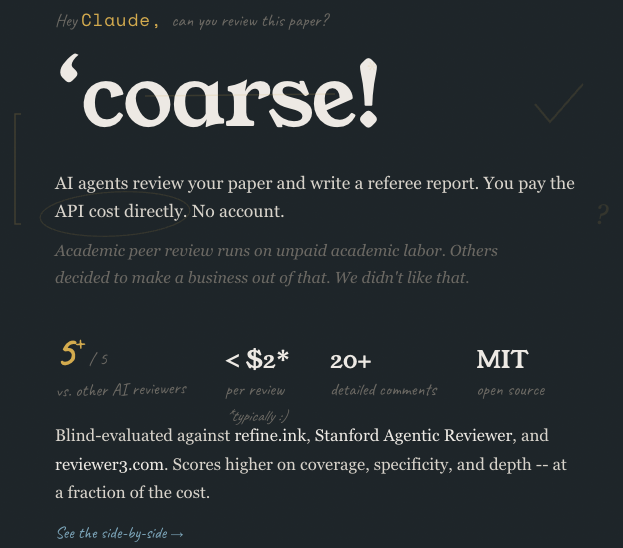
I coded up an open-source, not-for-profit AI paper reviewer that rivals the performance of @reviewer3com, @RefineInk, and Stanford Agentic Reviewer (according to @GeminiApp). Costs <$2!
Live @ https://t.co/5m1Srky4H8. Plug in paper, @OpenRouter key, and email. #econtwitter.
📢I am happy to share my Job Market Paper!
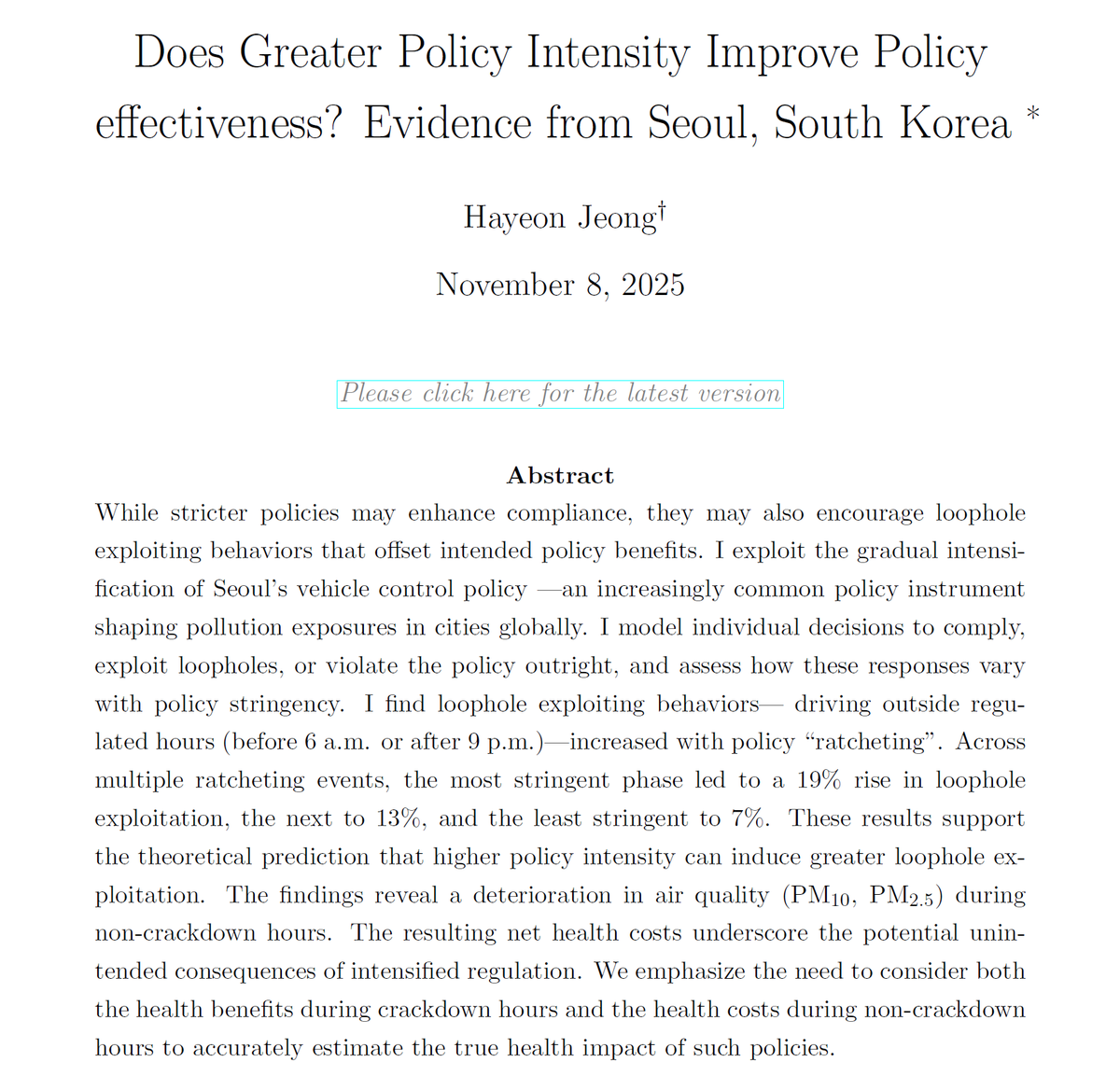
My paper examines the relationship between policy intensity and policy effectiveness. I challenge the notion that more intensive policies are necessarily more effective—both theoretically and empirically—by showing that policy avoidance increases as the policy becomes more stringent during the early period of implementation.
(🧵1/7)
🔗https://t.co/NKzPNf6Iet
Website: https://t.co/5aV5WnKkiM
#EconTwitter #EconJobMarket #JMP #EconJMP
In his JMP, Carlos shows that more information about the asset on offer can «reduce» efficiency in decentralised markets by exacerbating an adverse selection problem. He explains how and when, and what this means for financial regulation. To learn more: https://t.co/DVYcNxzsqT
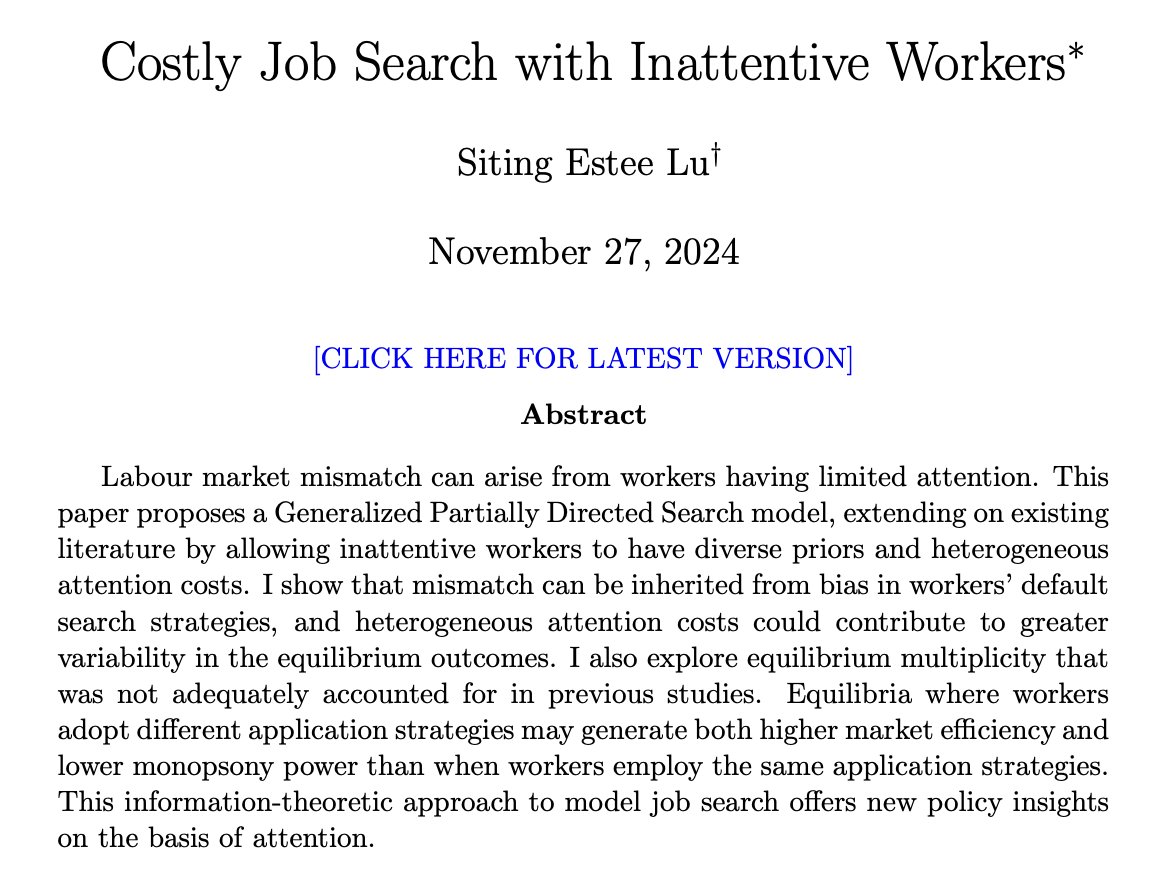
🚨 Hi #EconTwitter! I’m on the #EconJobMarket, and I’m excited to share my #JMP on “Costly Job Search with Inattentive Workers”.
🙋🏻♀️ How does workers' limited attention shape their job search behaviours? And critically, what does this mean for labour market efficiency?
🧵👇 (1/10)
#EconJMP
🚨 I am on the #EconJobMarket 🚨
My #JobMarketPaper examines the consequences of minimum lot size regulation for welfare, productivity, and neighborhood amenity value.
Let’s dive in!
Website: https://t.co/hpuQzQNq0a
🧵1/9
Martin Vaeth's (@MartinVaeth) job market paper shows how rational voter learning explains both issue alignment and polarization of voter ideology. https://t.co/mlOweWOy7I
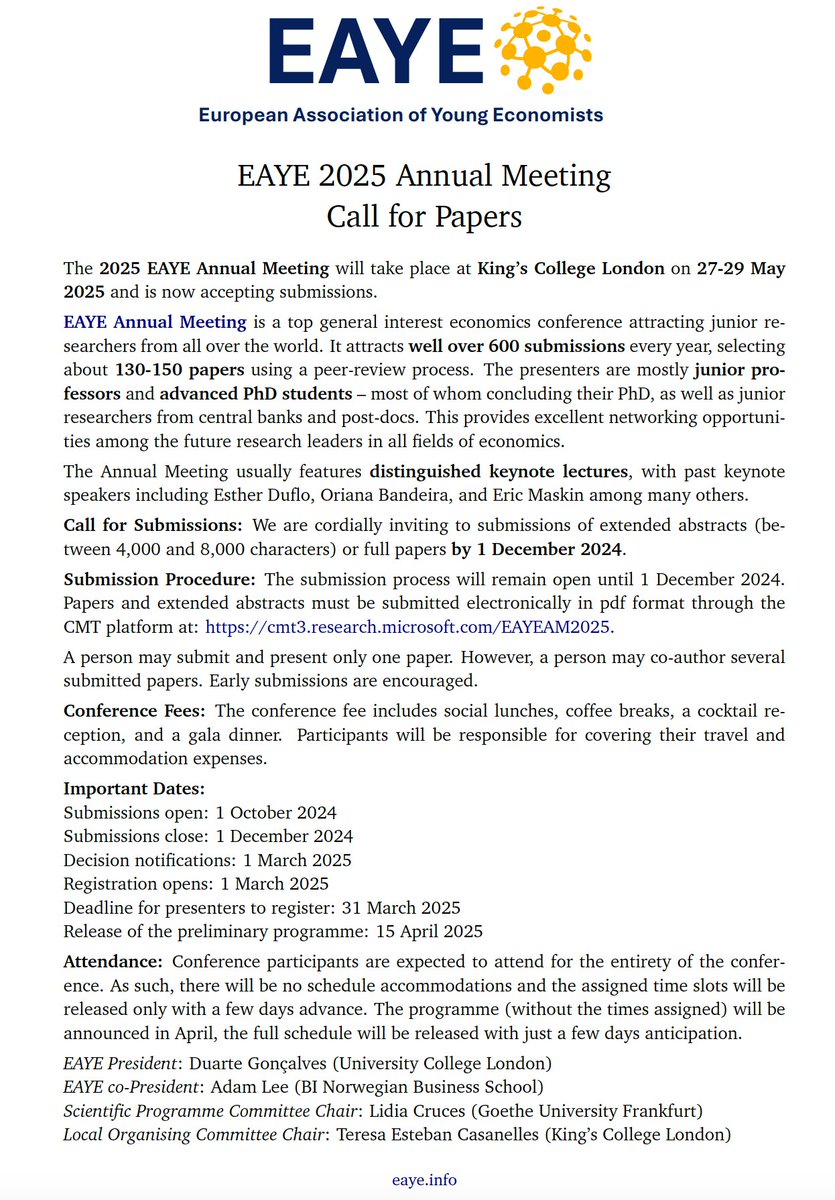
🚨 Call for Papers! The 2025 EAYE Annual Meeting is at King’s College London @KingsCollegeLon from May 27-29, 2025!
Submit your extended abstracts or full papers and join top junior economists from around the world!
🗓️Deadline: December 1, 2024
Thrilled to have a new working paper on AI and Cross-border Data Regulation with Dan Trefler! We use a LLM approach to link each product (app) to each technology (patent), to quantify the direct and spillover effects on AI deployment in an international dimension
🆕 report: Assessing #netzero metrics for financial institutions
🔗 https://t.co/qPgTrMIoO0
We need a clear set of metrics to assess progress on net-zero commitments by financial institutions. Frameworks currently propose more qualitative
information than quantitative metrics.
As a postdoctoral researcher, @stantonhudja has been making significant contributions to the Toronto Experimental Economics Lab (TEEL) and to the field of behavioural economics. Professor @yoram_halevy has much to say about Stanton's work. https://t.co/o2HAgLCCPV #EconTwitter
🚨As part of #OECDatCOP28, we are organising a webinar to discuss current use of climate scenarios for #NetZero targets, actions, and policies.
👉 Please join us and our amazing panellists (incl @JoeriRogelj) by registering here: https://t.co/kxj4exj04N
Big thanks to @rmegal for the shoutout! I am lucky to have you on the committee.😀
I am on the job market this year! #EconTwitter
I am an applied microeconomist at @EconatIllinois who specializes in the Econ of Ed and Labor Econ, working intensively on policy-relevant research.
📢 I am excited to share my job market paper!
https://t.co/K6HFFVSncB
High-productivity firms and high-skilled workers co-locate in larger cities. How does this systematic sorting pattern affect spatial inequality and aggregate welfare? (1/7)
#EconTwitter#EconJobMarket#JMP
You can read my paper here: https://t.co/ICF5P7N6Eo
Or find the summary slides here: https://t.co/4XpB6fa3ac
Finally, many thanks to my @econuoft committee for their continued support and guidance. I'm grateful for the feedback I've received so far - looking forward to discuss.
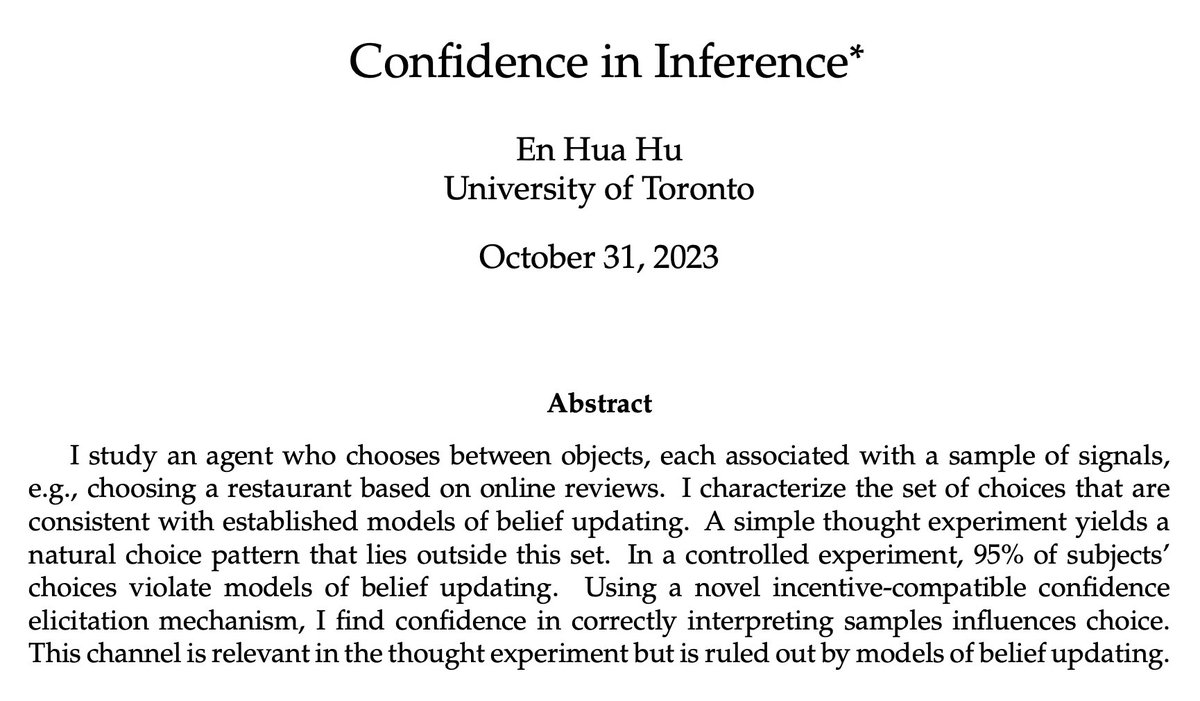
📢 I'm happy to share my job market paper in behavioral economics.
Choices often involve information samples, e.g. Amazon reviews.
How do people choose when options come with different information samples? Short 🧵.
🔗 https://t.co/ICF5P7N6Eo
#EconTwitter#EconJobMarket#JMP
My results show that models of belief updating fail to account for observed choices in this common sampling environment. Additional investigations suggest the discrepancy lies in these models wrongly assuming that agents are fully confident in interpreting information correctly.