CRISPR-Cas systems enable genome engineering of probiotics to enhance beneficial properties and expand applications as next-generation probiotics.
https://t.co/I77kFSuTO4
#CRISPR#Probiotics#MicrobialEngineering
Graphical abstract: Abrar Hussain et al. | CC BY 4.0
Cross-kingdom noncoding RNA regulation facilitates Nosema bombycis proliferation by modulating a host miRNA and parasite gene axis.
https://t.co/uqC3UgBqsE
#NoncodingRNA#Microsporidia#HostPathogenInteraction
Graphical abstract: Pengcheng Zhang et al. | CC BY 4.0
A pathway-independent three-module self-induced system enables sequential gene expression, improving 3-HP production to 7.0 g/L.
https://t.co/08av2LZXTv
#MetabolicEngineering#SyntheticBiology#Biomanufacturing
Graphical abstract: Yaping Gao et al. | CC BY 4.0
A fermentation-driven strategy enhances nitrogen removal by redirecting carbon toward bioavailable electron donors and strengthening carbon–nitrogen coupling.
https://t.co/Hk3xHtNJ8s
#Denitrification#WastewaterTreatment
Graphical abstract: Ji Qi et al. | CC BY 4.0
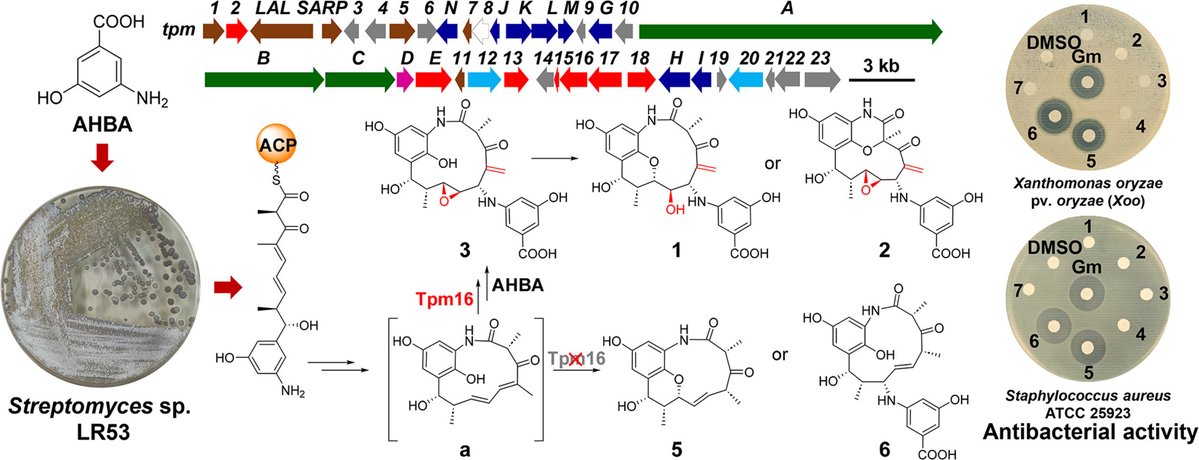
Genome mining of Streptomyces sp. LR53 reveals seven novel tropansamycins, including compounds active against plant and human pathogens.
https://t.co/RdUAPaWzPa
#GenomeMining#NaturalProducts#AntibacterialActivity
Graphical abstract: Haotian Wang et al. | CC BY 4.0
Our latest issue is out!
On the cover: Fuad Ale Enriquez, Stephen J. Callister et al. quantify methanogen robustness under bioprocess perturbations and uncover stress-specific proteomic responses relevant to biomethanation.
https://t.co/XPkH3Vpgw2
#Proteomics#Biomethanation
Researchers identify a small heat shock protein that improves the thermotolerance of Bacillus thermoamylovorans, enabling more efficient PET degradation at elevated temperatures.
https://t.co/AlRoXAtFdq
#PETDegradation#MicrobialEngineering#Biotechnology
How do phages recognize Bacillus subtilis?
Researchers characterize three B. subtilis phages and identify wall teichoic acid as a key receptor determinant for phage recognition and infection.
https://t.co/DyWfZNugXe
#Bacteriophage#PhageBiology#BacillusSubtilis#Microbiology
Genetically encoded biosensors are advancing high-throughput screening of microbial cell factories by linking product synthesis to detectable outputs.
https://t.co/s6BJVntuXg
#SyntheticBiology#Biotech#MicrobialCellFactory
From mevalonate accumulation to downstream lactonization, this review outlines chassis selection, metabolic engineering, and fermentation strategies for microbial mevalonolactone production. https://t.co/jFn9TDzknp #SyntheticBiology#GreenChemistry
PE biodegradation review covers degradation efficiency, microbial and enzymatic mechanisms, plus synthetic biology and machine learning tools. Read the paper: https://t.co/IKUTyFZWwG #Bioremediation
🎉🎉 We are delighted to announce that Engineering Microbiology has received its first Impact Factor of 6.1 and a 2025 CiteScore of 10.1.
Thank you for your support and for being part of our journey.
#EngineeringMicrobiology#Microbiology#ImpactFactor#CiteScore
🍠 How does resistant starch type 5 impact your gut? New review explores its modulation of gut microbiota for digestive wellness.
📰 Engineering Microbiology | DOI: 10.1016/j.engmic.2025.100250
#GutHealth#Microbiome#ResistantStarch
🔬 New insights into yeast mating! Nanjing Tech University researchers reveal how PRE element arrangement controls Ste12 oligomerization, regulating gene expression.
📰 Engineering Microbiology | DOI: 10.1016/j.engmic.2026.100249
#Yeast #SyntheticBiology#EngineeringMicrobiology
🔬 Chinese Academy of Scientists engineered 17 aspertetranone derivatives via pathway reprogramming in A. oryzae. Compound 6 shows antibacterial (MIC 4.50 μg/mL) & antifungal activity; Compound 11 demonstrates broad-spectrum anticancer effects.
Read more: https://t.co/RdxQLMSyCu