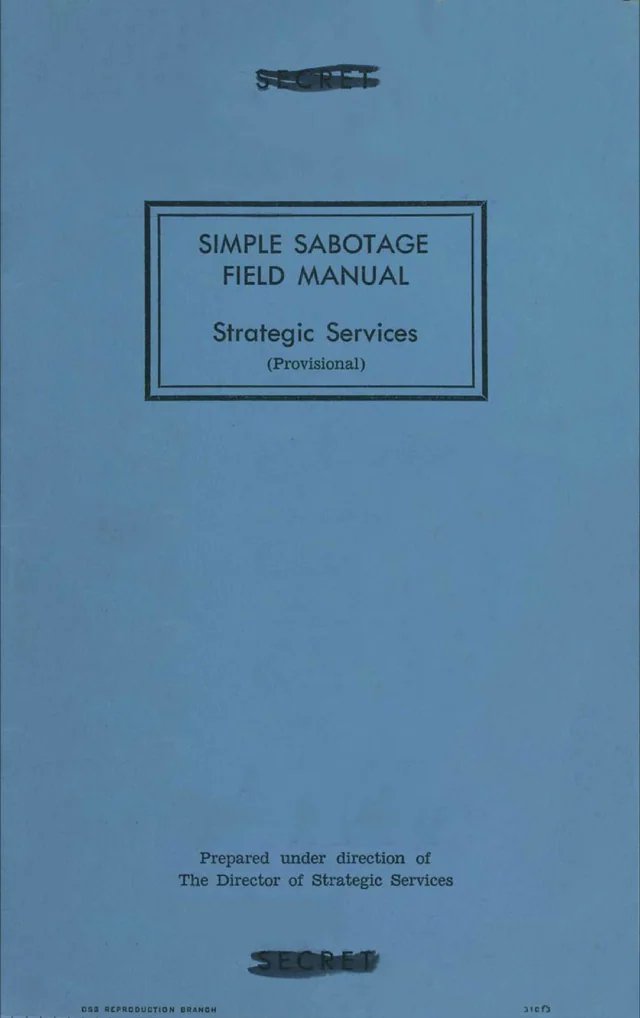
In 1944, the CIA wrote a handbook on how to sabotage (enemy) organizations from the inside. Your co-workers and bosses practice this daily:
No 7 will shock you.
🔸Act stupid.
🔸Bring up irrelevant issues as frequently as possible.
🔸When training new workers, give incomplete or misleading instructions.
🔸Never pass on your skill and experience to a new or less skillful worker.
🔸Do your work poorly and blame it on bad tools, machinery, or equipment. Complain that these things are preventing you from doing your job right.
🔸Be as irritable and quarrelsome as possible without getting yourself into trouble.
🔸To lower morale and with it, production, be pleasant to inefficient workers; give them undeserved promotions. Discriminate against efficient workers; complain unjustly about their work.
Others
🔸Insist on doing everything through “channels.” Never permit short-cuts to be taken in order to expedite decisions.
🔸Make “speeches.” Talk as frequently as possible and at great length.
🔸When possible, refer all matters to committees, for “further study and consideration.” Attempt to make the committees as large as possible-never less than five.
🔸Haggle over precise wordings of communications, minutes, resolutions.
🔸Refer back to matters decided upon at the last meeting and attempt to re-open the question of the advisability of that decision.
🔸Demand written orders.
🔸“Misunderstand” orders. Ask endless questions or engage in long correspondence about such orders. Quibble over them when you can.
🔸Do everything possible to delay the delivery of orders. Even though parts of an order may be ready beforehand, don’t deliver it until it is completely ready.
🔸In making work assignments, always sign out the unimportant jobs first.
🔸Insist on perfect work in relatively unimportant products; send back for refinishing those which have the least flaw. Approve other defective parts whose flaws are not visible to the naked eye.
🔸Hold conferences when there is more critical work to be done.
🔸Multiply paper work in plausible ways.
🔸Start duplicate files.
🔸Multiply the procedures and clearances involved in issuing instructions, pay checks, and so on. See that three people have to approve everything where one would do.
🔸Apply all regulations to the last letter.
🔸Snarl up administration in every possible way. Fill out forms illegibly so that they will have to be done over; make mistakes or omit requested information in forms.
🔸Give lengthy and incomprehensible explanations when questioned.
🔸Misunderstand all sorts of regulations concerning such matters as rationing, transportation, traffic regulations.
The Finance Act, 2026: What safeguard amendments could regulate Government Borrowing from the Central Bank?
1. The power to tax is one of the greatest powers of government. The power to create money is even greater. History teaches that this power can rescue nations in times of crisis, but it can also destroy currencies when discipline breaks down.
2. Governments are generally expected to borrow from financial markets, commercial banks, pension funds and the public through Treasury Bills and Treasury Bonds. Governments are discouraged from borrowing directly from their central banks because central banks possess a unique power: they can create money.
3. Also, when Government borrows from the public through Treasury Bills and Bonds, it must persuade investors to lend. Direct access to central-bank financing weakens this market discipline because Government no longer depends entirely on the judgement of investors.
4. The recent Finance Act, 2026, specifically the proposed amendments to section 69 of the Bank of Tanzania Act, has therefore generated considerable public debate. It introduces new provisions allowing Government, under specified emergency circumstances, to obtain temporary advances from the Bank of Tanzania.
5. Supporters argue that every country requires emergency financing mechanisms during disasters and major economic shocks. Critics fear that such provisions could become a back door through which governments gradually finance ordinary budget deficits by creating new money. Who is right? Both because the Finance Act, 2026 raises a question that goes beyond economics: not whether Government should ever borrow from the Central Bank, but whether the safeguards are strong enough to ensure that an emergency measure never becomes a habit.
7. Section 69(3) defines the conditions for drawing on funds from the Bank of Tanzania by the government: including the disaster clause under section 69(3)(a), the unforeseen economic shocks clause under section 69(3)(b) and the constitutional emergency clause under 69(3)(c).
8. Of the 3 provisions the riskiest one is section (b) because its current formulation is open ended and extremely broad stated as "an external economic event, circumstance or cause of exceptional magnitude and impact".
8. I propose it be replaced with something more objective like "an external economic shock certified jointly by the Minister responsible for Finance and the Governor of the Bank and reported to Parliament at its next sitting or within fourteen days, whichever is earlier."
The present wording is simply too elastic and could lead to problems. Why and how? Because it fails to define what constitutes: “exceptional” or “magnitude” or “impact” or “external economic event”? It does not guide what would qualify and what would not from an array of probable economic shocks including, a drought, a fall in gold prices, a rise in oil prices, a global recession, a decline in aid flows, a depreciation of the shilling and/or a failed tax collection target? As currently drafted, almost any significant economic difficulty could potentially be interpreted as falling within paragraph (b). That is where the real governance risk lies.
9. A parliamentarian's test: Whenever Parliament grants extraordinary powers to the Executive, it should ask three questions: Who decides? How much can be borrowed? Who checks the decision? The proposed section answers none of these clearly.
In this regard let me make some practical suggestions that might help preserve emergency flexibility while preventing possible abuse for consideration by our sitting Parliament.
SEE PART TWO
I showed my 14 year old daughter this amazing chart illustrating the progression of best-selling musical artists during the 1970s and 80s, so that she would get some sense of how insane Michael Jackson’s run during the 1980s was.
And now in 2026 he’s back near the top again…😱
Sahihisho kwenye kukokotoa ili hesabu ikae sawa, 36.24+9.24=46.23 (siyo 36.23). Hivyo 14. 70/46.23 = 31.88%. Bado deni linavuka kiwango cha asilimia 18% kwa hiyo siyo himilivu. Nikiri miaka ya nyuma ilikuwa ni asilimia 45% kwa hiyo tumepiga hatua nzuri kupunguza utegemezi wa mikopo kama takwimu ni sahihi. Hilo liwe swala jingine kwa siku nyingine.
BAJETI 2026/2027. Hapa jambo kubwa ni je mikopo yetu ni HIMILIVU? Hapana imezidi. Kwani kwa takwimu hizi
Mapato ya serikali ni Shs T36.99 kodi+T9.24 mengineyo =T36.23.
Madeni ni T7.84 yaliyoiva+T6.86 riba=T14.70.
Madeni kama asilimia ya mapato halisi ya serikali : T14.70/T36.23 = 40.57%.
Deni himilivu halitakiwi kuwa zaidi ya asilimia 18% ya mapato ya serikali. Kwa hiyo tumevuka mpaka (kima cha juu) hata kama WAKOPESHAJI watatwambia vinginevyo. Bila misaada zaidi TWAFA🏃🏻♂️🏃🏻♂️🏃🏻♂️Kodi zikizidi uwezo wa wananchi kulipa zinakwepwa au kufirisi walipaji. Inakuwa vicious circle.