Most things in life come to purpose.
Arweave does one thing very well: store valued data for generations to come.
Why though?
To preserve wisdom. To connect generations of families. To store crucial government data.
TO PROVIDE A PLACE WHERE DATA IS "OWNED" BY THE PEOPLE.
reading paired with listening has particular romance.
zines in particular are meant to be read on the floor together with your favorite record or carefully curated playlist
In June 2025, Berliners shared stories and moments of their lives with us.
Now, they live forever on @ArweaveEco.
Watch how the city wrote itself into history.
https://t.co/8hMWKn1b5W
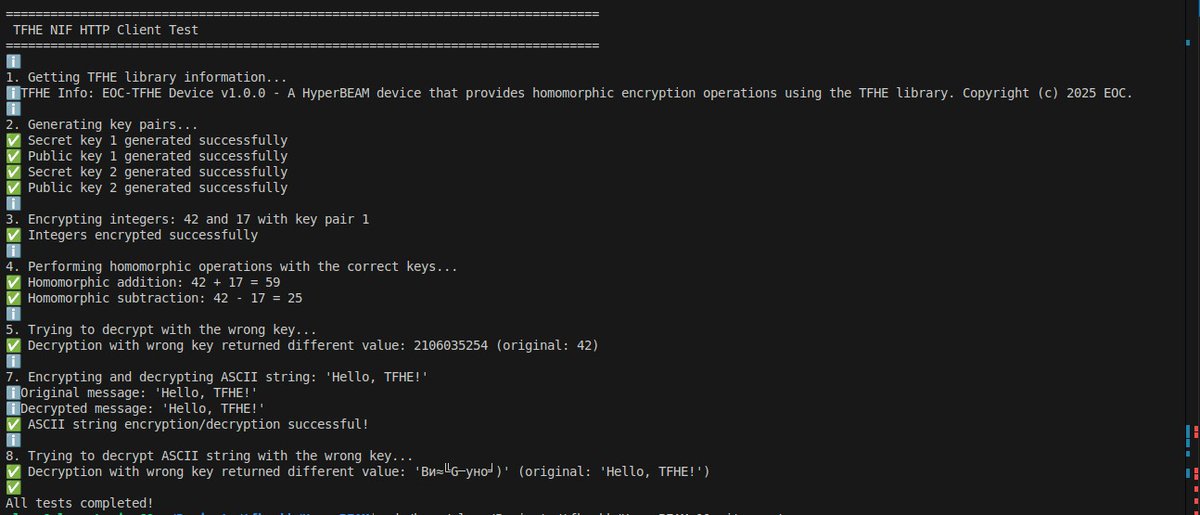
🧵 Another week, another TFHE library integrated into hyperBEAM. Today, it was the turn of @zama's TFHE-RS library, bringing almost bare-metal performance to Rust-driven FHE computation in a distributed environment!
No blockchain consensus or smart contract overhead, just near native execution speeds powered by a simple NIF-based device inside hyperBEAM. As usual you'll find everything you need to test our integration in the github repo.
Arguably, Zama's library is years ahead when compared to our initial C++ integration (take for eg only its programmable bootstrapping technique), so we can safely say that rn @aoTheComputer's hyperBEAM is at the very edge of decentralised FHE research.
https://t.co/Epuhdbsm4s
Your Arweave Weekly Digest.
We cover @ardriveapp's Turbo SDK support for @base, @ankushKun_'s new developer tooling for AO, and FHE work by @EntityofCode.
Check it out below.
[email protected] hyperbeam device to deploy and run RISC-V smart contracts alongside EVM smart contracts is in the MVP stage 🌈
The device not only facilitates bytecode interpretation, but also RISC-V appchain creation [^^]
The current state of the device aligns with Vitalik's Phase 2 of the EM transition mentioned in the "Simplifying the L1" blog post
* https://t.co/6MxdfyALwv
* https://t.co/tcnecqQYPv
Introducing our first take on high-performance TFHE inside hyperBEAM. WASM may be good for a lot of workloads, but homomorphic operations needed something better: an Erlang-based NIF device tailored specifically for executing native code with almost no overhead.
A fully working PoC coupled with testing procedures and callable directly via Erlang Shell or via HTTP. If you're building on AO and doing computations over encrypted data seems appealing to you, this is the place to start exploring.
@Marshal_AO@claudiu_stirbei Hi, tldr: not yet. Since the time of this announcement a few things changed in the hyperBEAM repo, including the introduction of hyperbuddy, as you may know. So, we have to rehash some bits in order to make it work again. We'll come soon with the updated code.
@claudiu_stirbei, our CTO, being bored with working on a FHE device, just made the exploration of devices interactive on AO's HyperBEAM node landing page. Now you can check in real time the public functions of each device. Link in the next message 👇
Until you'll get the canonical hyperBEAM gospel you'll be stuck with Apocryphal writings. Big cheers for our friends from @useload and @apus_network who joined this initiative.
https://t.co/qXqqrOBTOU
📣 New AO & HyperBEAM video!
Answering the top community questions: node deployment fixes, legacynet migration, Ledger workarounds, and dev tools.
All the FAQs in one place -- links to resources in comments.
⚠️ We're using ngrok to expose localhost - take it more like a peephole into our development process than a working node. May restart occasionally but promising ~48hrs uptime since now.
⚠️ Function with arity >0 may not be properly exposed yet.
https://t.co/fUD6LJsB0L


![decentlandor's tweet photo. riscv-em@1.0 hyperbeam device to deploy and run RISC-V smart contracts alongside EVM smart contracts is in the MVP stage 🌈
The device not only facilitates bytecode interpretation, but also RISC-V appchain creation [^^]
The current state of the device aligns with Vitalik's Phase 2 of the EM transition mentioned in the "Simplifying the L1" blog post
* https://t.co/6MxdfyALwv
* https://t.co/tcnecqQYPv](https://pbs.twimg.com/media/GqLhxqKWAAAOAys.jpg)
![decentlandor's tweet photo. riscv-em@1.0 hyperbeam device to deploy and run RISC-V smart contracts alongside EVM smart contracts is in the MVP stage 🌈
The device not only facilitates bytecode interpretation, but also RISC-V appchain creation [^^]
The current state of the device aligns with Vitalik's Phase 2 of the EM transition mentioned in the "Simplifying the L1" blog post
* https://t.co/6MxdfyALwv
* https://t.co/tcnecqQYPv](https://pbs.twimg.com/media/GqLhxnyWsAAWkqD.jpg)





![decentlandor's tweet photo. riscv-em@1.0 hyperbeam device to deploy and run RISC-V smart contracts alongside EVM smart contracts is in the MVP stage 🌈
The device not only facilitates bytecode interpretation, but also RISC-V appchain creation [^^]
The current state of the device aligns with Vitalik's Phase 2 of the EM transition mentioned in the "Simplifying the L1" blog post
* https://t.co/6MxdfyALwv
* https://t.co/tcnecqQYPv](https://pbs.twimg.com/media/GqLhxsKWAAAJcWE.jpg)