Hi All. The book that I have been working on is now available for pre-order. Nature and the Mind: The Science of How Nature Improves Cognitive, Physical and Social Wellbeing: Berman, Marc: 9781668058770: https://t.co/DrGp4IxyP1: Books https://t.co/7IU4aKoXh6
New paper on Roman Britain develops a new understanding of economic growth; shows how it happens in pre-industrial societies. New methods allow separation of intensive from extensive growth, due to settlement scaling @sfiscience@miurban
https://t.co/Ma3lZcrmtf
We're hiring a new lab manager to start this summer at the Environmental Neuroscience Lab! This is an ideal opportunity for motivated applicants looking to gain cutting-edge research experience in preparation for graduate school. Please distribute!
https://t.co/Ioc9MqLyMK
Conceptual story: Crime is explained by the management of commercial establishments AND context. And demographics still matter, too, as crime is higher in high-poverty communities, controlling for the effects of managers.
Thrilled to share an exciting new paper from our post-doc, Riley Tucker, published in the Journal of Quantitative Criminology! The study found that restaurants in Boston with higher ratings on Yelp tended to have lower rates of commercial disturbance. https://t.co/GjcQ4TXBGw
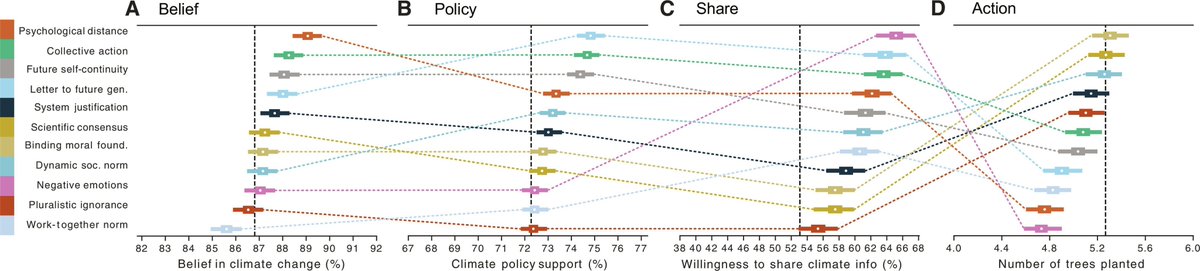
We tested 10 behavioral interventions to mitigate #climatechange in 63 countries (N = 59,440)
The interventions’ effectiveness was small, largely limited to nonclimate skeptics, and differed across outcomes:
-Beliefs were strengthened mostly by decreasing psychological distance (by 2.3%)
-Policy support by writing a letter to a future-generation member (2.6%)
-Information sharing by negative emotion induction (12.1%)
-No intervention increased the more effortful behavior—several interventions even backfired by reducing tree planting!
Our paper is in @ScienceAdvances : https://t.co/e28wBltTlg
It was led by @vlasceanu_mada and @kim_doell and included a massive team of over 250 collaborators from around the world!
Excited about our new paper out today in nature communications. It was a great collaborative effort led by @andrew_stier with @BettencourtLuis @Sajjadi_Sina and @fariba_k finding lower racial biases in larger cities. https://t.co/p6naI8Bgfk
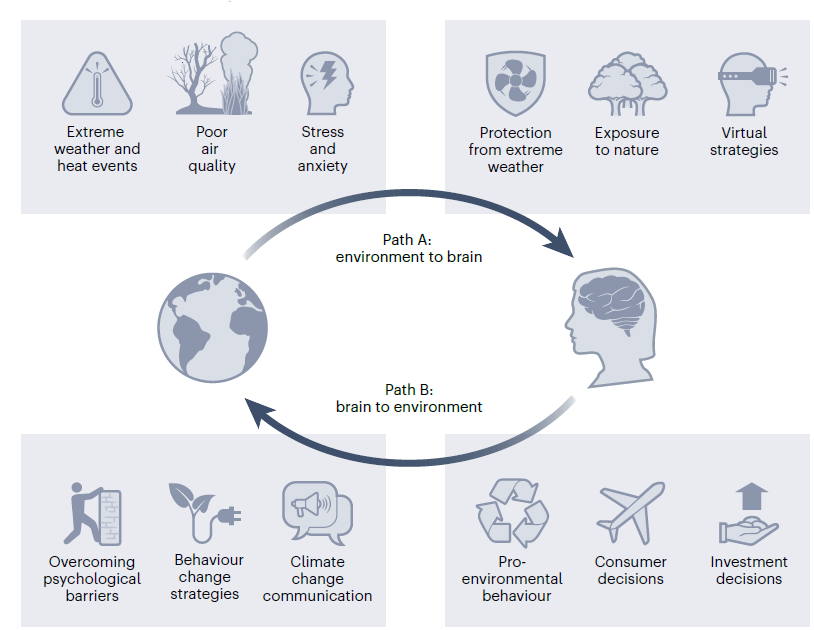
Our new paper outlines how neuroscience can be used to:
(1) study the impact of climate change on the brain
(2) identify ways to adapt
(3) study the neural substrates of environmental decisions & outcomes
(4) create better communication & interventions https://t.co/UKZgWkkQ4K
🚨🚨🚨We have a new perspective out today in @natureclimate called “Leveraging neuroscience for climate change research” https://t.co/OXEMMxcODk where we call on brain researchers to help combat #climatechange🧵
An extremely cool new paper led by the singular @kate_schertz published in @JEnvPsych! 🎉Proud to have contributed (along with several past/present @EnvNeuroLab members) to this work on how environments influence our thoughts and connections to others and the world around us! 😊
🌴CAB Lab posters #VSS2023
Sat AM: Julia Pruin asks if memorability can rescue memory during an attn lapse @WilmaBainbridge@MdeBettencourt
Sun PM: @AnnaCorriveau investigates aud+vis sustained attn &effects on memory
Tues PM: Ziwei Zhang debuts a 🧠model of surprise @zzwziwei
The Environmental Neuroscience Lab is actively hiring a new lab manager to start this summer! This is a great opportunity to gain research experience in preparation for grad school in a supportive and cutting-edge research lab. Please distribute widely! https://t.co/K6PUhm0GJv
The Environmental Neuroscience Lab is actively hiring a new lab manager to start this summer! This is a great opportunity to gain research experience in preparation for grad school in a supportive and cutting-edge research lab. Please distribute widely! https://t.co/K6PUhm0GJv
New CAB Lab preprint from Omid Kardan! Change in an existing fMRI network model of cognitive performance predicts improvement in cog perf from age 9-10 to 11-12. These changes were associated w/an important aspect of the physical environment: air pollution https://t.co/npegFE0nii
@TheAgenda @spaikin@ebombicino Thanks for having me on the show @spaikin@ebombicino @TheAgenda. I hope policy makers take our research seriously. Science is showing that public greenspaces are a necessity not an amenity.
It’s certainly more beautiful to be surrounded by mature trees than endless concrete and traffic — and research suggests it could be better for your mental and physical health as well. @spaikin speaks with Marc Berman (@EnvNeuroLab), tonight at 8/11pm | Producer: @ebombicino