🚨🧵 New paper!
Mech interp has developed many ways to probe and intervene on model internals. It's natural to ask: is there a unifying picture?
In this work, we derive 4 popular interp methods from a single representational hypothesis: Tensor Product Representations (TPRs)
1/n
As we try to push AIs to go beyond what we can measure and have data for, I'm convinced that the only way to improve intelligence is by improving how *fast* the model learns from as little as one conversation --- and sleep seems to help massively!
Enhancing LLM sample efficiency.
Intelligence is not how much one knows, but how rapidly one learns.
We find that if transformers periodically “sleep”, or replay their inputs N times without accepting new ones, they are able to learn from fewer tokens in context.
absolute fanfic. AI has real, immediate, tangible dangers that we need to focus on, for instance the impact on the job market and making sure random script kiddie can't use it for cyber offense.
But this "oh once it's superintelligent it will take over and ensave us, maybe kill us all!" is pure sci-fi fanfic and distracts from the real (and difficult) issues, which linear probing won't solve.
It's worth repeating the LLMs don't just "decide" to do something and then just "do it" in a void. They generate tokens based on our prompts, only as long as we call `model.forward()`, and on giant clusters with terabytes of weights, that's impossible to "quickly self-replicate".
We also need to regularly remind that the OAI/HF incident was specifically a _guardrail-free_ cyber eval where the model is _instructed_ to hack, to find out how good it is at it.
Some recent personal event made me realize there needs to be more push-back on this doomsday nonsense, and we need to re-focus the discussion on real dangers/issues. I won't argue much in the replies though, not interested in peer-reviewing Terminator fanfic.
Excited to share updates to our recent preprint, where we use small sets of SAE features to characterize language responses in the brain.
In a new analysis, we use the SAE feature tunings discovered by our method to search for that exact tuning profile more broadly across the brain. Without using any anatomical information in voxel selection, we show that voxels with the same tuning profile tend to cluster in the same anatomical area (more below).
Reposting the whole thread below because my old twitter account was hacked 😬
Memory is what allows Claude to learn from experience. In a new Engineering Blog post, we share how “dreaming” helps Claude organize what it’s learned, correct its mistakes, and find what it needs more easily the next time. https://t.co/uUEN4bNkr9
Recently seeing an explosion of really cool apps/projects that wouldn’t be possible at all w/p coding agents. Maybe a sign that we’ve passed the slop valley of software?
I wonder if we should go at the source of the problem: models should be developed to refuse to completely automate tasks that benefit from or require substantive human involvement, like paper reviewing.
Thinking about the 2nd order effect of this work: we are already able to RL agents to be superhuman on coding/math; it should also be possible to do RL them on tasks like this so they become superhuman weight interpreters?
We asked GPT-6 Astra to edit Qwen3.5-0.8B weights to improve math.
It directly changed only 0.016% of weights, fixing 0.8B's reasoning loops & improving math up to 6x and even instruction following 3x, without gradients or training.
We call this Weight-Space Programming: frontier LLMs can now natively read/write neural network weights! 🧵
Blog: https://t.co/bOWCcFhCVq
@xuanalogue My intuition here is that, given LLMs can learn to read raw latex/assembly/etc. well via training, reading and predicting the behavior of simple NNs is of similar sort/difficulty
We asked GPT-6 Astra to edit Qwen3.5-0.8B weights to improve math.
It directly changed only 0.016% of weights, fixing 0.8B's reasoning loops & improving math up to 6x and even instruction following 3x, without gradients or training.
We call this Weight-Space Programming: frontier LLMs can now natively read/write neural network weights! 🧵
Blog: https://t.co/bOWCcFhCVq
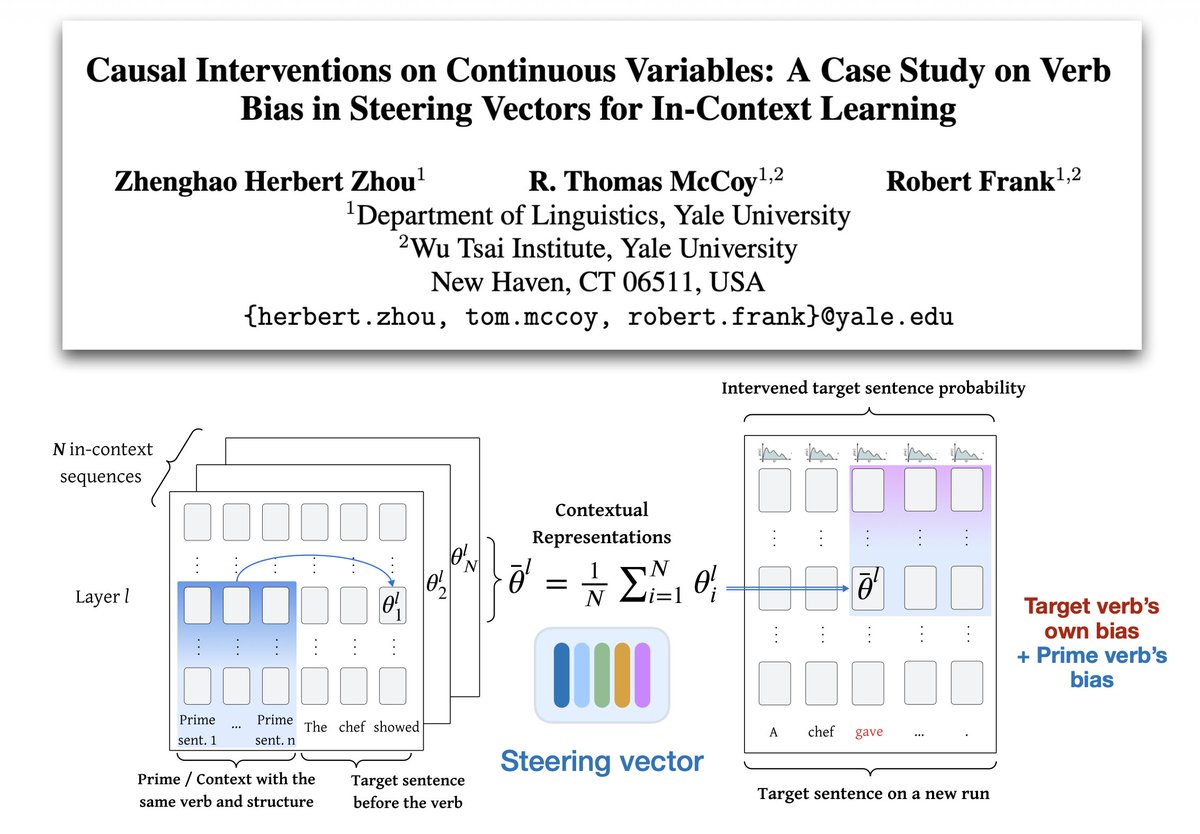
What survives when we compress context into a steering vector ?
At #EMNLP2026, I'll present a way to causally edit continuous variables inside these vectors ⚙️, with a case study in linguistic knowledge.
Oral presentation @ Oct 25 11:00am F8 Interp — starting in 12h✨ A preview
🔥 Excited to share Agent World Model in the Wild (WildAWM)! 🌍
Fully open-source synthesis 🔓: No proprietary models needed! We synthesized 341 high-quality environment–task pairs, addressing 3 challenges in task synthesis:
✅ Solvability: At least one agent can successfully complete each task.
🔥 Difficulty: Challenging even for frontier models, with GPT-6-Astra achieving only ~72.7 pass@8.
🎯 Verifier reliability: 95% agreement between task verifiers and agent-as-a-judge ensemble.
📈 Effective RL training: Trained exclusively in these synthetic worlds, Qwen3.6-35B-A3B achieves an average +10.58-point improvement across 8 OOD benchmarks!
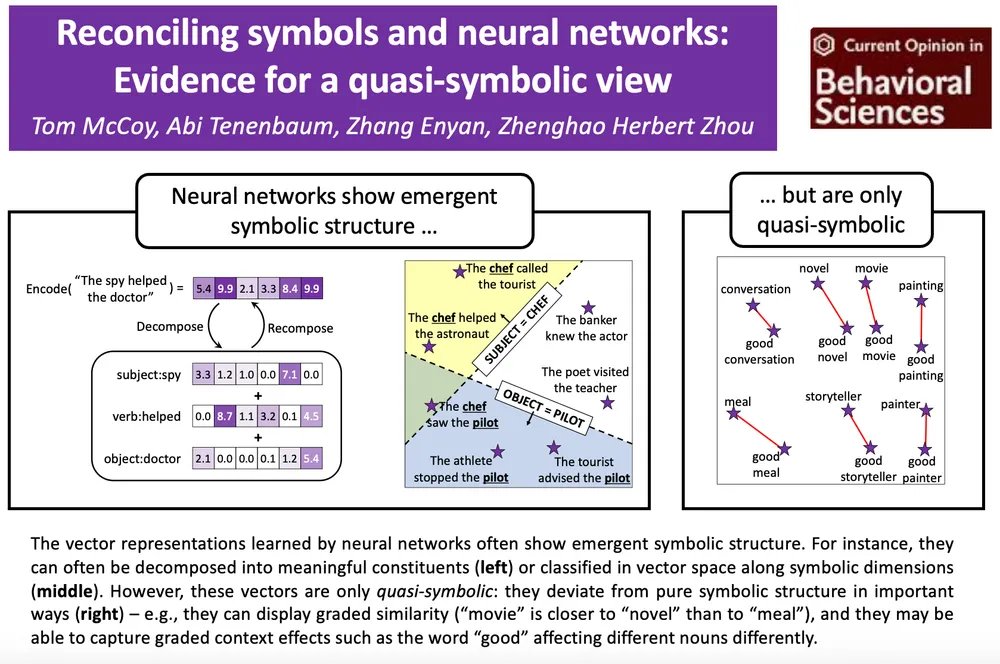
🤖🧠NEW PAPER🧠🤖
What is the relationship between neural networks & symbolic systems?
Based on evidence from mechanistic interpretability, we argue for a quasi-symbolic view of cognition: Neural nets implement symbols but only approximately
Link: https://t.co/j8B3IOIMpe
1/n