My new book with Cambridge Elements on Chinese Global Migration - https://t.co/MrYKDQP8oQ It argues that Chinese global migration is best understood as a barometer of global power transitions. It shows how migration patterns reflect transformations in the East Asian international system alongside China's domestic political upheavals.
Why did Chinese people migrate? From the 19th-century coolie trade, to refugee flows during Cold War ruptures, and post-1978 mobility, Chinese migration has always been caught between domestic upheavals and shifting world orders. Check out this new Open Access Element, @CambridgeCore@Cambridge_Uni #china #migration Chinese Global Migration: [Link]Chinese Global Migration - https://t.co/MrYKDQP8oQ
My new book with Cambridge Elements on Chinese Global Migration - https://t.co/MrYKDQP8oQ It argues that Chinese global migration is best understood as a barometer of global power transitions. It shows how migration patterns reflect transformations in the East Asian international system alongside China's domestic political upheavals.
It examines the varying roles successive Chinese states have played in regulating and responding to population mobility, the lived experiences of migrants, and how the meaning of 'return' has changed over the past two centuries.
Can we all collectively agree that paper writing and reviewing is a broken outdated practice and just move on? Just received 2 reports which are verbatim the same thing amd clearlyAI generated.
So. AI writes, AI reviews, AI fixes? What's the point?
The outcry from some economists over AI-assisted writing is a bit ridiculous.
The discipline abandoned the idea that good writing (and, to some degree, intellectual depth) was worth valuing and rewarding a long time ago.
It's kind of late for us to look there for purpose.
Where resistance persists, as in parts of Xinjiang and Tibet, the law’s success will depend on empirical evidence of whether those benefits are felt widely and fairly on the ground, and on whether integration can proceed without forcing communities to give up what they value.
https://t.co/kyLUMpVYuo
My take on the controversial Ethnic Unity Law in China: From Soviet autonomy to a Chinese melting pot: Why China wants ethnic unity now | ThinkChina https://t.co/Sh7oU91hyn
More than half of Americans support “friendly cooperation and engagement” with China.
For Democrats, it’s 2/3.
From a new Chicago Council survey: https://t.co/K9vYGROJuA
All this anguish over the reception that Trump is extending to Xi has me fondly recalling the memoirs of every American diplomat.
The Chinese, they say, are obsessed with diplomatic protocol. We practical Americans couldn’t care less about form, we just focus on the substance.
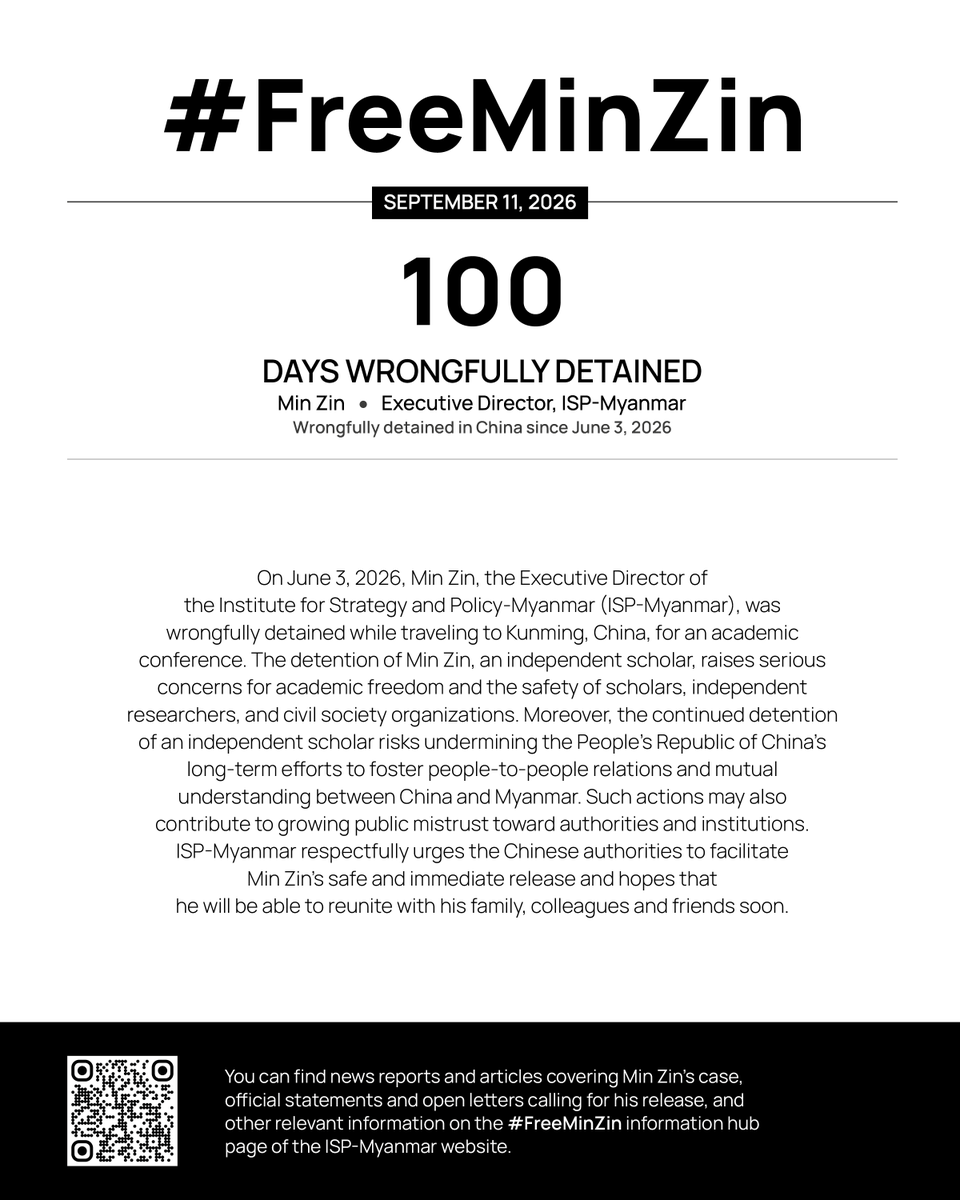
On June 3, 2026, Min Zin, the Executive Director of the Institute for Strategy and Policy-Myanmar (ISP-Myanmar), was wrongfully detained while traveling to Kunming, China, for an academic conference. The detention of Min Zin, an independent scholar, raises serious concerns for academic freedom and the safety of scholars, independent researchers, and civil society organizations. Moreover, the continued detention of an independent scholar risks undermining the People’s Republic of China’s long-term efforts to foster people-to-people relations and mutual understanding between China and Myanmar. Such actions may also contribute to growing public mistrust toward authorities and institutions. ISP-Myanmar respectfully urges the Chinese authorities to facilitate Min Zin's safe and immediate release and hopes that he will be able to reunite with his family, colleagues and friends soon.
#FreeMinZin
On Friday, the United Nations General Assembly adopted an African proposal for a new world map, which shows countries’ true size relative to one another.
In favor: 164
Against: 1
Abstentions: 6
“Thailand routinely recognises Beijing as the sole legal government of China and Taiwan as an inalienable part of it. But this statement went further, adding that Thailand ‘firmly supported peaceful reunification and will not support any call for the independence of Taiwan’ and that Thailand ‘supported China’s one country, two systems policy’.”
Thai attitudes to the Taiwan Strait track their views on democracy at home, turning a distant dispute into a domestic dividing line, writes Enze Han.
https://t.co/CWDigBfntj