What can unsupervised representation learning learn from deep RL? As it turned out, we can learn representations (unsupervised) by making plans!
Check out our new work at https://t.co/3QbKataX3b
When I started my PhD, quantum computing gatherings were small. By the time I shifted to AI, they filled conference halls.
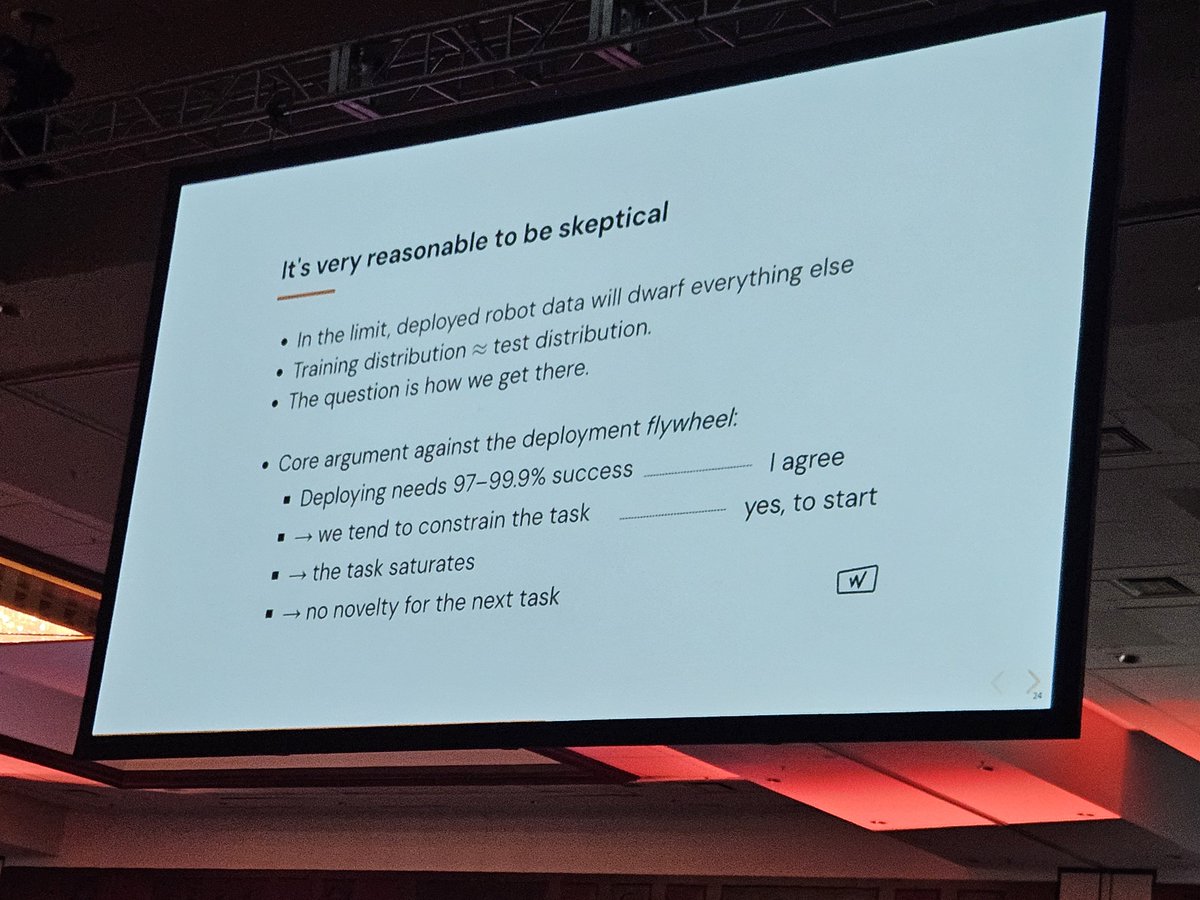
CoRL this year feels the same. Here are some thoughts on what comes next for robot learning.
Robots Learning in a Million Worlds — before entering ours.
My essay on where robot learning goes next, and how simulation can scale the research needed to get there.
https://t.co/mCT1EJpzoe
Trained entirely in imagination, our policy matches a PPO policy trained in simulation on the same locomotion test (81.8% vs 80.7% command-tracking success), with 7.9× fewer simulator transitions and about half the training time.
More results soon 🤫
People are underestimating the importance of sensorimotor learning.
We loved Eka’s demo, and want more people to be able to do the same.
so we figured that we should show what a few MIT undergrads are able to do in a week. This video was our first test.
@EkaRobotics has raised a $150M Series A.
Generality v/s Performance is the fundamental tension at the frontier of robotics. Generality without performance is just a prototype. Performance without generality is just a single-purpose tool.
Customers shouldn’t have to choose. Eka breaks the tradeoff. Powered by our Vision-Force-Action (VFA) model, we deliver the performance and versatility customers need to put robots to work every day.
Eka is built on three convictions:
⚡️Force is the language of manipulation.
🚀 Reinforcement learning is how dexterous manipulation scales.
🎂 System 1—fast, reliable physical execution—is the bottleneck to solve.
With this funding, we will scale our model and accelerate customer deployments.
Grateful to be building alongside a dream team and investors who share our ambition.
You got to take a look at the cut where the arm flew off together with the ball :P
A perfect example of how massive closed-loop training can do to physical systems.
2/9 To train it, we reset the simulator to a recorded hardware state, apply the same recorded commands, and learn command corrections so the simulated rollout matches the recorded hardware trajectory.
We previously used UAN on a quadruped's arm (https://t.co/3DwdfYx3Xw).
But motion with contact was tricky.
Hi, I'm Felix. I'm an eng lead working on Claude. I love watching people take flight and do things they never thought possible.
We often describe that as "being more ambitious" when using AI, which is tricky advice to follow. I wrote a tutorial:
https://t.co/vNPPs5FWm8