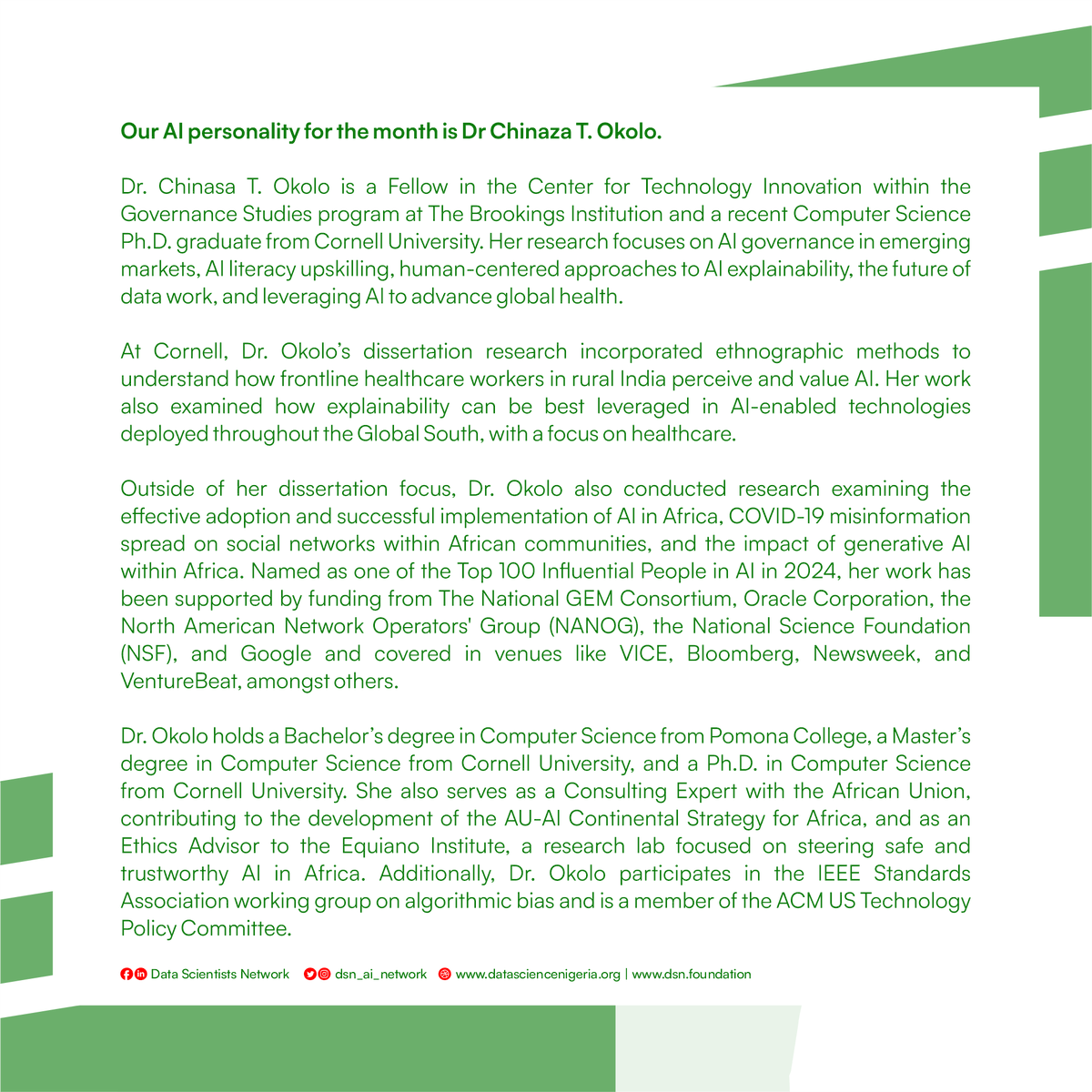
Our AI personality of the month is @ChinasaTOkolo
Dr. Chinasa is currently a Fellow at @BrookingsInst and a recent Computer Science Ph.D. graduate from @CornellCIS. Her research focuses on AI governance in emerging markets, AI literacy upskilling, human-centered approaches to AI explainability, the future of data work, and leveraging AI to advance global health. In addition to her work at Brookings.
Named as one of the Top 100 Influential people in AI by @TIME, Dr. Okolo also serves as a Consulting Expert with the African Union, contributing to the development of the AU-AI Continental Strategy for Africa, and as an Ethics Advisor to the Equiano Institute, a research lab focused on steering safe and trustworthy AI in Africa.
Additionally, Dr. Okolo participates in the IEEE Standards Association working group on algorithmic bias and is a member of the ACM US Technology Policy Committee.
#AIPersonality
I look forward to attending #CSCW2024 next week to share my latest work with a great group of collaborators!
We critically examine AI for Social Good partnerships to understand power imbalances, influence of funding agendas, community organizations’ contributions, and more.
My interview with @ChannelsTV, one of the largest broadcasters in Nigeria, is now live!
I enjoyed the opportunity to share my story and am proud to be spotlighted by Nigerian media outlets.
https://t.co/yuTymc6rMz
Thank you to Hongjin for presenting our paper yesterday!
This is the last chapter of my dissertation and I'm proud to have it published at EAAMO. It's now available on the @TheOfficialACM Digital Library: https://t.co/yOxfzFBQUn
🧠🖼️ New paper on interpreting VLMs!
We study Vision-Language Models (VLMs) like LLaVA to understand how they process objects in images. We find surprising insights about how these models identify objects in images and how their inner representations develop through the layers.
We're launching a Cooperative AI PhD Fellowship, open to both current and future students! Fellows will receive up to $40,000 per year plus tuition fees, alongside many other benefits. Applications close on October 14th. Find out more and apply here: https://t.co/2Hk9HxP2mY.
Applications are now open for the 2025 Cooperative AI PhD Fellowship! The CAIF @coop_ai is committed to the growth of a diverse and inclusive research community, and we especially welcome applications from underrepresented backgrounds. Find out more and apply here : October 14th.
In their new paper, Mozilla argues that AI development shouldn't be driven solely by private companies.
They introduce a framework for Public AI, which prioritizes public goods and an inclusive approach to AI development.
Read the full paper:
https://t.co/gl2LqeFKlS
@mozilla
→ What changes once AI can automate R&D?
→ How close are bottlenecks from power, physical resources, and training data?
→ What (if anything) is most likely to prevent explosive growth from AI?
Listen to @tamaybes —
https://t.co/AXH2muxaAF
The @UN is speaking up about AI - particularly in the global south. Ian @ianbremmer and Bilawal @bilawalsidhu sit down at @TED to discuss, and we couldn't agree more. Benefit sharing recommendations include AI compute, capacity and fund etc https://t.co/ZrsmmHNPxz
Audrey Tang (@audreyt), Megan Smith (@USCTO44), Danielle Allen (@dsallentess), & Mathias Risse joined us in the Forum to explore how technology is being used to transform political institutions, civil society, & political culture to support democracy.
📹 https://t.co/CIvAb9A7sm
We're delighted to have @jonas_kg, Founder and Director, @equianoAI, as a speaker at the @OxGenAI Summit! #OxGen24
Read more - https://t.co/rs0PiDz09K
Get your tickets now at https://t.co/NwZowQPwzH. #OxGen24
Dr. Zheng-Xin Yong presents another great paper on low-resource languages with questions on synthetic data:
(1) if LLM cannot speak the language, how do we use it to generate data?
(2) can synthetic data be as good as manually collected data, esp for low-resource languages?
Our work finally accepted to EMNLP 2024 findings (with the most bizarre score of 2,2,5 + being nominated for best paper – thank you third reviewer 💙)
Super proud of this work because, as everyone is hyping up synthetic data, two questions remained unexplored till now:
(1) if LLM cannot speak the language, how do we use it to generate data?
(2) can synthetic data be as good as manually collected data, especially for low-resource languages?
We show that we can use lexicons to generate data, and it is as good as manually collected training data.
Having worked to include more diverse people across the world in AI safety with Apart, it's great to see that @OpenAI is beginning to prioritize this aspect of the AI value creation! Kudos https://t.co/FaLmUNSlwB
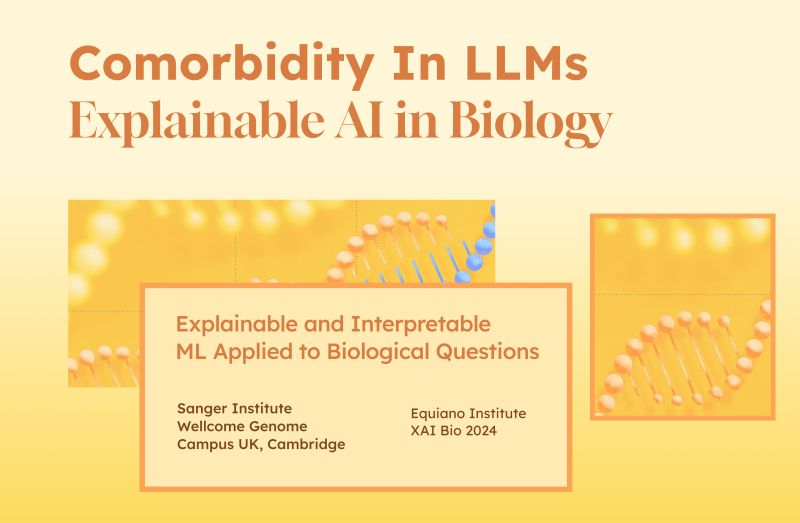
We will be presenting on biologically explainable comorbidities in LLMs at the Explainable AI in Biology Conference 2024. We explore how LLMs can be exhibit biologically explainable outputs for comorbidities—conditions where patients experience two or more diseases simultaneously
Exploring Pluralistic Perspectives in AI 📣
Pluralistic Alignment @NeurIPS 2024 Workshop
December 15, 2024 in Vancouver, Canada @pluralistic_ai
Submissions that discuss the technical, philosophical, and societal aspects of pluralistic AI are welcome
https://t.co/lN4b3n5HEt
Congratulations to our Advisor @ChinasaTOkolo for being named one of @TIME's 100 Most Influential People in AI! Learn more about her work in AI Governance.
Why Chinasa T. Okolo, a Nigerian-American computer scientist and a Brookings Institution fellow, is one of the most influential people in AI https://t.co/ZgOWqz3e4o
Why Chinasa T. Okolo, a Nigerian-American computer scientist and a Brookings Institution fellow, is one of the most influential people in AI https://t.co/ZgOWqz3e4o