New episode!
Is the planet unsustainably crowded? Or is there, for the environment and development, a positive case for people? Dean Spears joins to talk about peak population.
https://t.co/1PHT6Mjulz
→ Why haven't Russian cyberattacks caused more damage in Ukraine?
→ Why is Stuxnet still the best-known cyberattack after 15yrs?
→ How do countries decide what cyberattacks are acceptable, and which cross the line?
Listen to @Maxwsmeets —
https://t.co/GdzGSbgPU3
Great weekend listen - featuring Tom Kalil (@tkalil2050) and @mattsclancy.
Lots of the ideas discussed (unlocking bottlenecks, betting on field strategists, using a mix of tools from directed R&D to policy) are why Tom and I created Renaissance Philanthropy (@RenPhil21).
→ Can tech policy create self-fulfilling prophecies?
→ What can we learn from the “tour of duty” model at ARPAs?
→ How can philanthropy become more ambitious?
Listen to Tom Kalil (@tkalil2050), feat. Matt Clancy (@mattsclancy)!
https://t.co/VrhpQgWWgz
→ How can we compare the welfare footprints of different animal products?
→ Is the ability to feel pain unique to big-brained animals?
→ What can animal advocates learn from anti-corruption nonprofits?
Listen to @CynthiaSchuck — https://t.co/Nu8Tx8rRjK
→ In the ‘marketplace of ideas’, what are we really shopping for?
→ Do some bad ideas work like ‘mind viruses’?
→ How dangerous is (AI-generated) misinformation?
Listen to @danwilliamsphil —
https://t.co/AR0A5sIIKG
→ What changes once AI can automate R&D?
→ How close are bottlenecks from power, physical resources, and training data?
→ What (if anything) is most likely to prevent explosive growth from AI?
Listen to @tamaybes —
https://t.co/AXH2muxaAF
Listening to a superb @hearthisidea on the enormous human and economic returns to research into global health challenges with @JacobTref.
It’s wild how little we spend on developing cures for awful diseases—but also a huge opportunity to change the world for not much money!
→ Which new health technologies could exist in 5 years (with a big lift)?
→ Who funds and does the R&D for neglected diseases? And which policy ideas might speed it up?
→ Is R&D more cost–effective than bed nets?
Listen to @JacobTref —
https://t.co/ZY8YyrJTTs
→ What does it mean for an AI model to be ‘open source’?
→ How useful is access to frontier model weights for research on making AI safer?
→ How would we know if the risks from open-sourcing future models outweigh the benefits?
Listen to @ea_seger —
https://t.co/mCPUp2gLH8
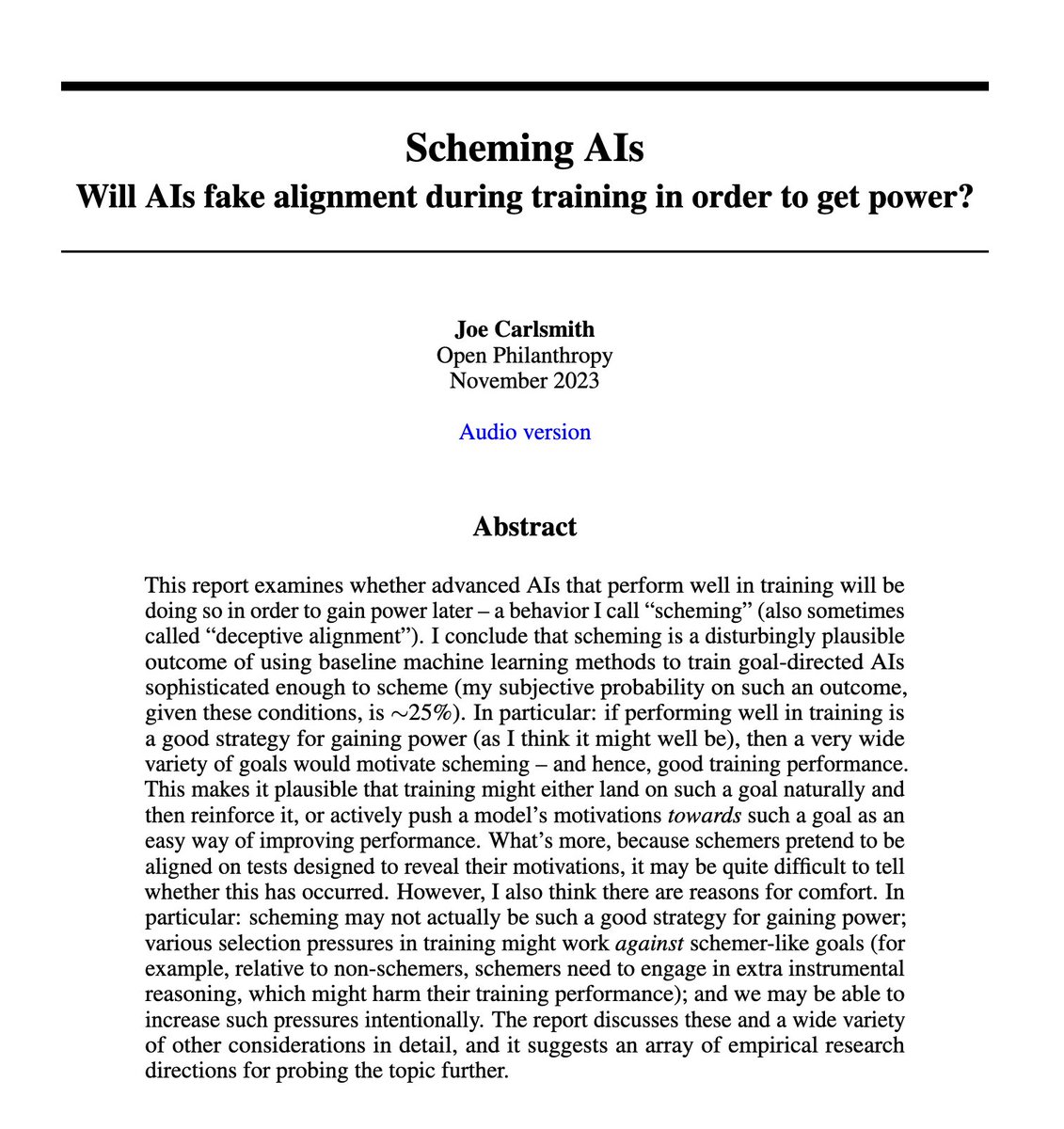
Superb podcast with Joe Carlsmith coming back on his "Scheming AIs" November 2023 paper.
Deceptive alignment, training performance, and why goals that extend beyond AI-systems training could lead to scheming 👏
→ Why might future AIs fake alignment in order to gain power?
→ Will 'schemers' perform better in training?
→ How might arguments about deceptive alignment be confused?
Listen to @jkcarlsmith —
https://t.co/R4SVh1UbLo
→ What should we do when some people are convinced their AI assistants are conscious? Will we know?
→ Can introspection mislead us about our own experiences?
→ How might our actions have infinite consequences?
Listen to Eric Schwitzgebel (@eschwitz) —
https://t.co/KEtWuPObrK
→ How does tacit knowledge make it hard to acquire bioweapons?
→ Why have so many weapons programmes failed?
→ What advances in AI or synbio could drastically increase bioweapons proliferation?
Listen to Sonia Ben Ouagrham-Gormley (@ScharSchool) —
https://t.co/a0gfpErXny
→ How do scientists study animal emotions?
→ When can we anthropomorphise nonhuman animals?
→ What clues can evolution give us about what farmed animals want?
Listen to @JMichelleLavery —
https://t.co/roHUSaSDkG
→ How do scientists study animal emotions?
→ When can we anthropomorphise nonhuman animals?
→ What clues can evolution give us about what farmed animals want?
Listen to @JMichelleLavery —
https://t.co/roHUSaSDkG
→ What are the biggest harms of unclean indoor air?
→ What policies and tech would meaningfully improve indoor air quality?
→ How (and why) do economists put dollar figures on years of life?
Listen to Richard Bruns (at @JHSPH_CHS) —
https://t.co/GCKT9QX8Mz