Ageless: The new science of getting older without getting old is out in paperback!
‘A tour de force of anti-ageing science’ – @thetimes
‘A fascinating look at how scientists are working to treat the aging process itself’ – @drsanjaygupta
Buy a copy at https://t.co/T9k6uASUmn
🎥 Andrew Steele (@statto) at the #AdinberriLongevityForum2026: "Ageing can be slowed down using everyday tools, without having to wait for cutting-edge treatments".
▶️ You can watch their full presentation on our YouTube channel: 🔗 https://t.co/bxN3BmSGeG
Your Mac keeps a file that lists who it thinks your family members are, with a confidence score next to each name.
Researchers found a family classifier that uses 144 inputs such as - same surname, shared address, who appears in your photos on weekends rather than weekdays.
It combines those signals with Contacts, Calendar, and Family Sharing to build a record of the people around you and their relationships. Stuff like if there was a child in the household and its age, the daycare it went to, and associated phone numbers.
The positive here is that all this happens on-device, locally.
The negative is that we were never told that this exists, or given an option to stop this creepy guessing game.
Ten years ago today, Her Majesty the Queen officially opened The Francis Crick Institute, and my picture of her arriving got retweeted by @RoyalFamily! https://t.co/MTQLNLhNfK
Becoming just increasingly worried about the incredible pace of AI progress and do not think society is reacting nearly fast enough to what's happening
Is the UK Government literally #1 in the world in terms of how well it's preparing for AGI, given the resources it has available?
After last week's budget, I think so.
Puts some other countries to shame really.
Re. compute vs bio data collection, path is obvious when you consider EV of marginal spend on either:
If a frontier lab put $50M into collecting data that may be gating, e.g. rich multiomics from real human longitudinal trials, that's ~1 day of compute budget.
Such data takes incompressible time from study initiation.
If pure simulation doesn't need this data, cures delayed 1 day.
If the data guides models to simulate sooner, cures accelerated by months or years.
If the data is strictly necessary, cures accelerated years.
Obvious choice if eg the first AI benefit example in your S-1 is ""profoundly accelerate the rate of progress in biology and medicine, potentially curing diseases that have plagued humanity for millennia ..."
I've been meaning to share these thoughts for a while and touched on them briefly in a recent conference talk. They are relevant to a lot of the discussions today. https://t.co/YywkAS87eQ
"The longevity industry exists to exploit humanity, not to save it." - Seamus O'Mahony writes @TheLancet
Or, as he puts it, "the longevity industry is a goldrush without gold."
Talk about throwing out the baby with the bathwater!
Of course, the field is drowning in hype and commercial interests pushing unproven interventions. But that doesn't detract from the fact that slowing human aging - even if slightly - would have enormous health and medical benefits.
Manipulating human aging may prove harder than many in the field currently promise. But aging is no doubt malleable, so let's not lose sight of the field's long-term transformative potential.
The challenge is to tell hype from science, not to dismiss the science because of the hype.
The series is actually now watchable for free online! You can check out this whole episode here: https://t.co/oFkbyiMHDH
(That link skips to a bit with me in it, in case you’re interested.)
I can’t believe it’s been TEN YEARS (this week!) since I visited the world’s largest radio telescope, FAST in southern China, to film an episode of Impossible Engineering.
It’s genuinely one of the most awesome (in the original sense) things I’ve ever seen.
what I would like is for someone with programming skills to make a bit of software to search the internet for GMC registered drs making these sort complaints and report, as well as ASA. let me know if you have these very particular skills and are in need of a thankless task
Great to see the launch of AD-SMART, a multi-arm platform trial to test new drugs for Alzheimer’s in the UK’s NHS.
We would love to see something similar for repurposed longevity medicines—which might even be some of the same drugs! https://t.co/WljhoVMhKs
This is bonkers surely? Surely whichever camp you fell in in covid discussions* the lesson is that coronavirus at least was controllable?
*with the exception of the niche, but suprisingly still extant "we hit herd immunity in March 2020" camp
Nature’s clocks: why some lives fly by. This episode on #animal#ageing features @jpsenescence (@unibirmingham); Noah Snyder-Mackler (@ASU); Stephen Clark (Kallel Foundation); and @statto (The Longevity Initiative). 🎧Listen here:
https://t.co/Nw4OdpMFpq
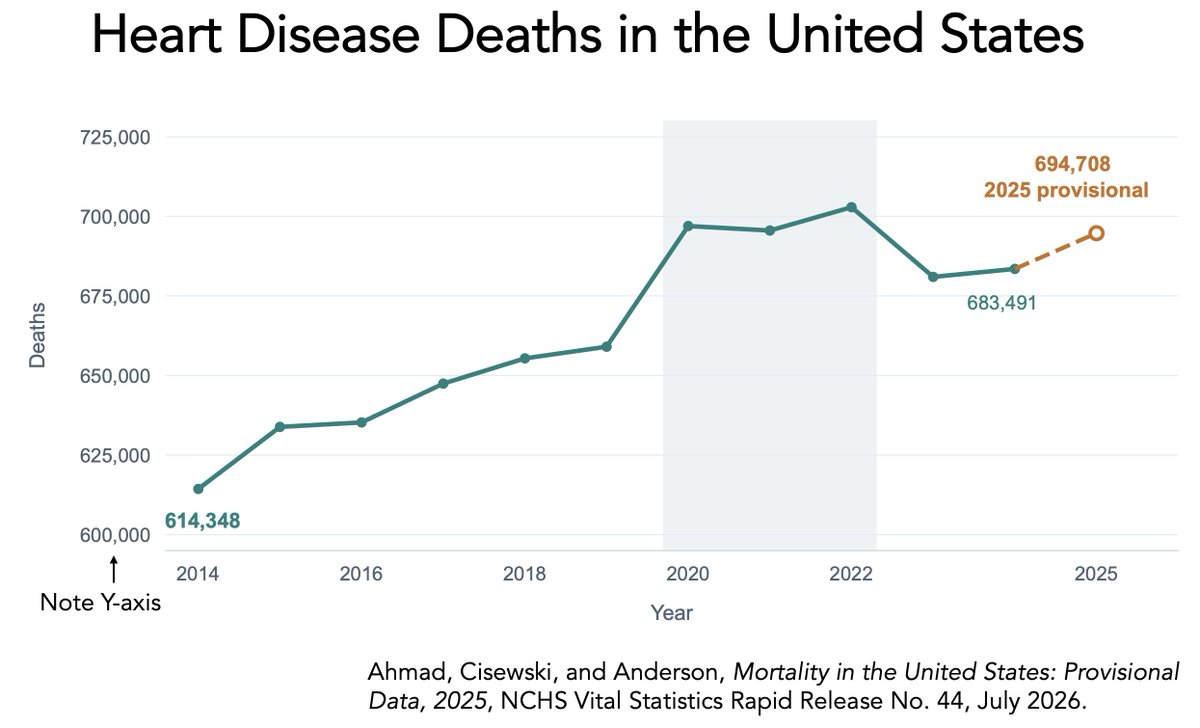
@EricTopol@ndp405 I’m sorry Eric, perhaps I’m being dumb, but I still don’t understand what you’re seeing—the final point there is very clearly below the black line, and I looked up the underlying data and it’s monotonically downward every quarter since 2023. What do you mean is on the increase?
Graph title should be: the US population has grown, and they are on average older.
@EricTopol’s very next post is an age-adjusted rate graph…and heart disease is trending downwards aside from a pandemic-related spike!
@paulg@EricTopol Fewer people are dying of both, because people are overall healthier and healthcare has improved! But even completely curing cancer and heart disease would only add ~5 years to life expectancy—we need drugs that slow the ageing process that causes both… https://t.co/TxfQs7FVLg
Graph title should be: the US population has grown, and they are on average older.
@EricTopol’s very next post is an age-adjusted rate graph…and heart disease is trending downwards aside from a pandemic-related spike!