Helpful reminder here (And thanks to @KellyGToGo for the original posting reference to this): In his new piece, The Broken Logic of "Sold a Story," (will post link right after this), Tom Newkirk offers robust research and reasoned perspective. At one point, he quotes a particularly strong caution against the constant and misused qualifier, "The Science of" in regards to any discipline or education theory. He and others remind us that certain groups try to cloak themselves in the semblance of science-like vocabulary, phrasing, and pundits, but they are often found very unscientific when put under close scrutiny. Here is a composite of passages from one research article referenced by Newkirk in his response: "Perhaps the most obvious example [of using science to justify a certain reading approach over all others]... is the statement that “the [research] results were so conclusive in favor of systematic phonics instruction that the Institute of Education Science [IES] no longer funds research on whether systematic instruction is effective. It is considered ‘settled science.’” We would challenge the authors...to provide evidence of any such IES policy.
...[S]ettled science might be considered an oxymoron. Scientists are never entirely comfortable that their current data and explanations are fully explanatory. They are continually testing the veracity and utility of current theories, findings, and interpretations. They look for anomalies in their data, and they set an extremely high bar for any conclusions that might approach certainty...
Multidimensional continua, not binaries, are the stuff of science, especially when science is applied to real-world decisions in the realm of instructional practice (see Yaden et al., 2021)....In short, [a group, district, or state that promotes a strict focus on phonics and diminishes the merits of balanced literacy and other approaches]...uses science as a rhetorical tool to promote a preferred orthodoxy or, as some have argued more forcefully, as a bludgeon to silence discussion or debate (Ayres, 2006). Science, used this way, is not a means of inquiry toward better understanding or to obtain better results, but something that requires uncritical deference and genuflection. It suggests that the aim of science is to reach a state where no further understanding is possible, where no more questions need to be asked, where no more evidence needs to be considered, where no other perspectives or interpretations can be reasonably offered, and where anyone who thinks otherwise is a misguided, if not a heretical denier of immutable truth. Such perspectives are not science, especially in matters of teaching and learning, which are always embedded in an incredibly complex social system that entails cultural norms, values, and beliefs, including issues of equity and justice." @DrMaryHoward@plthomasEdD
In one of the most notable moments in sports history, Kenyan runner Abel Mutai was just a few feet from the finish line, but became confused with the signage and stopped thinking he had completed the race.
A Spanish athlete, Ivan Fernandez, was right behind him, and after realizing what was happening, he started shouting at the Kenyan for him to continue running; but Mutai didn't understand his Spanish.
Fernandez eventually caught up to him and instead of passing him, he pushed him to victory.
A journalist asked Ivan, "Why did you do that?"
Ivan replied, “My dream is that someday we can have a kind of community life where we push and help each other to win.” The journalist insisted “But why did you let the Kenyan win?" Ivan replied, "I didn't let him win, he was going to win.” The journalist insisted again, “But you could have won!”Ivan looked at him & replied, “But what would be the merit of my victory? What would be the honor of that medal?
What would my Mom think of that?”
Values are transmitted from generation to generation.
What values are we teaching our children?
Let us not teach our kids the wrong ways to WIN.
1 reassesssment mistake, according to @tguskey: “Asking students to independently correct their learning errors is like saying to students, ‘I tried my best to teach you, but I wasn’t successful. So now it’s up to you to learn on your own!’” https://t.co/jeVZ8TxsvO via @ASCD
Grades can provide some useful extrinsic motivation--something helpful in the short-term.
But this won’t lead them to the deep learning & long-lasting knowledge & skills we want for them.
That deep learning comes from intrinsic motivation--something beyond the scope of grades.
Hot take:
If you view assessments results as just grades to give students instead of feedback for how well you provided learning, you're probably doing it wrong.
That is all.
Stop chasing achievement with so much energy.
Chase engagement instead.
Little or no engagement = Little or no achievement gains.
Every time.
The good news is we can design for engagement to happen.
Not entertainment, engagement.
Make it a part of your Tier 1.
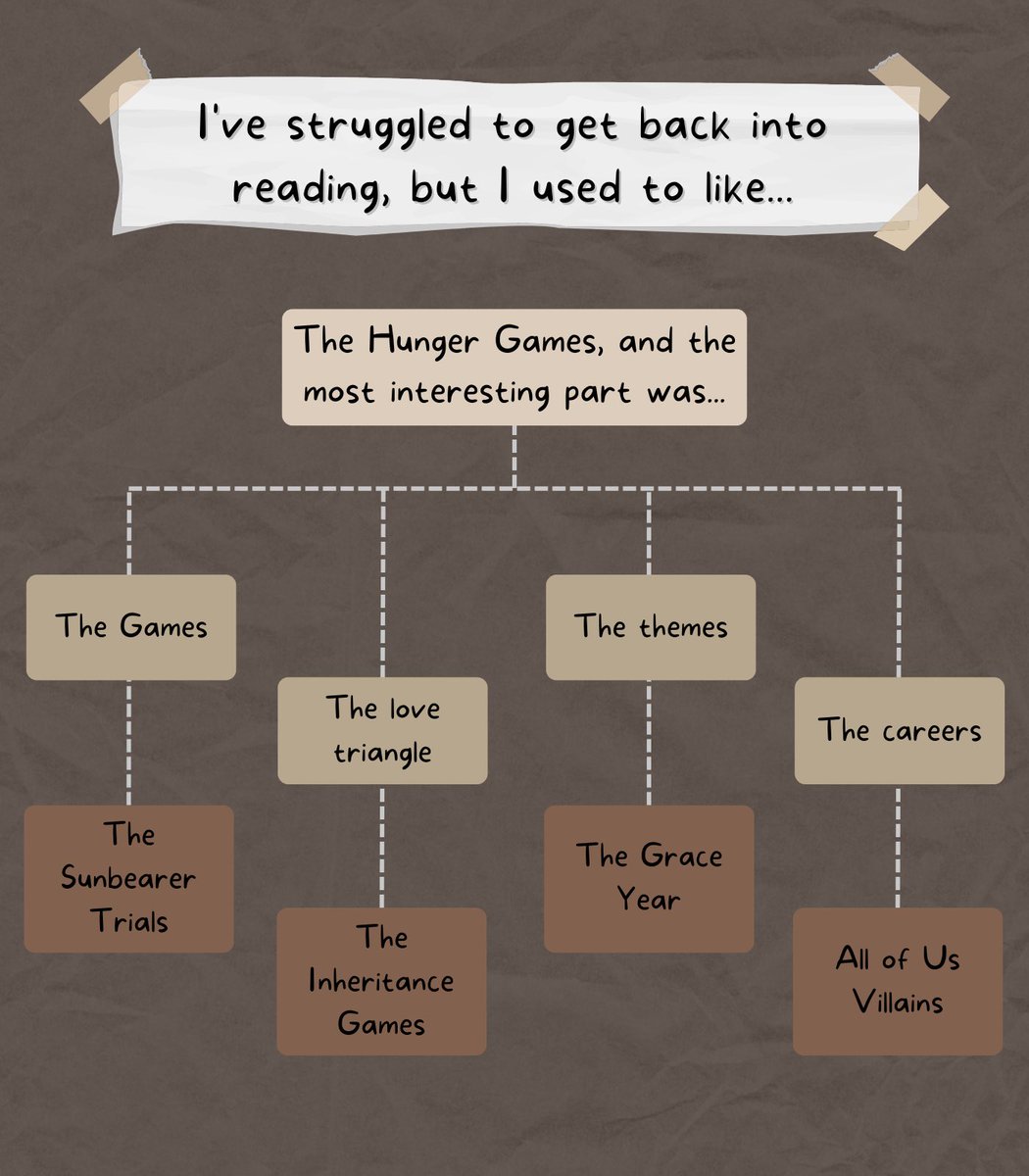
When people tell me that they want to get back into reading but can’t seem to find THAT BOOK, I have some go-to recs based on what made them love reading in the first place
— here are 56 of them 🧵
Grading experts recommend that student grades only be used “to communicate student learning.”
Not “to motivate.”
Not “to punish.”
This change and focus is largely what grading reform is all about.
#edchat
When I was a high school English teacher, I was constantly blown away by how willing and how eager my students were to grapple with the difficult topics and questions that arose from books we read. Young people are capable of far more than many adults often give them credit for.
This teacher finally stopped using rubrics after realizing that trying to tweak them was a fool's errand. Once she looked at how "students as *people* interact with them," she saw that rubrics inherently "make education less human": https://t.co/R9xndju9So