We taught a brand-new mini-series this year at @SCSatCMU on Modern GPU Programming for ML Systems, as part of the ML Systems course, touching on fun questions like what data layout swizzling is, how to use 3D TMA, and state-of-the-art Blackwell programming. We released a curated online book based on the materials: https://t.co/5ZJg2lySNO check it out
New Science Blog: Why has AI advanced faster in coding than in biology?
To agents, bio databases are like cities built before cars—maddening to drive in because they're designed for different traffic.
How do we build infrastructure agents can use?
https://t.co/PQaNQ4GRJZ
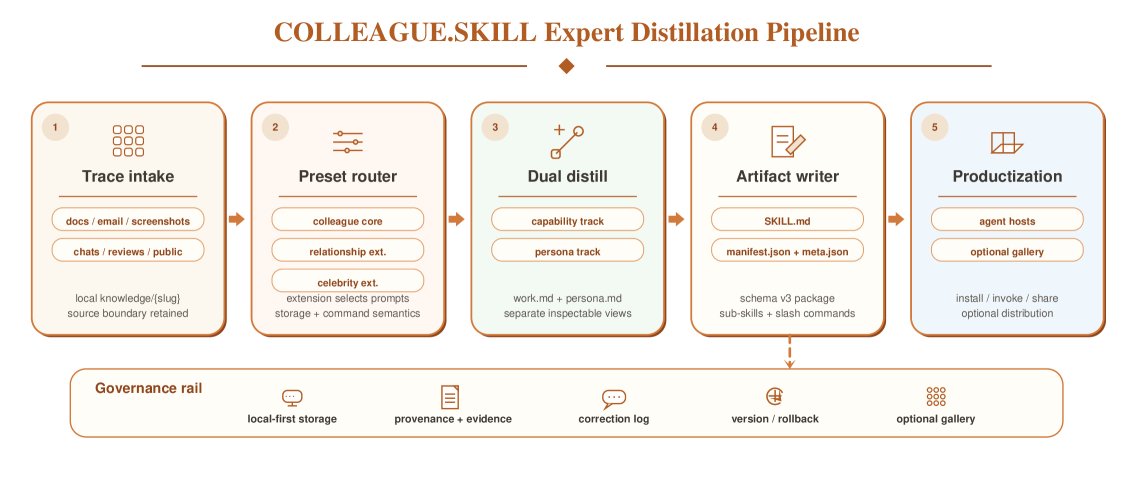
COLLEAGUE.SKILL turns chat logs into portable AI agent skills
Distill a colleague, partner, or public figure into a versioned skill package that captures their thinking style and voice. 18.5k GitHub stars and 215 community skills.
OpenAI Robotics is hiring, looking for exceptional full-stack hardware, ops, systems, and ML engineers to help us program and manufacture robots that are useful for society.
AI should be able to help people in the physical world. In the short term, we are focused on robots to support skilled workers to build our future infrastructure; in the long term, we imagine everyone having a personal robot doing anything they need.
Our world simulation research program, led by Aditya Ramesh (@model_mechanic), has evolved over the past year into OpenAI Robotics. Progress is rapid, and based on a foundation of co-design between robotics hardware and ML research.
If you love working hands-on across the robotics stack and want to build the future, please consider joining us. Send an email with your background and evidence of exceptional accomplishment to: [email protected]
Until now, physicians using AI in clinic had to assemble the patient’s context themselves. Allergies, comorbidities, medications, prior procedures, copy-pasted in from the chart.
Today we’re announcing a partnership with @CedarsSinai. OpenEvidence now works directly inside Epic, drawing on the patient’s full record and interpreting the medical literature through the lens of that specific patient.
Cedars-Sinai is the first academic health system to deploy patient-aware clinical intelligence at enterprise scale. The clinician asks a complex question in natural language. The answer reflects both the best available evidence and the patient in front of them.
Patient data is never stored after the clinical session or used for any other purpose.
The bitter lesson in 26 words:
Don’t be distracted by human knowledge, as AI has been historically.
Instead focus on methods for creating knowledge that scale with computation, like search and learning.
[chexpert-labeler] The most important thing of CheXpert challenge is actually the labeling from reports, however everyone chooses to ignore it in 2019.
MICCAI-Intrapartum Ultrasound Grand Challenge (IUGC) 2025: 32,000 images from 24 hospitals and research institutes
"IUGC: A benchmark of landmark detection in end-to-end intrapartum ultrasound biometry", Medical Image Analysis, 2026 https://t.co/JRImS8Q8zD



![Eric_ahaa's tweet photo. [chexpert-labeler] The most important thing of CheXpert challenge is actually the labeling from reports, however everyone chooses to ignore it in 2019. https://t.co/1V1rWQ9VOT](https://pbs.twimg.com/media/HIXHC0GaoAACtS_.jpg)




