Using labor force surveys from 160 countries to build a new microdatabase on hours worked covering 97 percent of the world population to explore working hours determinants, from @amorygethin and Emmanuel Saez https://t.co/B720Hjqf7l
(1/2) Measuring global GDP is challenging, especially in middle- and low-income countries where reliable statistics are scarce.
In new research, @HansbergRossi combines nighttime lights, land use, emissions, and a random forest model to estimate subnational GDP.
Trump’s presidency can be viewed as a test of the effects of institutions on the economy. If institutions matter, Trump’s agenda will cost the US economy. The only catch is that these effects will take time to see.
What about the economy under Trump? I don’t expect great news for workers, and I see big risks from Trump’s overall agenda, both because of his approach to AI and Silicon Valley, and because of his (likely) impact on US institutions.
BREAKING NEWS
The Royal Swedish Academy of Sciences has decided to award the 2024 Sveriges Riksbank Prize in Economic Sciences in Memory of Alfred Nobel to Daron Acemoglu, Simon Johnson and James A. Robinson “for studies of how institutions are formed and affect prosperity.”
#NobelPrize
Congratulations to Team Sampol on completing this year's Stoltzekleiven Opp – the world's steepest race: 910 meters, over 800 steps climbing at an average grade of 34.5 per cent. Amazing!
@UiB@UiBsamfunn
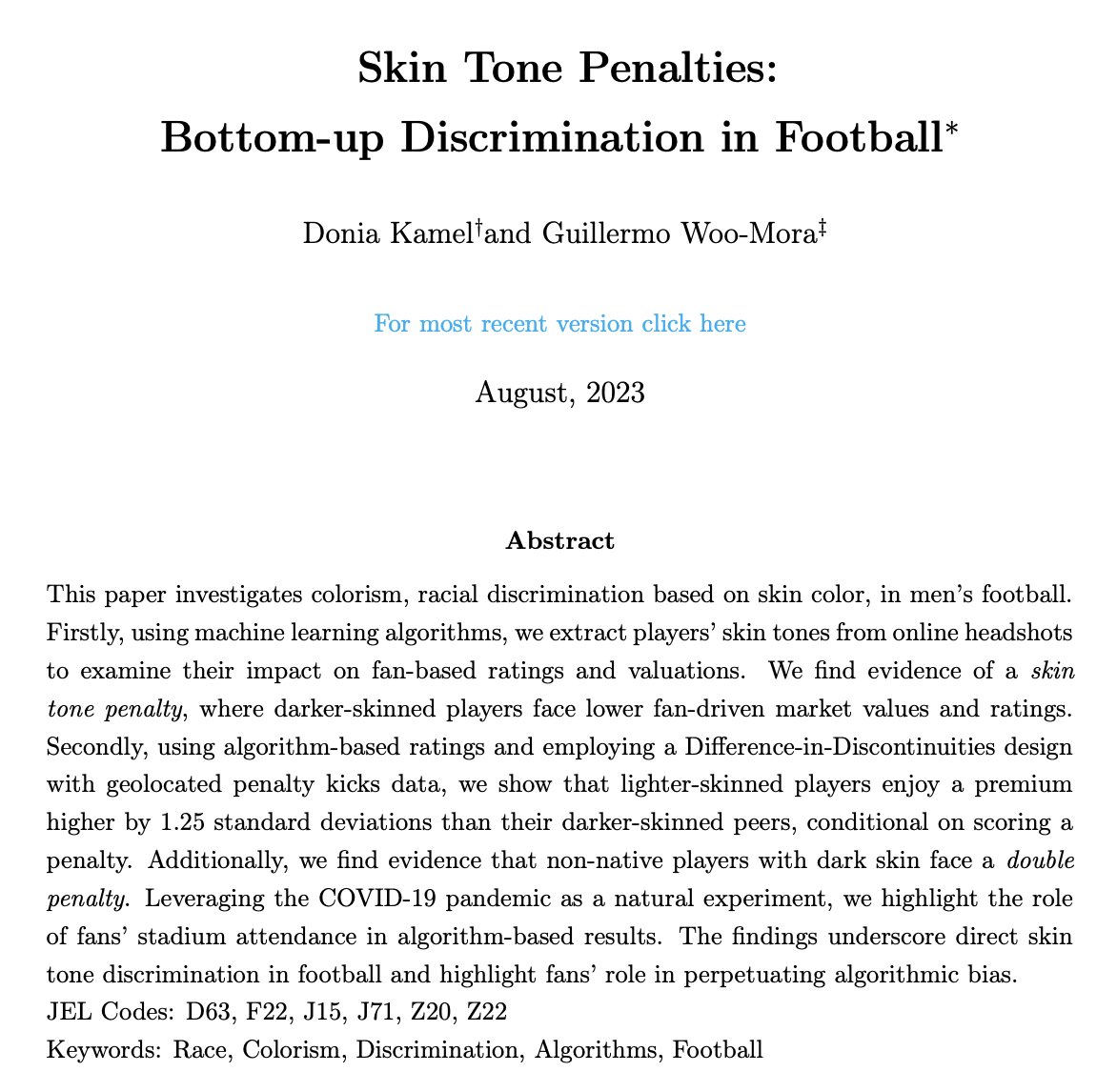
Excited to share a new WP with my good friend @billywoom, in time for this weekend's European football leagues kickoff ⚽️
“Skin Tone Penalties: Bottom-up Discrimination in Football”
Using football as a lab, we study colorism or skin tone discrimination.
Thread 🧵 #EconTwitter
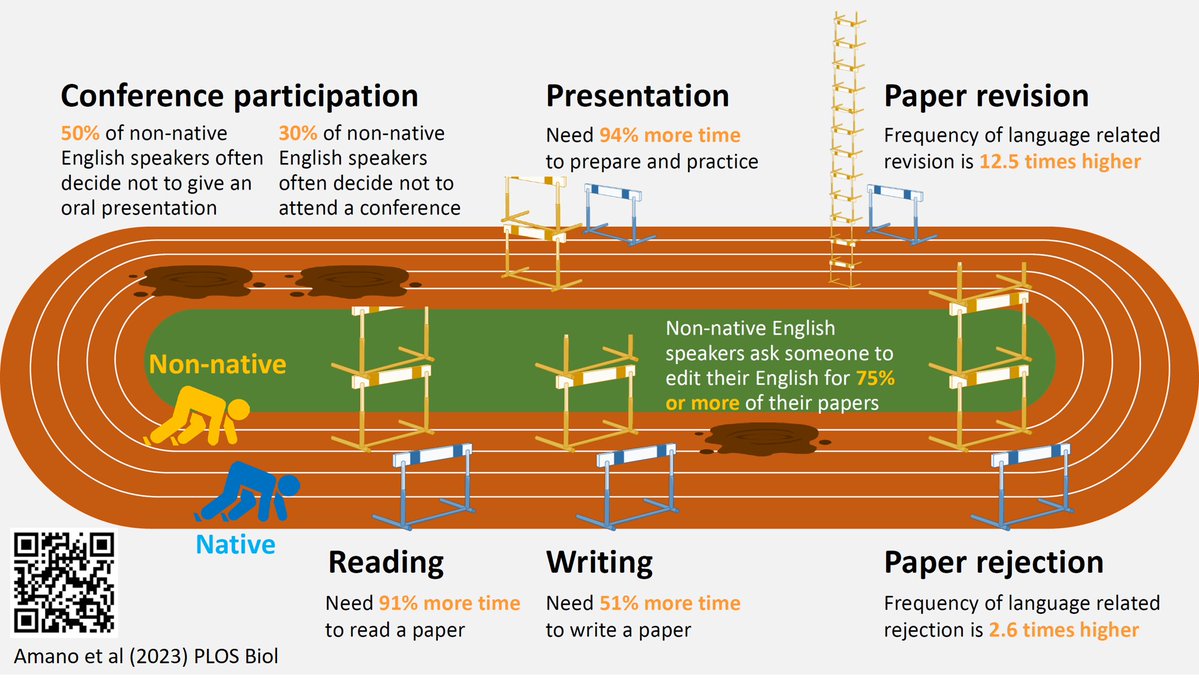
How hard is it to do science in a language that’s not your first language? We quantified the severity of #languagebarriers for non-native English speakers when reading/publishing papers and attending/presenting at international conferences.
https://t.co/Z6za22rMgg
1/9
@Nichogachet Y finalmente, la literatura sugiere lo que comentas, no hay evidencia del argumento capacidades - democracia/desarrollo. Lo interesante es ver como diferentes configuraciones evolucionan históricamente y producen diferentes resultados: https://t.co/cmVeuTmAyu
@Nichogachet 2. Un hecho irrefutable es que no hay casos exitosos de sociedades desarrolladas sin estado. Este paper se pregunta sobre el mecanismo causal, la respuesta es que el estado es una condición de supervivencia: https://t.co/sa0MsWDr3W
@jpjaramillo25 2. Todavía no hay concenso sobre el argumento estado-primero, luego democracia/desarrollo. 3. En LATAM el argumento de Tily de que guerra=capacidad estatal no se sostiene (por falta de guerras inter-estatales), es una idea pensada para el contexto europeo
Using historic variation as IVs has become a fad in economics. This is an interesting paper reviewing the development over time. The push for IVs coincided with the advent of Cliometrics – the quantitative approach to history. https://t.co/chzBFV28eY
What paths or sequences of democratization & state building are more likely to end in democracies with capable states? Is there only 1 viable path? What determines progress toward a high-capacity democracy?
This long🧵summarizes claims related to these question made in 6 books👇