Imagine Country A has cocoa and Country B has chocolate factories.
Country A sells cocoa to Country B and buys back chocolate. Everyone is happy.
But then Country A realizes it would make a lot more money by processing its cocoa itself, so it does.
Now Country B is furious, because overnight it has lost a source of raw material and a market.
So Country B finds a few people in Country A with grievances or hardline ideologies, gives them a few weapons, and says, "Go carry out your activities where Country A is building this factory."
Now Country A has a problem: its country is destabilized. So it goes to Country B to buy weapons.
Country B says, "Fine, we will sell you weapons, but you must agree to scrap that factory."
So Country A scraps its factory and resumes selling cocoa and importing chocolate.
Country A gets its weapons, Country B gets its raw material and market, and they live happily ever after.
This post has very little to do with chocolate. But now I need some chocolate. Which do you recommend, Cadbury or Nestlé?
The Rwandan Public Prosecutor’s Office is seeking a life sentence for opposition leader Victoire Ingabire, who is accused of conspiring against President Kagame from #Rwanda
UN experts have described her detention as arbitrary, and the European Parliament has denounced “serious irregularities” in the trial.
Whilst awaiting her sentencing, Ingabire is to receive an award in Spain. On 2 October, the day before her 58th birthday, the Reus Reading Centre will present her with the Josep i Liesel Vidal Memorial for Peace in recognition of her career as a non-violent political activist.
https://t.co/1uBy2odnBS
You can say what you want about Iran but they're definitely pretty unique in their communication: never seen a country threaten another with a math equation before 😅
For those who didn't get it: there is a famous monetary policy formula used by the Fed called the "Taylor rule" that says a central bank's policy rate (i) should equal the neutral real rate (r*) plus target inflation (π*), plus 1.5 times the inflation gap and 0.5 times the output gap (the "i = r* + π* + 1.5(π−π*) + 0.5(y−y*)" part of Ghalibaf's formula).
Ghalibaf adds α(SOH−SOH*) and β(BEM−BEM*): SOH referring to the Strait Of Hormuz and BEM to Bab El-Mandeb. Both have positive coefficient, meaning the more those chokepoints are choked, the higher the rate the Fed would have to set to fight the resulting inflation.
In a nutshell this is Ghalibaf trolling the Fed, telling them that Iran is - in a very real way - setting American monetary policy.
🕯️ Honoring the victims. Preserving memory. Rejecting instrumentalization.
In April 1994, Tutsis were killed because they were Tutsi — a genocide. Each Tutsi victim was a loss for all Rwandans. Memory must center victims, not political agendas.
Respect. Empathy. Dignity.
🕊️ 6 avril 2026 — 32 ans après l’attentat contre l’avion du Président Habyarimana.
Se souvenir, c’est aussi exiger la vérité, mettre fin à l’impunité et rejeter la culture de l’élimination politique.
Sans justice, pas de paix durable.
À l'occasion des commémorations des 32 ans du génocide survenu au Rwanda en 1994, voici ce que l'on vous a caché sur l'événement déclencheur du génocide: 2 chefs d’État africains en exercice ont été tués en premier. Qui s'oppose à la vérité ? Ce livre paraît le 7 avril prochain
FDLR : SORTIR DU PIÈGE NARRATIF
L’article de Christophe Rigaud sur @afrikarabia rappelle une réalité que presque tous les observateurs reconnaissent aujourd’hui : après plus de vingt ans d’opérations militaires, la « neutralisation » des FDLR reste un objectif insaisissable.
Mais si tout le monde admet désormais qu’il n’existe pas de solution militaire, pourquoi toute piste politique — faite de dialogue, de discussion et de compromis — reste-t-elle systématiquement écartée ?
Si la neutralisation des FDLR apparaît comme un objectif inatteignable, c’est pour une raison simple : les FDLR ne sont pas seulement un groupe armé. C’est un mouvement politico-militaire enraciné dans une réalité bien plus large, celle de centaines de milliers de réfugiés rwandais vivant depuis près de trente ans dans l’est de la RDC et dans la région, souvent sous la menace constante du régime rwandais et de ses relais.
On ne peut pas « neutraliser » militairement un phénomène lié à une population de réfugiés aussi importante. Kigali peut multiplier les annonces et les opérations de rapatriement forcé, mais ces retours ne représentent qu’une goutte d’eau. Le problème est politique et structurel.
Un autre problème tient au langage utilisé dans la plupart des analyses. Les FDLR sont presque systématiquement décrites comme un mouvement « génocidaire » ou porteur d’une « idéologie génocidaire ». Pourtant, très peu d’éléments précis sont avancés pour étayer ces affirmations. Qui peut aujourd’hui citer ne serait-ce que cinq dirigeants actuels des FDLR accusés de génocide par une juridiction internationale ou même par la justice rwandaise ? Même les deux figures les plus connues du mouvement — Gen. Victor Byiringiro et le commandant militaire Gen. Omega — n’ont jamais été inculpées pour génocide ni par la justice internationale ni même par la justice rwandaise.
De la même manière, si l’on affirme que les FDLR porteraient une idéologie génocidaire ou extrémiste, il serait utile de pouvoir citer des textes, communiqués ou déclarations officielles qui en témoignent clairement.
Christophe Rigaud est sans doute, comme beaucoup d’analystes, de bonne foi. Mais nombre d’analyses sur les FDLR restent prisonnières d’un cadre narratif largement façonné par Kigali. Cette grille de lecture, parfois inconsciemment reprise, empêche souvent de voir la réalité politique du problème.
Tant que cette dimension — celle des réfugiés rwandais et de leurs revendications politiques — restera ignorée, la question des FDLR continuera d’apparaître, comme le disent beaucoup d’analystes eux-mêmes, comme un casse-tête insoluble.
Dès lors, une question stratégique mérite d’être posée : et si rendre la question des FDLR — et plus largement celle des réfugiés rwandais — apparemment insoluble constituait précisément l’objectif poursuivi par Kigali ?
Réfléchir dans cette perspective permet peut-être de mieux comprendre certaines logiques régionales et certaines positions politiques qui, autrement, paraissent difficiles à expliquer.
Deux articles pour mieux saisir le sujet:
▪️https://t.co/wLlKZSiKpr
▪️https://t.co/ld2FYUfahE
🌸 Happy Women’s Day! 🌸
“Well-behaved women seldom make history.” Today, the world honors the courage, resilience, and unyielding spirit of women who challenge oppression and fight for freedom. From Rosa Parks, who refused to give up her seat, to Malala Yousafzai, who stood for girls’ education, to countless unnamed heroines, history remembers their bravery.
In Rwanda, this courage is embodied by women like @VictoireUmuhoza and other freedom fighters imprisoned for standing up for justice and human rights. Their unwavering commitment reminds us that true liberty demands courage.
Today, we celebrate all women who dare, speak, resist, and inspire. Your legacy lights the path for generations.
#WomensDay #Courage #FreedomFighters #Justice #Resilience
@AnnGarrison@JudiRever@michelawrong@HarianaVeras@louiseuwacu@rifdp@dzaneza@Nevesbabe@IEAmbUganda@FirstLadyRwanda@EgidieBibio@kayikwambaT@LydiaMutyebele@yngandu@Curious39031228
KAGAME’S NARRATIVE IS STUCK ON A BROKEN RECORD
Yesterday in Kigali, during the dinner held in honor of the diplomatic corps, President @PaulKagame once again deployed the full architecture of the Rwandan narrative regarding the war in eastern Congo.
On @Jambonewsnet, we have already analyzed this narrative in detail.
Nothing new was presented. The same storyline was repeated almost word for word.
The Rwandan leadership once again portrayed the FDLR as an existential threat to Rwanda, attempting to revive the emotional memory of the 1994 genocide. In that context, Kagame even mentioned Jean-Luc Habyarimana, presenting him as "the son of the former president who led Rwanda into genocide" — an attempt to symbolically link today’s political actors to the events of 1994.
This is not a serious analytical argument. It is a crude political manipulation — an attempt to instrumentalize the memory of the genocide and the suffering of Rwandan victims and survivors for purely political ends.
The objective is clear: to keep the genocide narrative permanently activated in order to justify Rwanda’s current military actions in the Democratic Republic of Congo — including territorial advances, support for the M23, and the exploitation of Congolese mineral resources.
In Kigali’s diplomatic messaging, the logic remains the same: if Rwanda is facing a “genocidal threat,” then any military action becomes legitimate — even operations conducted hundreds of kilometers inside Congolese territory.
But a diplomatic narrative only works if the key actors of the international system adopt it.
And this is precisely where the Rwandan strategy is now failing.
Since December 12, 2025, when U.S. Ambassador @michaelgwaltz addressed the United Nations Security Council, the United States has decided to move away from ambiguity and focus on the reality on the ground.
Washington’s position is now explicit: Rwanda is conducting a war of aggression in eastern Congo, using the M23 as a proxy force, while invoking the FDLR narrative as a political pretext.
The objective of this war is no longer seen as defensive. It is increasingly understood as a strategy linked to territorial influence and control of mineral resources in eastern DRC.
This shift also explains the growing impatience within the Trump administration.
In Washington, policymakers are not interested in historical storytelling. They focus on facts, strategic stability, and accountability.
When the Rwandan leadership continues repeating the same narrative framework despite mounting evidence and an evolving diplomatic consensus, it does not persuade anyone.
It simply wastes time.
In Washington, wasting time in the middle of a regional war that directly affects the security of critical mineral supply chains in an already tense global environment is not seen as diplomacy. It is seen as an attempt to evade responsibility.
At this stage, repeating the same narrative does not strengthen Rwanda’s position. It reinforces the perception that Kigali is refusing to engage with the reality of the conflict.
As we explained on Jambonews, the Rwandan diplomatic strategy is built on a carefully constructed narrative architecture.
And if we at Jambo can identify and dissect that architecture, you can be certain that American policymakers understand it perfectly as well. As civil society, it is also our responsibility to ensure that all actors and facilitators have the necessary clarity to address this crisis in the right way.
Discover below our analysis of the Rwandan diplomatic narrative of the conflict:
https://t.co/dOpznVCiRB
Remis en 2021 au président Macron dans une atmosphère de complaisance médiatique et ce malgré ses lacunes, ses biais et son militantisme à peine dissimulé, le rapport Duclert sur le Rwanda est aujourd’hui passé au crible de la critique scientifique. JAMBO https://t.co/GBOIHG8IfG
@Fidias0 José Maria Aznar was an eager proponent of the illegal war on Irak in 2003 and heavily pushed the weapons of mass destruction hoax as an explanation. He was a strong support for the US and the UK together with Berlusconi in Italy and Barroso in Portugal.
Minister @oNduhungirehe, this is misleading.
Rwanda voluntarily signed a Multi-Annual Indicative Programme with the European Union and receives substantial EU development funding.
That cooperation is governed by EU treaties and external action law, which make respect for human rights, the rule of law, and judicial independence essential principles of the partnership.
When European MPs raise concerns about political repression or lack of judicial independence in Rwanda, they are not claiming jurisdiction.
They are exercising legitimate political oversight over how EU taxpayers’ money is used.
Presenting this as “colonial arrogance” is populist propaganda, not law.
If Rwanda truly rejects scrutiny on human rights and independent justice, the logical step is simple:
stop accepting EU funds and formally end the partnership framework.
You cannot claim absolute sovereignty while benefiting from conditional international cooperation.
Accountability is not interference.
Sovereignty is not immunity.
Fyi: https://t.co/xPpJW07COK
CC: @hildevautmans@ThierryMARIANI@MounirSatouri@RimaHas@NachoSAmor@catarinacv @Rosa_Estaras @jcoetjen
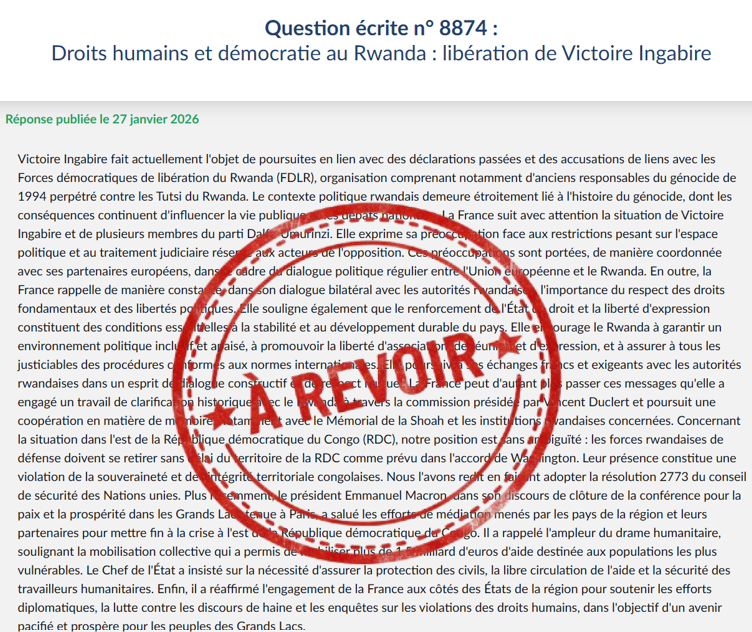
Monsieur le Ministre @jnbarrot,
Votre réponse officielle sur le cas de Victoire Ingabire Umuhoza est profondément problématique et appelle une révision nécessaire, au regard des faits.
Vous affirmez que Mme Ingabire fait l’objet de poursuites en raison de « déclarations passées et des accusations de liens avec les Forces démocratiques de libération du Rwanda (FDLR) ».
👉 Cette présentation est inexacte et trompeuse.
📌 Même la justice rwandaise, dont l’indépendance est largement contestée, a acquitté Mme Ingabire en 2013 des accusations les plus graves, notamment celles relatives à la création d’un groupe armé, faute de preuves suffisantes.
Ces charges ont donc été juridiquement rejetées, y compris en appel. Les présenter aujourd’hui comme un fondement valable est erroné.
📌 La réalité que votre réponse occulte :
– Mme Ingabire a été arrêtée le 19 juin 2025 sans mandat, après avoir comparu comme simple témoin devant la Haute Cour ;
– Elle est poursuivie pour des faits relevant de l’expression politique pacifique (lecture d’un ouvrage sur la résistance non violente, réunions pacifiques, opinions politiques) ;
– Les personnes liées à cette affaire sont détenues depuis 2021 sans jugement, une situation qualifiée d’arbitraire et contraire au droit international par le UN Working Group on Arbitrary Detention en 2024.
📌 Le contexte est clair et documenté :
– une opposante est emprisonnée pour ses idées,
– son parti est interdit,
– ses proches sont emprisonnés, portés disparus ou assassinés,
– et le Rwanda refuse toujours d’exécuter l’arrêt rendu en 2017 par la African Court on Human and Peoples’ Rights. Cette Cour a jugé que le Rwanda avait violé la liberté d’expression et le droit à un procès équitable de Mme Ingabire, et a ordonné la restauration de ses droits — une décision toujours ignorée par Kigali.
⚠️ L’invocation du génocide de 1994 dans des dossiers sans lien direct avec ces événements relève de pratiques régulièrement dénoncées, consistant à délégitimer toute critique politique en l’assimilant à une menace mémorielle ou sécuritaire.
La France, dans sa parole officielle, devrait se garder de reprendre des ressorts discursifs utilisés par les autorités rwandaises pour réduire au silence l’opposition, et éviter toute formulation pouvant laisser penser à une instrumentalisation, même indirecte, de la mémoire des victimes d’hier.
Le respect dû aux victimes impose une distinction rigoureuse entre le devoir de mémoire et la répression de l'opposition politique rwandaise d’aujourd’hui.
📌 Le @Europarl_FR , dans sa résolution du 10 septembre 2025, a été sans ambiguïté :
il demande la libération immédiate et inconditionnelle de Victoire Ingabire, l’abandon des poursuites politiquement motivées, et la mise en conformité du Rwanda avec ses obligations internationales.
🇫🇷La France ne peut se contenter de “préoccupations exprimées” lorsqu’une opposante pacifique est emprisonnée pour avoir exercé ses droits fondamentaux.
La démocratie exige des positions claires, non une diplomatie de l’évitement.
👉 Dans cet esprit, il est indispensable que la position officielle de la France soit revue et corrigée, afin de :
✔ refléter fidèlement les décisions judiciaires et internationales existantes,
✔ s’aligner explicitement sur la résolution du Parlement européen,
✔ et reconnaître clairement le caractère politique et arbitraire de l’arrestation de Mme Ingabire.
Le respect de la mémoire, de l’État de droit et des droits humains exige précision, cohérence et clarté.
C’est à cette exigence que la France est aujourd’hui attendue.
Lien:https://t.co/ks1J6atXD1
CC:
@AurelieRG@JeremieRobertCG@eblatmann@OlivierR_Bel@Aurelientache@chikirouparis@francediplo@ClementBoursin@VictoireUmuhoza