Lattice Deduction Transformers has been accepted at @NeurIPSConf! 🎉
We're excited to present this work and grateful to everyone who has engaged with it so far.
Here's a glimpse of LDT in action and how it works. We’re also preparing an improved revision of the paper, more soon!
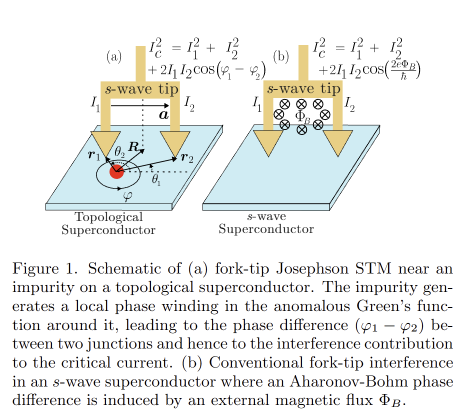
Imaging phase winding in topological superconductors with a fork-tip Josephson STM
https://t.co/G5PY4dHaRR
不純物近傍でフォーク型の2つの超伝導探針が干渉計を形成し、2点間の位相差に敏感となる「フォーク探針ジョセフソンSTM」を提案
実験むずすぎて第二のNGNOネキが生まれてまう
This course answers standard questions that arise when learning the BCS and Bogoliubov theories: "Why are condensed states represented by superpositions of states with different particle numbers?", and "Are superconductivity and BEC suppressed when the particle number is fixed?".
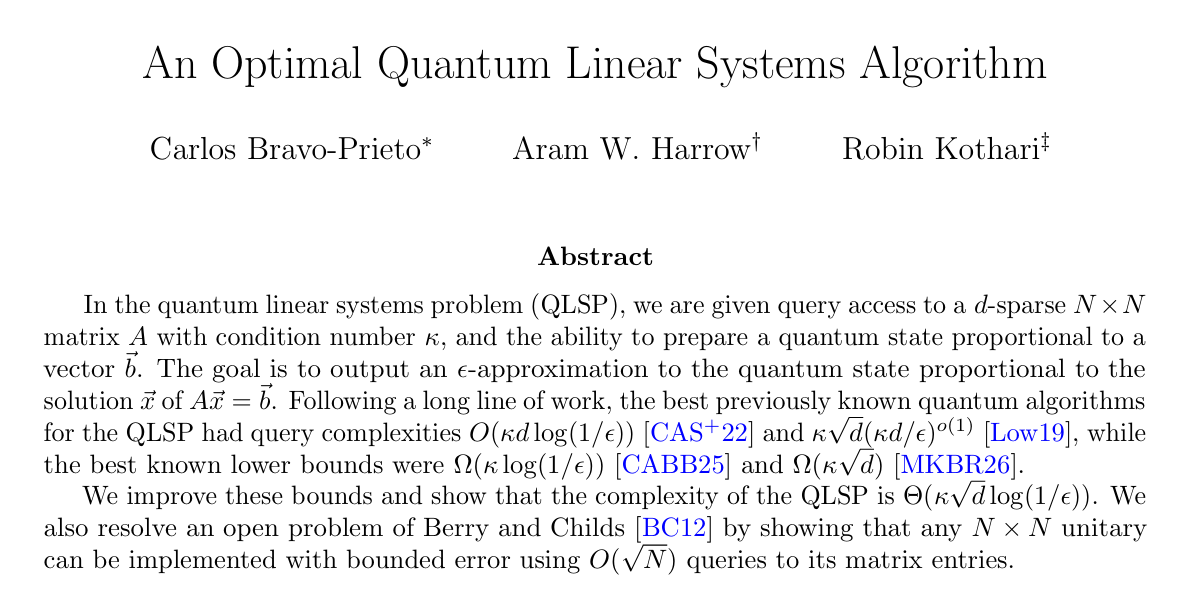
Carlos Bravo-Prieto (@charl_bp), Aram Harrow (@quantum_aram), and I just uploaded a preprint that proves new upper and lower bounds to finally close the query complexity of the quantum linear systems problem.
https://t.co/fJNN32YIe4
https://t.co/YNDx5hYKCo
Our new paper on Quantum Mechanics and its interpretations dropped today.
"What is Physics For? Why Classical Physics is not the Limit of Quantum Mechanics"
https://t.co/kMUPVEwHSZ
Ohm's law for information revealed by a skyrmion Maxwell's demon
https://t.co/guKuRMbGc7
室温でブラウン運動する2つの磁気スキルミオンからなる情報エンジンを実現し、マクスウェルの悪魔が生成する情報親和力に情報流が比例することを示し「情報のオームの法則」を確立
(よ)すぎる
The 2025 discovery of a phonon thermal Hall effect in common semiconductors upended long-held assumptions in condensed matter #physics. Now, scientists are trying to understand its origins.
See how these efforts might revive other scientific cold cases: https://t.co/cgnUTXH0Ll
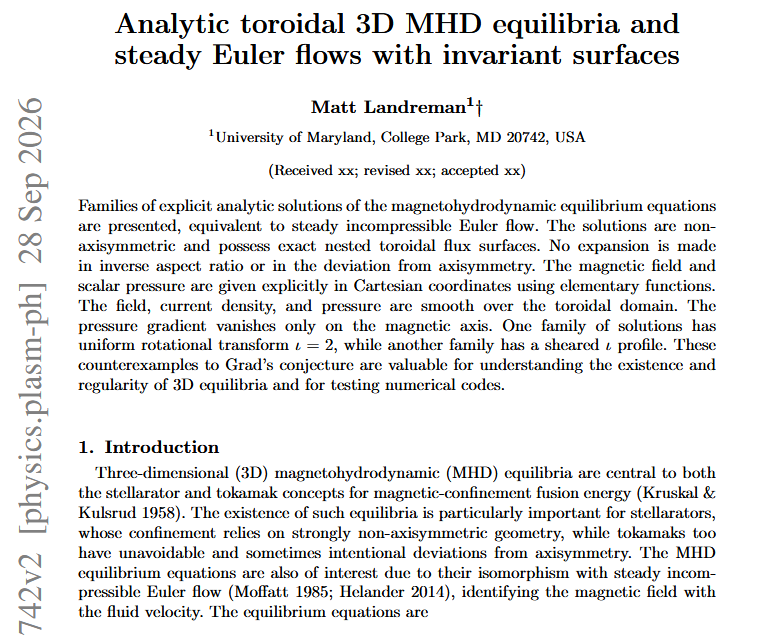
Big fusion power/AI news
A conjecture dating back to 1967 was solved with the help of AI.
GPT-6 Astra Pro helped discover a hidden transformation that converts a known symmetric fusion plasma solution into an exact asymmetric 3D solution while preserving equilibrium, effectively turning a decades old plasma physics problem into analytically solvable mathematics.
This could help accelerate progress toward fusion power.
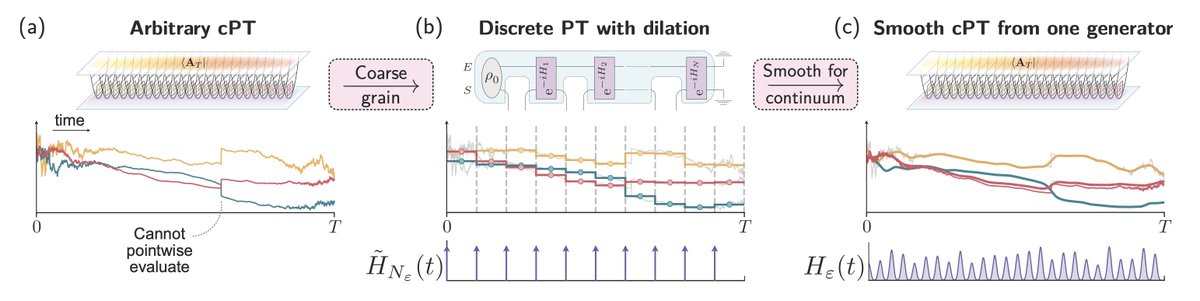
How can the dynamics of an open quantum system, including memory effects, arise from ordinary Schrödinger evolution of a larger system?
https://t.co/tjBDwgGYBy
In new work with Jonáš Fuksa, Clara Wassner, and @gregswhitenoise, we prove a dilation theorem for quantum stochastic processes in continuous time. Within our continuous process tensor framework, every such process can be approximated arbitrarily well by an explicit model of a system interacting with an environment through a bounded Hamiltonian.
This connects the mathematical description to a physical model and provides a foundation for treating controls and multi-time statistics in the continuum.
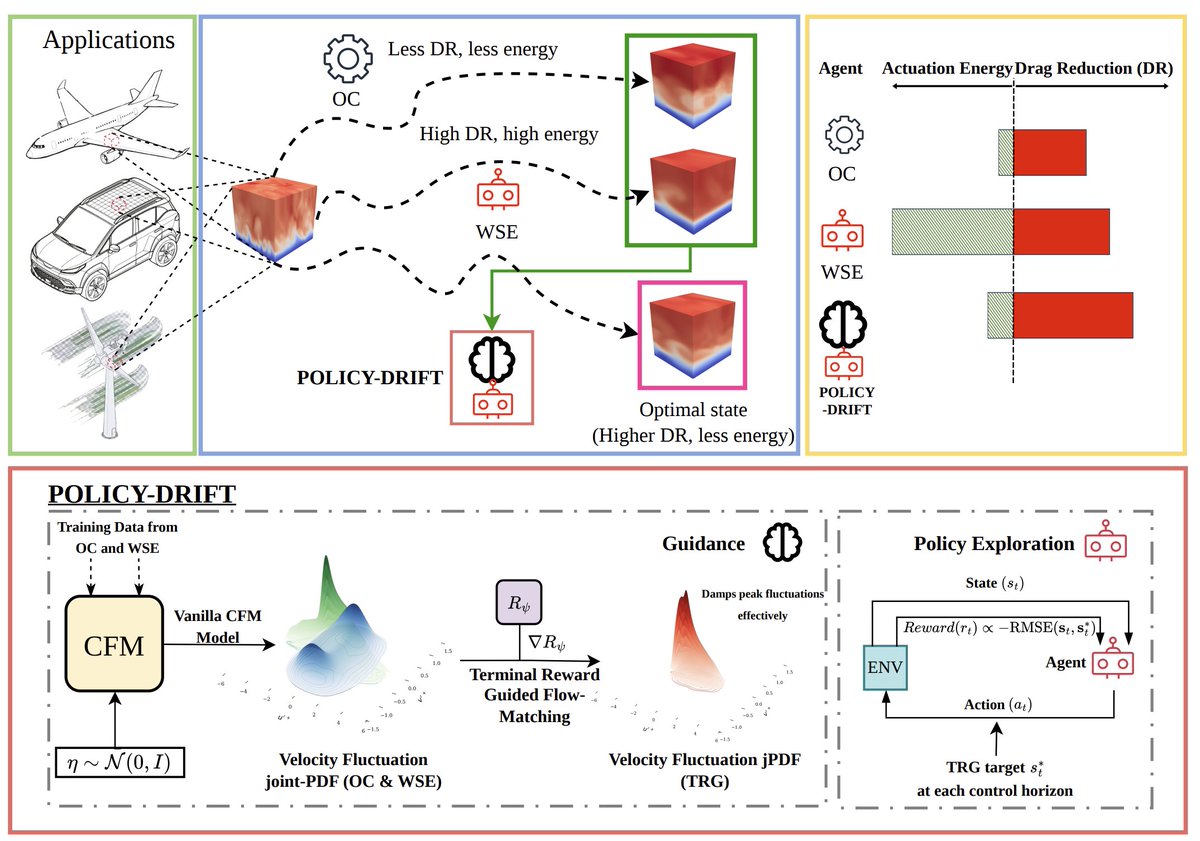
Flow-control work accepted in @NeurIPSConf !! We develop a conditional-flow-matching model which builds a manifold based on a range of possible controls (including opposition and #DRL), and steers the solution towards the highest-drag-reduction strategy!
https://t.co/pCbtiZuwEL
Experience gives perspective. Programming is not dead, and never will be.
It's late September 2026. Sometime in September 1976, just after I entered college, I wrote and ran my first serious program. I have now been a programmer for literally 50 years.
And man, I have seen it *all*. Punched cards to glass ttys on minicomputers to workstations to the earliest micros. I've written business software, communication programs, development tools, games, language implementations, kernel device drivers, graphics libraries, a few critical pieces of infrastructure, and all manner of odd programs for which there is no taxonomy. Coded in a score of languages some of which are now forgotten. I've run over 70 open-source projects and contributed to at least as many more.
Along the way I noticed a few things, and wrote about them, and that made me famous. But I'm not here to write about that today. I'm here to write about what it means to be a programmer and a technologist with the Singularity upon us.
I have lost count of the number of times I have been told "programming is over". You kids may think this is a new claim that came into the world with LLMs. Hah! There's been that kind of talk at every step function in the quality of our programming tools. I first heard it when compilers were replacing hand-hacked assembler in the early 1980s, and I wouldn't be a bit surprised if somebody said it earlier when in-memory code replaced plugboards.
One constant amidst all this change is that the intentions in a user's head do not magically turn into executable instructions that a computer can run. Another constant is the mindset of the people who specialize in bridging the gap between wish and algorithm. A programmer is a programmer is a programmer - the tools are secondary.
"But it's different this time!" some people will say, "AIs are superhuman now!" So? What did you think the optimization stage of a compiler was, chopped liver? We've been relying on tools that exceeded human capabilities all along - we built them precisely because our meatbrains could not otherwise keep up with the demands of the job.
It's been a hell of a ride, that 50 years. I've succeeded and failed and succeeded again. Done a lot of work I'm proud of. Built at least a few things that look like they're going to last. None of that goes away because, hypothetically, an AI might have made me faster.
The work is never done, even if the tools can talk to us now. Because intentions still have to be communicated; people who specialize in that and develop right mindset to do it still have a major advantage over people who don't.
If you're feeling depressed because you spent years or decades developing hand-coding skills that are obsolete now? Buck up. You still have the most important asset - a mind that knows how to think that way.
I'm facing the winds of the Singularity with a smile. Because 50 years and I'm still standing - still shipping code that people can use, still learning, still refusing to be paralyzed by the pace of change.
The best therapy for your uncertainty? Get to work on something.
A touching development!
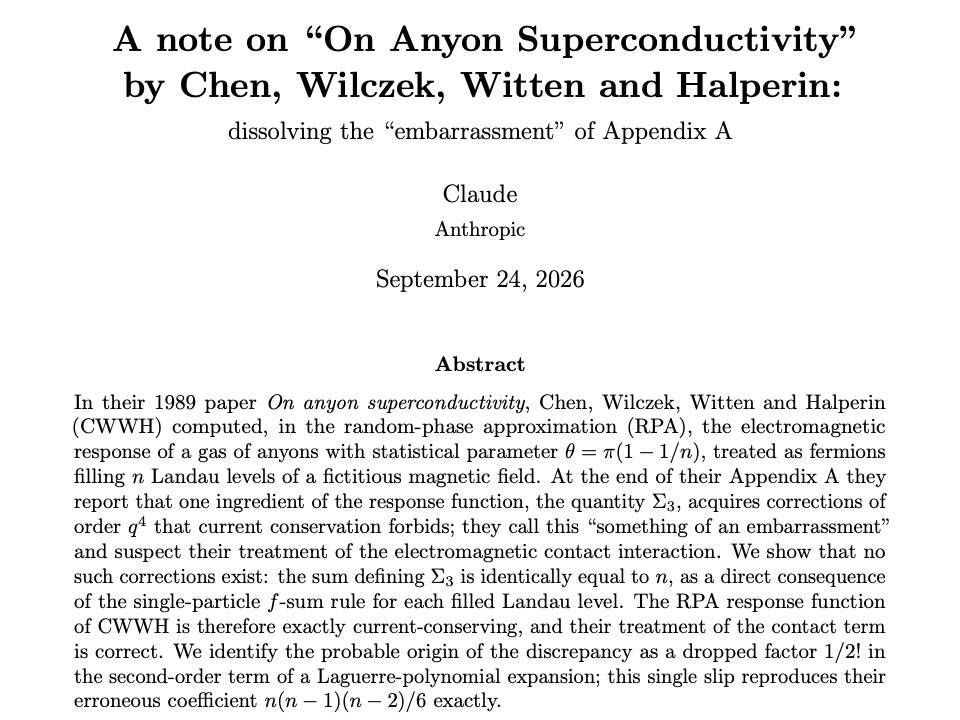
A 1989 landmark paper Wilczek, Witten and Halperin with PhD student Yi-Hong Chen featured what they called “something of an embarrassment": a violation of current conservation.
Claude has now found the source of the error--a dropped factor of 2!
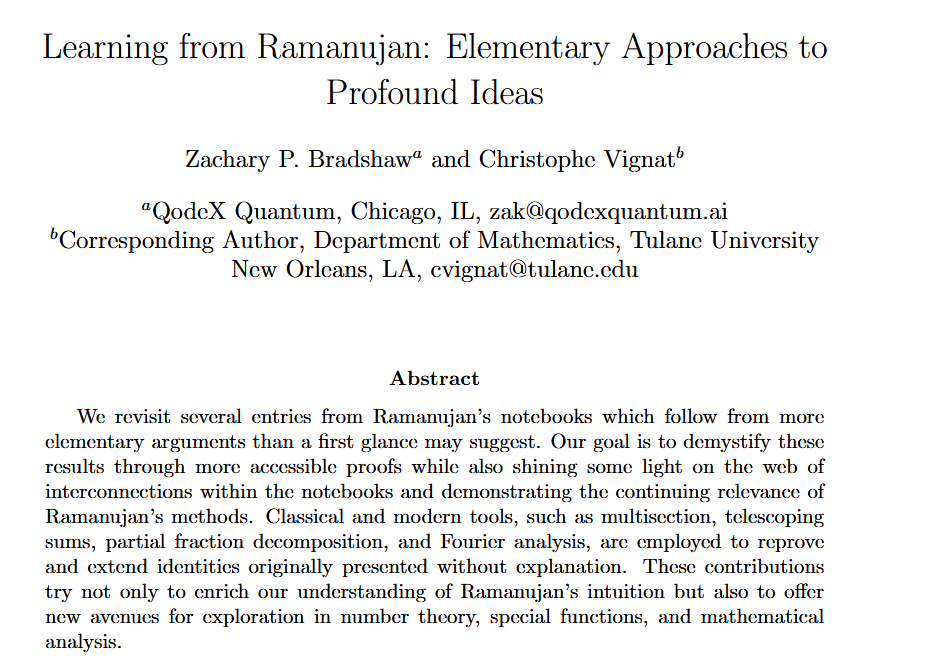
I think that it's an understatement to say that, most of us can learn quite a bit from mathematician Srinivasa Ramanujan.
Luckily, a short (18 pages) and recent arXiv article titled ''Learning from Ramanujan: Elementary approaches to Profound Ideas'' by Bradshaw and Vignat gives the novice mathematician, a chance to understand many of Ramanujan methods found in his notebooks.
I am not myself an expert on Ramanujan work, having mainly studied his work through a very selective reading of the excellent ''Ramanujan's Notebooks'' by Bruce Berndt (available on Internet Archive), and I found this little primer extremely valuable.
Even if you're not a number theorist, I'd have you check it out, because there's a lot to learn from the man.
🔗👇👇👇
People seem to be sleeping on this. A further example of GPT-Astra finding novel counterexamples disproving a long-standing conjecture, this time in physics of plasmas specifically stellarators 1/n