Today we're launching app builder for Grok. It lets you build fully functional apps and publish them instantly, on a unique domain, all from within Grok. Available now on https://t.co/01Y4BOVWIn.
Just today I've already seen Wispr Flow, Granola and WHOOP all "reverse engineered" and open sourced with a fully free version
Very interesting to see what's happening
The question is if normies will pick up on this (I think they will) and how companies will react and pivot to still make money
I failed for years: ~14 projects.
And then I tried B2C iOS apps.
I'll hit $10k/m in a few weeks.
I think it's the easiest way to win.
Because the "moat" is the easiest to build.
These are the moats I see:
1. The moat of complexity.
Think Postiz or Revolut. APIs that take weeks to get approved. Or complex industries, like banking need capital or regulatory approval.
You simply can't vibe code these in a weekend. Complex B2B products will survive, because there's too much effort involved in making it.
Can be very hard difficulty I think. You have to put in the grind on the product. And there's still an element of luck involved: for example, there's a lot of PostBridge clones that went nowhere. I tried this and failed!
2. The moat of personality.
Big developers will always be able to sell by virtue of their following. This is true in any domain. Verified MRR existed before Marc, but no one trusted an anon dev with their stripe. It's a really good idea, but it succeeded in part because Marc is so trusted.
This is a very tricky moat to build, as it relies on growing a following. I believe there are clear patterns for social medi growth, but that's a post for another day.
3. The moat of a network.
Think NomadTable or IG. People use these apps because of their network. Anyone can vibe code them in a day. But people still use the app because of their huge network.
This is potentially the hardest moat. Involving either a lot of luck, massive amount of work or a big network from previous experience.
4. The moat of mass distribution (B2C).
Most mobile apps are very technically incredibly simple. The effort instead is 90% marketing. If you have a tiny bit of taste it's easy to stand out massively.
Here, we're not selling to businesses. We're selling to the masses, the normies who doesn't even use ChatGPT!
In my view this is the easiest moat, because it's the one with the least amount of luck involved.
Marketing is not yet a science, but there are a lot of proven patterns for success: AI UGC, paid tikslop/apple ads.
This is just my anecdotal experience! n=1.
I may have gotten lucky: I'm building a new app to do it all again, so we will see if it's a science.
you can run Grok 4.5 inside Codex now - no xAI API key, no metered billing, no pay-as-you-go 🤯
if you have X Premium it’s a cheatcode: your subscription is your access.
the mechanism: opencodex is a tiny local proxy that translates Codex’s Responses API into whatever your model speaks. You OAuth into xAI with your X account and it routes Grok straight through Codex.
the subscription you already pay for becomes the credential.
how to set up (3 min):
1. install bun, then: npm install -g @bitkyc08/opencodex
2. ocx login xai - sign in with your X account, OAuth handles the rest
3. ocx init to inject into Codex, then ocx start
4. run it: codex -m “xai/grok-4.5” “your prompt”
that’s the full setup.
and the timing’s perfect: Grok 4.5 just got a lot better.
There's panic right now that AI is eating indie software. I see it differently.
For 10+ years you could spin up a few hundred auto-generated pages, rank them, and let Google send you signups for free.
Now the answer people used to click your site for sits right inside ChatGPT and Google's AI overviews.
If your whole business ran on that one faucet, the water's turning off, and it feels like the end of the world.
And I've built a few of these projects, so I feel that darkness too.
But let's look at the data. Has it really gotten dark/worse for software founders and indie devs??
Let's look a Stripe Data...
New companies on Stripe Atlas are up 130% year over year. Companies are hitting $10M ARR within three months of launch at double last year's rate. One in five charges its first customer inside the first month, up from 8% in 2020. Fastest business formation anyone's ever recorded!!
And the solopreneurs, the exact people saying they're getting crushed, are winning the most.
63% of new companies on Atlas are solo founded, and AI native solo startups pull 2.3x the revenue by month 24. This category was basically non existent at the scale we're seeing rn like 5 years ago.
TLDR;
So my thinking it's a channel shift wearing a collapse costume. The people hurting share one setup: they sell inexpensive tools to other indie hackers, and/or their traffic comes from SEO.
That's the most exposed spot in the whole market, because your customers can rebuild your $20 SaaS in a weekend, and your traffic source is the exact thing the models replaced. Kinda feels like 2 cannons pointed at one little boat.
Call me an optimist, but here's my take....
Building software is a bigger game than it's ever been.
More companies, forming faster, making money sooner, run by fewer people, than any point in history.
If you got scared of the selloff this month. Nothing fundamental is broken, Korea will be fine. This is a must watch interview with Gavin Baker explaining the thesis for how compute constrained were and how much more we need. We're still so early. He's giving free game!! Bookmark
I think good chance he's right
Economically this makes sense
Barrier to entry for most bootstrapped indie businesses has been wiped out, anyone non-technical can build the same now for a $9/mo subscription, only thing they have remaining is distribution if they have an audience or distribution if they have specific skills to get users free or cheaply (like being rly good at posting on TikTok for ex)
VC funded companies have the benefit of capital, they raise $50M and can now buy ads to get millions of users (paid distribution) and tokens to develop lots of products/features/etc (outshipping indies) and ofc hiring engineers still
Both pay the BigAI companies for tokens to ship, who in turn win by making money on tokens (that is until open Chinese models blow them out of the water, in that case whoever hosts the models wins)
So yes I think he's right
Time to fly to SF raise money, my indies???
The “indie hacker” product type is dying and the reason are coding agents
The products you are building sit right in a spot that is not winnable anymore:
Your product is not valuable enough that Claude + MCP cannot replace it and you do not have the capacity to create a huge, vertically or horizontally integrated product scope that would drive value and retain people
On the other hand, everyone can now vibe code an 80% version of your product themselves
The only two remaining categories are the foundation model labs themselves entering the application layer and VC funded startups because they have the money to hire teams that can out engineer the vibe coders (for some time)
This is also only true for the years in which applications matter at all, afterwards everything will go to voice input into a model wrapper directly and then from there to agents which can do everything, so applications will then become fully irrelevant
I'm seeing a trend here of declining revenue and traffic with indiehackers
On my own projects too
Maybe big VC products too but I wouldn't know cause they don't share revenue
To me it seems clear BigAI is cannibalizing everything that used to be apps
Not bad btw, just times are changing and we have to adapt
I cancelled and then vibecoded 100% of my SaaS subscriptions
I only pay for domains, server hosting and storage and AI APIs
So the irony of being replaced myself after I replaced everything I pay for is not lost on me
I am happy I invested most of the money I made in the last 10+ years though so I have no worries financially
But obviously preferrably I keep make more money with my projects but for that we will have to adapt or make entirely new type of projects
Times of change are fun for me though, if there's no challenges life gets boring fast!
We need more power.
Data center power demand in the US is projected to surge +253% from 2026 levels, to a record 194 gigawatts by 2035.
One gigawatt is roughly equivalent to the capacity of a single traditional nuclear reactor.
As a result, data centers are expected to account for ~20% of US electricity consumption by 2035, up from ~6% today.
To put this into perspective, data centers are estimated to consume ~12% of US electricity by 2030.
Much of this growth is concentrated in a handful of grid regions, such as PJM, which serves the District of Columbia and 13 states, including Virginia, Pennsylvania, and Ohio.
Electricity is the next AI bottleneck.
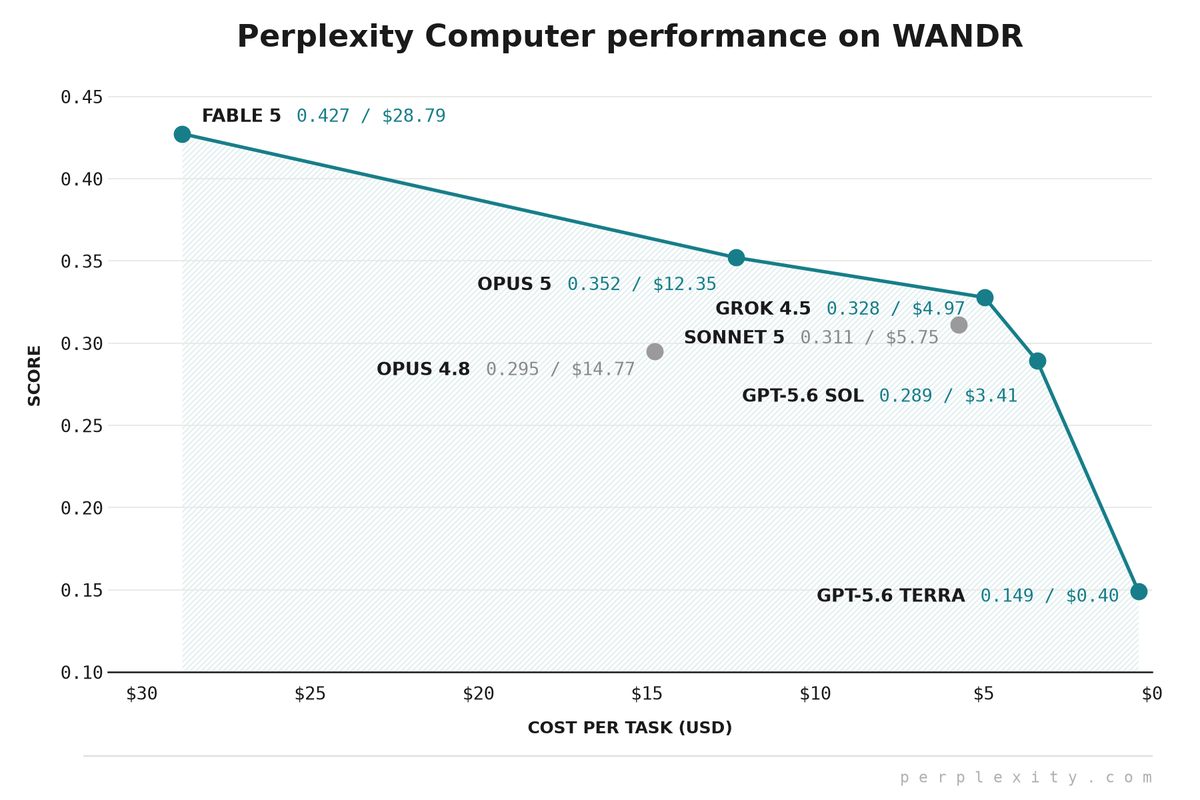
Claude Opus 5 is now available in Perplexity and Perplexity Computer.
We evaluated it against six other models on WANDR. It outperformed all but Fable 5, while being 57% cheaper.
I was in the plane this week
A guy next to me was eating a bag of Haribo candy, it was so good, just destroying this bag, I wanted this candy too
Then he ordered 2 cola and downed them
Then he ravaged a ham cheese croissant
Then another cola
Then he downed a whole can of Pringles
He went through 2000+ calories in less than an hour
I was jealous of all the good tasting processed trash he was eating, seducing me, but then I also realized he looks like he was 12 months pregnant and fat and would probably have a heart attack in 5 years
Then it was easier for me to accept that no I shouldn't eat that stuff and I ate my steak
Thank you anonymous fat man
Gavin Baker: "my model is we're in 1996 - a group of stocks compounded at 40% per year for a decade - Oracle, Cisco, Microsoft, Dell - we're entering year three of AI"
this is him explaining why AI is not ending anytime in the next 5 to 10 years, why deregulation alone could push America to 5% real GDP growth, and what the US government made SpaceX do to baby seals
"$40 billion budgeted for EV chargers - in four years they built seven chargers - seven"
"$30 billion to connect low-income rural areas to broadband - they connected a dozen homes - and they wouldn't let SpaceX be part of it"
"the US government made SpaceX kidnap baby seals, put headphones on them, and hire a baby seal psychiatrist to watch if they were emotionally distressed during a simulated rocket launch
multiply that by 10,000 and you see how regulations have been slowing us down"
bookmark & watch the full conversation ↓
Ron Baron: "SpaceX is going to be a $20 to $30 trillion company - when people hear that number they say it sounds like you're on drugs - I don't do drugs, I don't drink"
this is him explaining how he turned a $2 billion SpaceX investment into $25 billion across 27 separate transactions, why he just bought another billion on the IPO, and why he thinks he'll make 20 to 30 times from here
"I came to New York in 1969 in debt $15,000 - my credit wasn't good enough to get a telephone"
"$100,000 book value in 1982 - that's now $6 billion"
"we made $40 billion in profits before Elon and $30 billion more with Elon - I think we're going to make hundreds of billions from here"
bookmark & watch the full conversation ↓