Bringing together experts from policy, public, private sectors, academia to address ethical issues in AI collaboratively. Part of @EthicsinAI and @uniofoxford
How to SOLVE the AI puzzles of today?🧩
We start by tilling the #DataSoil🌱, tending our gardens of #CivicAI care & making democracy fast, fair & fun again.
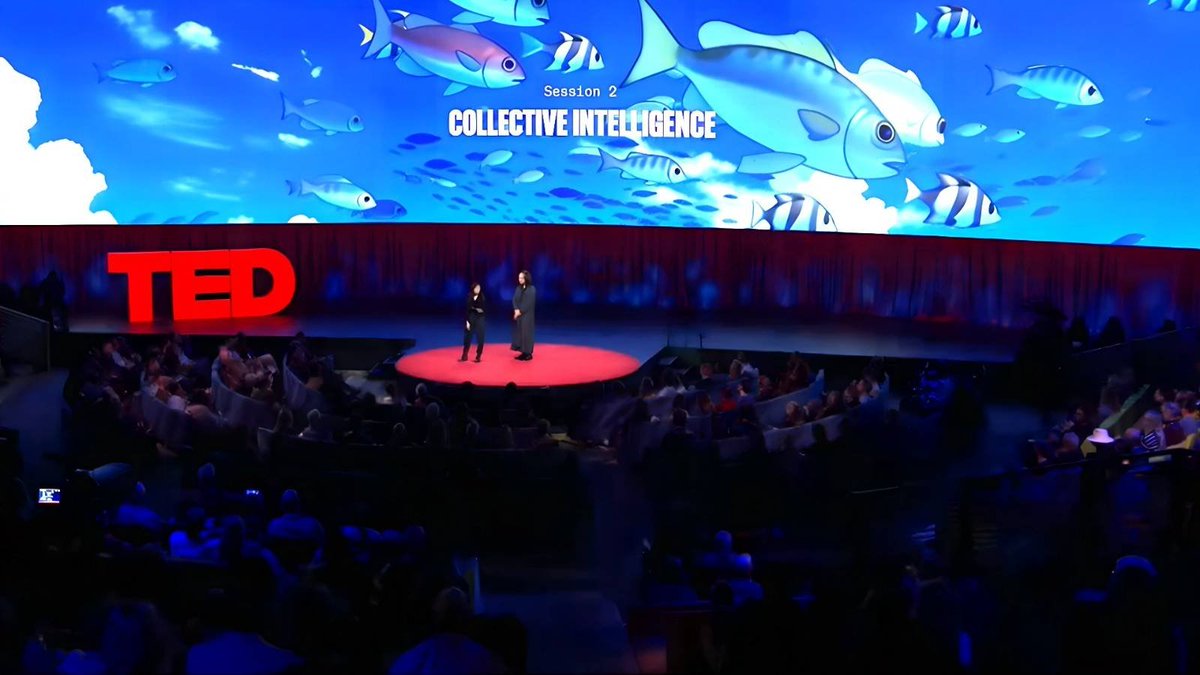
Watch my SOLVE at MIT 2026: Keynote Speech & Fireside Conversation with Hala Hanna!🙏
▶️https://t.co/qKsubE8A6g
#LLAP🖖
Safe & sustainable AI doesn’t lie beyond the stars.🌌
It’s on Earth. It’s in us. It’s our relationships of care.🫂
Software freedom holds the key to Kami-cultivated #CivicAI & a future of ⿻Plurality.
Take my @UniofOxford FLOSS lecture.🙏
▶️https://t.co/W1ruLPnBNU
#LLAP🖖
We won’t let the prophecies get us down!
Let’s fill up on hope, ideas, innovation & inspiration at #SXSWLondon.🙌
Join me & Caroline Green for our Reimagining AI Alignment for Humans Fireside Chat.🙏
▶️https://t.co/RDe6FcKzZZ
#ScrollLess, #SleepMore & #GoGreyscale.💯
#LLAP🖖
The CBWT Diaries | Part 7: Rio de Janeiro 🇧🇷
🗓️ November 28, 2025
📍 Rio de Janeiro & Manaus, Brazil
🙏🏿 Made possible by a vibrant coalition of Brazilian partners
When we first embarked on the Coded Bias journey, we had big dreams for where we'd go. But we never envisioned screening the documentary on a boat floating down the Amazon River. 🛶🌿
Our Brazil stop was a journey of incredible contrasts. We started deep in the Amazon in Manaus, partnering with WEF Young Global Leaders for an intercultural learning journey led by Luana Génot. There, floating on the river, we grounded our work by learning directly from Indigenous leaders and local entrepreneurs.
From the Amazon, we made our way to Rio de Janeiro to screen the film in Brazilian Portuguese. The energy was electric and driven by immediate stakes. Policymakers in Brazil are debating the use of facial recognition technologies in public spaces, including football stadiums. To meet this moment, we held a post-film Q&A featuring Brazilian activist and computer scientist Nina da Hora alongside Dr. Joy Buolamwini (@jovialjoy). Together they explored:
❓What are the AI risks and opportunities in Brazil?
❓Who truly benefits from the collection and use of biometric data in AI systems?
❓How might "data nutrition labels" change the way we interact with AI tools?
❓...and what actually is a Poet of Code?
This stop took a village: The Núcleo Rio de Janeiro RBAC, Secretaria Municipal de Ciência, Tecnologia e Inovação do Rio de Janeiro, Instituto da Hora, Cátedra Fredric Litto - UFRJ, Tatiana Roque, Carla Rênes, Ana Carolina da Hora, Semaj Warren Moore, and Veronica Vieira from Diaspora Black.
From a boat on the Amazon to national news, we held #CriticalAIConversations pushing to protect our public spaces and ensure technology serves the people.
🔗 Explore the full Rio stop here: https://t.co/Gq28B8EBRd
Next week: the grand finale in Boston! 🇺🇸
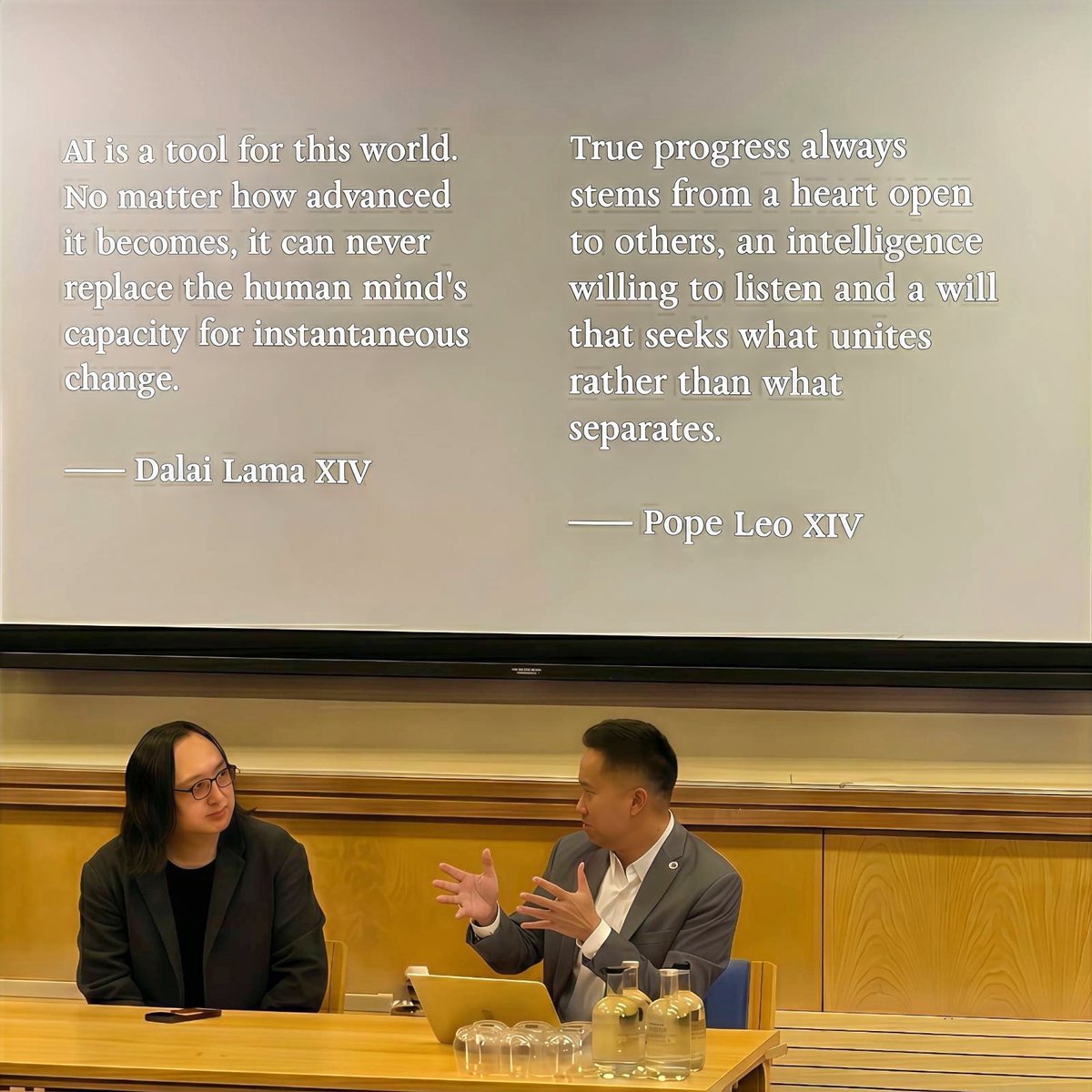
.@DalaiLama’s & @Pontifex’s words of wisdom carry wonderful weight in the Age of AI.💯
They inspire us to listen broadly & tend our #CivicAI garden with ⿻Plurality & 6⃣Pack of Care principles.
Dig deeper via my topical talk at @OSGAOxford.🙏
▶️https://t.co/u8Cku9zXZP
#LLAP🖖
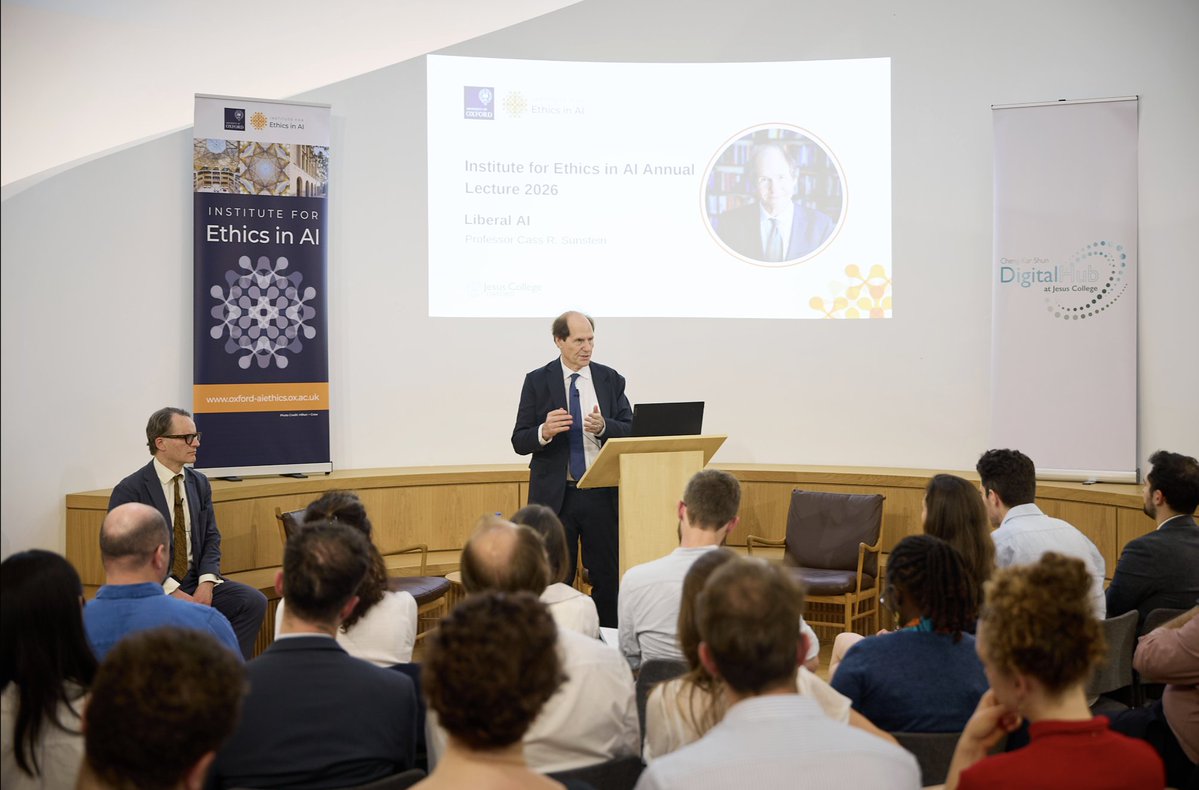
Many thanks again to @jackclarkSF for delivering the second annual Cosmos HAI Lab Lecture on Wednesday. And thanks to @Brendan_McCord for an excellent fireside chat. A great start to bringing this series to the brand-new Schwarzman Centre at @UniofOxford. @EthicsInAI@OxHumanities
Excited for year 3 of our HAI Lab grad seminar, co-taught by a philosopher and an entrepreneur. Our theme this year will be dimensions of human autonomy in the age of AI agents. Speakers incl Jack Clark (Anthropic) and Thomas Wolf (Hugging Face). People outside Oxford may apply! 🧵
📢 Applications are now open for the HAI Lab ‘Philosophy, AI, and Innovation Grad Seminar: Autonomy in the Age of Agents’.
The in-person seminar, co-taught by Professor Philipp Koralus (@PhilippKoralus) and Brendan McCord (@Brendan_McCord), explores issues at the intersection of philosophy, AI, and technological innovation, with visiting speakers from philosophy and the technology industry, including:
• Jack Clark (@jackclarkSF) (co-founder of @AnthropicAI)
• Joe Edelman (@edelwax) (Meaning Alignment Institute @meaningaligned)
• Herman Cappelen [joint work with John Hawthorne] (HKU)
• Simon Cullen (@DrSimonCullen) (UNC Chapel Hill @UNCchapelkill)
• Thomas Wolf (@Thom_Wolf) (co-founder of Hugging Face @huggingface)
Registration is essential. To ensure continuity of discussion, participants are expected to commit to attending for the full term.
📅 Dates: 28 April to 16 June
🕒Time: 4-6pm
🔔Deadline: 24 April Midday
📌Venue: St Catherine’s College, Oxford
🔗More information and application: https://t.co/HiJYUoy4hm
We are delighted to welcome Mat Dryhurst (@matdryhurst) as a Fellow of our Accelerator Fellowship Programme (@EthicsinAI_AFP).
An artist working across technology and digital systems, exploring new forms of creative practice.
🔗Learn more:
https://t.co/jWSa8LB3Yr
We are delighted to welcome Lucy Hall (@lucyhall03) as a Fellow of our Accelerator Fellowship Programme (@EthicsinAI_AFP).
A researcher at Save the Children UK, she focuses on how humanitarian systems adapt to global challenges.
🔗Learn more:
https://t.co/s1AS54pVJU
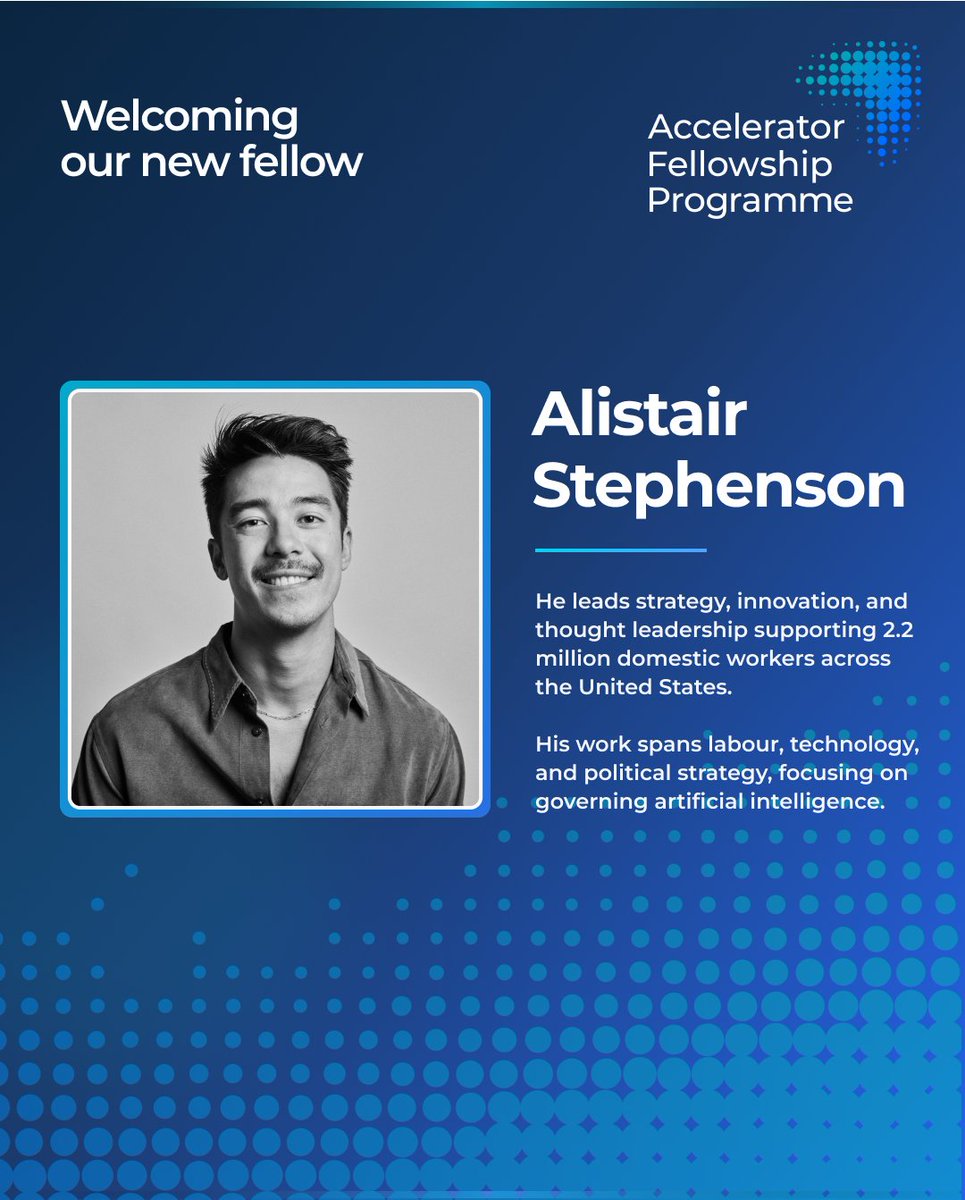
We are delighted to welcome Alistair Stephenson (@alistairws) as a Fellow of our Accelerator Fellowship Programme (@EthicsinAI_AFP).
Chief Strategy and Impact Officer at NDWA, he leads work supporting domestic workers across the US.
🔗Learn more:
https://t.co/Mj3dcAP9Ht
We are delighted to welcome Kit Green (@kit_green) as a Fellow of our Accelerator Fellowship Programme (@EthicsinAI_AFP).
An artist working across theatre, music and performance, she will explore the ethics of AI in therapy and elder care.
🔗Learn more:
https://t.co/LdheUv0g7L
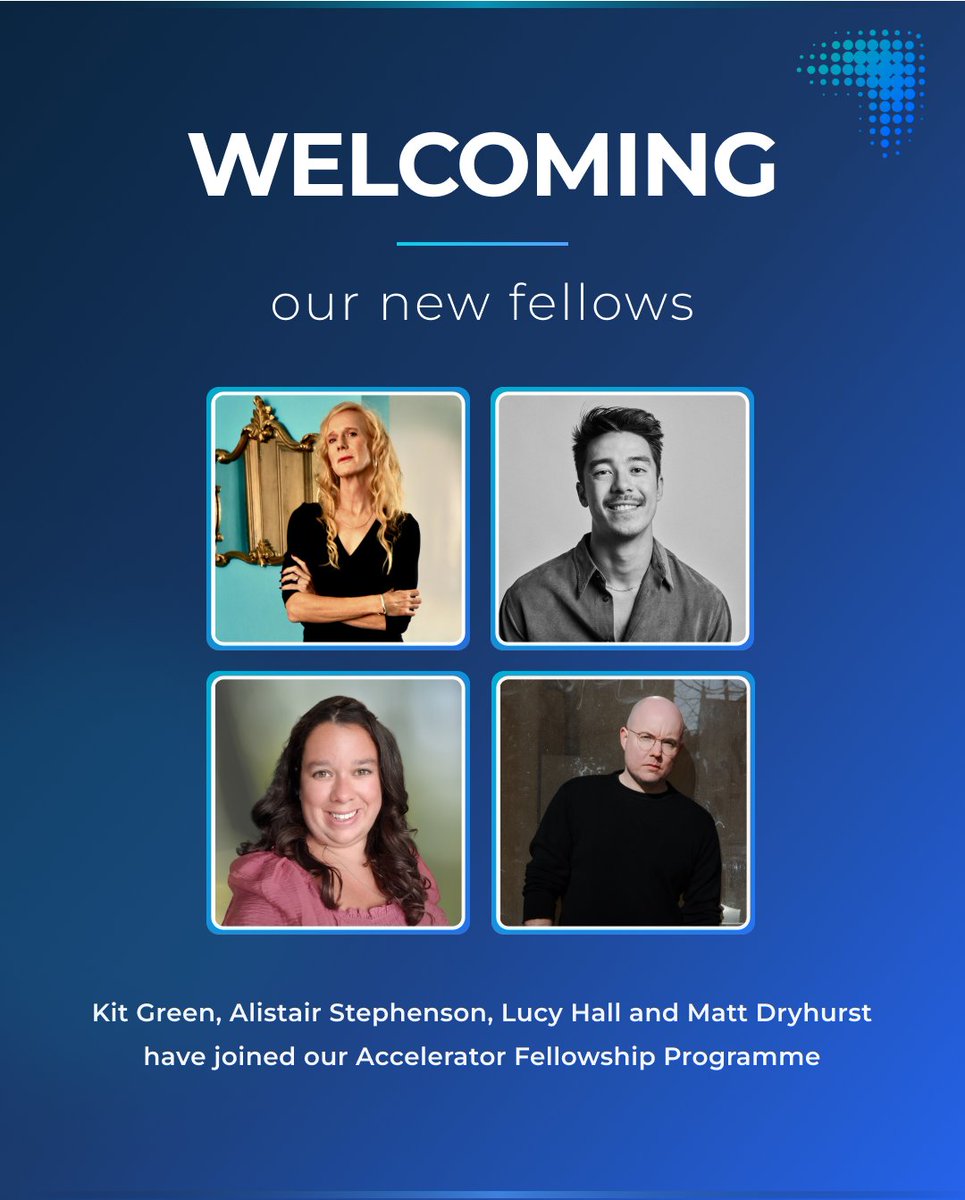
🎉We are delighted to welcome four new Fellows to our Accelerator Fellowship Programme (@EthicsinAI_AFP).
Kit Green (@kit_green), Alistair Stephenson (@alistairws), Lucy Hall (@lucyhall03) and Mat Dryhurst (@matdryhurst) bring a wealth of expertise spanning the arts, humanitarian systems, labour and technology. We look forward to supporting their work as part of the Programme.
🔗Learn more about our Fellows:
https://t.co/Hniz07XzVQ
As part of the @EthicsinAI_AFP at the @EthicsInAI, Ushahidi is convening a workshop at the @UniofOxford on ethical licensing for community-generated data in the age of AI. We'd love to have you in the room.
Register here: https://t.co/1IMb9RNAS4
🔊 We are pleased to announce a new collaboration between the Institute for @EthicsInAI at @UniofOxford through its Accelerator Fellowship Programme @EthicsinAI_AFP and @famtech_org
This partnership brings together academic research and technology innovation to support the responsible development of AI in caregiving, ensuring that caregivers, families and those receiving care are actively involved in shaping its future.
Read more: https://t.co/pAxC7nGn29
"We must ensure that [technology] serves as an ally, not a threat, in the growth and development of children and adolescents." — Pope Leo XIV
Some rooms you never forget walking into. 🕊️
Last November, an AJL delegation traveled to the Vatican to join leaders from government, academia, and civil society for a convening on one of the most urgent questions of our time: what does AI mean for the next generation?
Our founder, Dr. Joy Buolamwini (@jovialjoy), joined Megan J. Smith (@smithmegan), Cathy O'Neil (@mathbabedotorg), and Camille François (@camillefrancois) to make the case directly: safeguarding children from AI harm is a moral imperative, and a responsibility that belongs to all of us, across every faith and every community.
💬 From Dr. Joy: "Faith communities around the world are starting to embrace the responsibility of safeguarding the next generation as unchecked AI systems pose threats to dignity, mental health, and human relationships. I hope to see growing interfaith dialogues that bring wisdom traditions to AI deliberations."
🏆 And a full circle moment we didn't see coming. It was in that very space that we first crossed paths with Megan L. Garcia, who would go on to receive AJL's 2025 Global AI Justice Award.
The fight for accountable AI belongs everywhere. Even, and especially, the Vatican. 🔗 https://t.co/W4nhJSnlll
Dr Caroline Emmer De Albuquerque Green, our Director of Research at the Institute for Ethics in AI, was featured this month on the @FinancialTimes podcast Tech Tonic in the episode Artificial intimacy: Prescribing robots to combat loneliness.
The episode, hosted by @CristinaCriddle, focuses on how policymakers are trialling AI companions to help tackle loneliness among elderly and vulnerable populations. But can machines really replace human company? And are we outsourcing care for marginalised communities to robots?
🎧 Listen to the podcast here – Dr Green’s contribution can be heard from 21:00 to 27:00: https://t.co/848afsuz8s
🔗 Learn more about Dr Green’s work on AI and social care in her recent Lancet article - https://t.co/CO4ouvBXxx
📄In a new Tech Policy Press (@techpolicypress) perspective, Professor Yuval Shany (@yuvalshany1) explores the legal and ethical foundations of AI systems through the case of Anthropic’s Claude.
The article highlights how Claude’s newly published “Constitution” sets out rules on safety, ethics and acceptable use, but raises concerns about the absence of explicit human rights protections within its framework.
It argues that recent developments - including tensions with the US Department of Defense and reported military uses of AI - expose gaps in governance, and proposes that human rights should be embedded directly into AI systems “by design” to ensure stronger safeguards and accountability.
🔗Read the perspective: https://t.co/iqVgi7S28h



![AJLUnited's tweet photo. "We must ensure that [technology] serves as an ally, not a threat, in the growth and development of children and adolescents." — Pope Leo XIV
Some rooms you never forget walking into. 🕊️
Last November, an AJL delegation traveled to the Vatican to join leaders from government, academia, and civil society for a convening on one of the most urgent questions of our time: what does AI mean for the next generation?
Our founder, Dr. Joy Buolamwini (@jovialjoy), joined Megan J. Smith (@smithmegan), Cathy O'Neil (@mathbabedotorg), and Camille François (@camillefrancois) to make the case directly: safeguarding children from AI harm is a moral imperative, and a responsibility that belongs to all of us, across every faith and every community.
💬 From Dr. Joy: "Faith communities around the world are starting to embrace the responsibility of safeguarding the next generation as unchecked AI systems pose threats to dignity, mental health, and human relationships. I hope to see growing interfaith dialogues that bring wisdom traditions to AI deliberations."
🏆 And a full circle moment we didn't see coming. It was in that very space that we first crossed paths with Megan L. Garcia, who would go on to receive AJL's 2025 Global AI Justice Award.
The fight for accountable AI belongs everywhere. Even, and especially, the Vatican. 🔗 https://t.co/W4nhJSnlll](https://pbs.twimg.com/media/HFO1_RrXQAAoofn.jpg)
![AJLUnited's tweet photo. "We must ensure that [technology] serves as an ally, not a threat, in the growth and development of children and adolescents." — Pope Leo XIV
Some rooms you never forget walking into. 🕊️
Last November, an AJL delegation traveled to the Vatican to join leaders from government, academia, and civil society for a convening on one of the most urgent questions of our time: what does AI mean for the next generation?
Our founder, Dr. Joy Buolamwini (@jovialjoy), joined Megan J. Smith (@smithmegan), Cathy O'Neil (@mathbabedotorg), and Camille François (@camillefrancois) to make the case directly: safeguarding children from AI harm is a moral imperative, and a responsibility that belongs to all of us, across every faith and every community.
💬 From Dr. Joy: "Faith communities around the world are starting to embrace the responsibility of safeguarding the next generation as unchecked AI systems pose threats to dignity, mental health, and human relationships. I hope to see growing interfaith dialogues that bring wisdom traditions to AI deliberations."
🏆 And a full circle moment we didn't see coming. It was in that very space that we first crossed paths with Megan L. Garcia, who would go on to receive AJL's 2025 Global AI Justice Award.
The fight for accountable AI belongs everywhere. Even, and especially, the Vatican. 🔗 https://t.co/W4nhJSnlll](https://pbs.twimg.com/media/HFO1-lZa4AAoa4i.jpg)






![EthicsInAI's tweet photo. 📢 Applications are now open for the HAI Lab ‘Philosophy, AI, and Innovation Grad Seminar: Autonomy in the Age of Agents’.
The in-person seminar, co-taught by Professor Philipp Koralus (@PhilippKoralus) and Brendan McCord (@Brendan_McCord), explores issues at the intersection of philosophy, AI, and technological innovation, with visiting speakers from philosophy and the technology industry, including:
• Jack Clark (@jackclarkSF) (co-founder of @AnthropicAI)
• Joe Edelman (@edelwax) (Meaning Alignment Institute @meaningaligned)
• Herman Cappelen [joint work with John Hawthorne] (HKU)
• Simon Cullen (@DrSimonCullen) (UNC Chapel Hill @UNCchapelkill)
• Thomas Wolf (@Thom_Wolf) (co-founder of Hugging Face @huggingface)
Registration is essential. To ensure continuity of discussion, participants are expected to commit to attending for the full term.
📅 Dates: 28 April to 16 June
🕒Time: 4-6pm
🔔Deadline: 24 April Midday
📌Venue: St Catherine’s College, Oxford
🔗More information and application: https://t.co/HiJYUoy4hm](https://pbs.twimg.com/media/HGHDdKRXcAA4FKW.jpg)





![AJLUnited's tweet photo. "We must ensure that [technology] serves as an ally, not a threat, in the growth and development of children and adolescents." — Pope Leo XIV
Some rooms you never forget walking into. 🕊️
Last November, an AJL delegation traveled to the Vatican to join leaders from government, academia, and civil society for a convening on one of the most urgent questions of our time: what does AI mean for the next generation?
Our founder, Dr. Joy Buolamwini (@jovialjoy), joined Megan J. Smith (@smithmegan), Cathy O'Neil (@mathbabedotorg), and Camille François (@camillefrancois) to make the case directly: safeguarding children from AI harm is a moral imperative, and a responsibility that belongs to all of us, across every faith and every community.
💬 From Dr. Joy: "Faith communities around the world are starting to embrace the responsibility of safeguarding the next generation as unchecked AI systems pose threats to dignity, mental health, and human relationships. I hope to see growing interfaith dialogues that bring wisdom traditions to AI deliberations."
🏆 And a full circle moment we didn't see coming. It was in that very space that we first crossed paths with Megan L. Garcia, who would go on to receive AJL's 2025 Global AI Justice Award.
The fight for accountable AI belongs everywhere. Even, and especially, the Vatican. 🔗 https://t.co/W4nhJSnlll](https://pbs.twimg.com/media/HFO2FAiWoAAfuzw.jpg)





