Curious about the extent to which Large Flexible Loads (LFLs) respond to wholesale electricity prices in ERCOT?
Here are some fresh stats I presented on behalf of ERCOT at April's Large Flexible Load Task Force. (1/5)
1/ 🚨New study alert!🚨
My DukeU colleagues and I just released a 1st-of-kind study on how the US grid could integrate up to 100 gigawatts of data centers w/out major new infrastructure, provided modest load flexibility (0.5%/yr). AI load growth can be managed faster, cheaper, & cleaner. 🧵
DM me if you are interested and qualified to step into the following leadership role with Lancium, at the forefront of two transformative industries—energy and AI.
Reporting directly to me, the VP of Power Operations will lead retail and wholesale power operations for a multi-GW portfolio of ultra-large generative AI customers at our cutting-edge Lancium Campuses in West Texas.
Referrals are welcome as well!
https://t.co/wHKGBPuj53
Been digging in on success rates for battery energy storage projects to reach commercial operations in ERCOT, as well as the time it takes to do so.
Thread (1/7)
@CampDadCam@hash_bender@SGBarbour If you want to play ball with the big boys, best to speak their language. There is no second best.
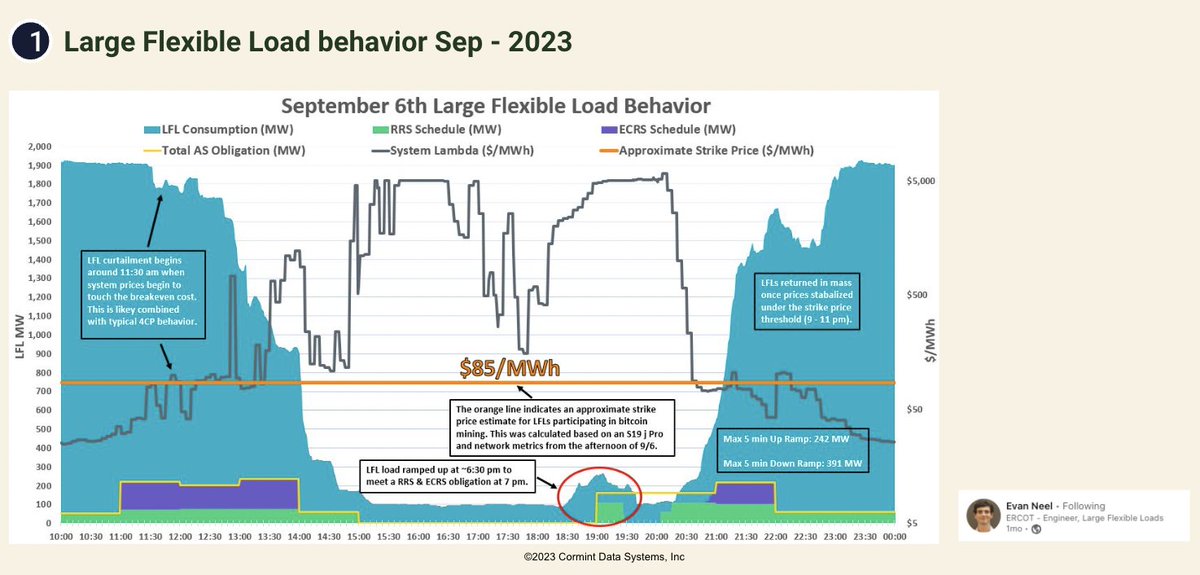
41.67 * (hashprice/efficiency) = $/MWh breakeven
Curious about the extent to which Large Flexible Loads (LFLs) respond to wholesale electricity prices in ERCOT?
Here are some fresh stats I presented on behalf of ERCOT at April's Large Flexible Load Task Force. (1/5)
@ramirazodi @lanirugzo If the load needs to ramp up in interval 12 of the previous hour to meet the obligation at the top of the next hour, then yes, that could definitely have an influence.
@lanirugzo @ramirazodi Also, AS obligations were factored out of the criteria for determining curtailment, so they shouldn’t cause any noise. “Price responsiveness” was only evaluated on non-obligated MW.
@lanirugzo @ramirazodi It’s due to the fact that there are fewer total intervals w/ higher prices. So not curtailing in a few high price intervals will lower the % more for those thresholds than the S21 threshold. So basically LFL21 rode out some large price spikes.
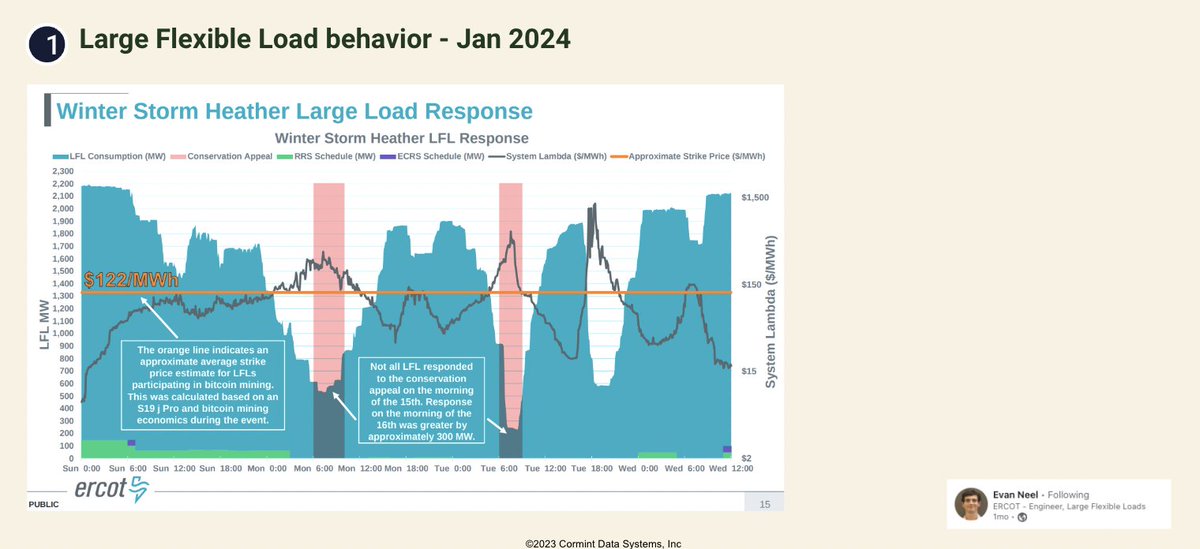
Additionally, it paints an impressive overall picture of the likelihood that the approximately 2.5 GW of currently operational LFLs will curtail in the event of extreme prices - most notably observed during extreme grid events such as the recent Winter Storm Heather. (5/5)
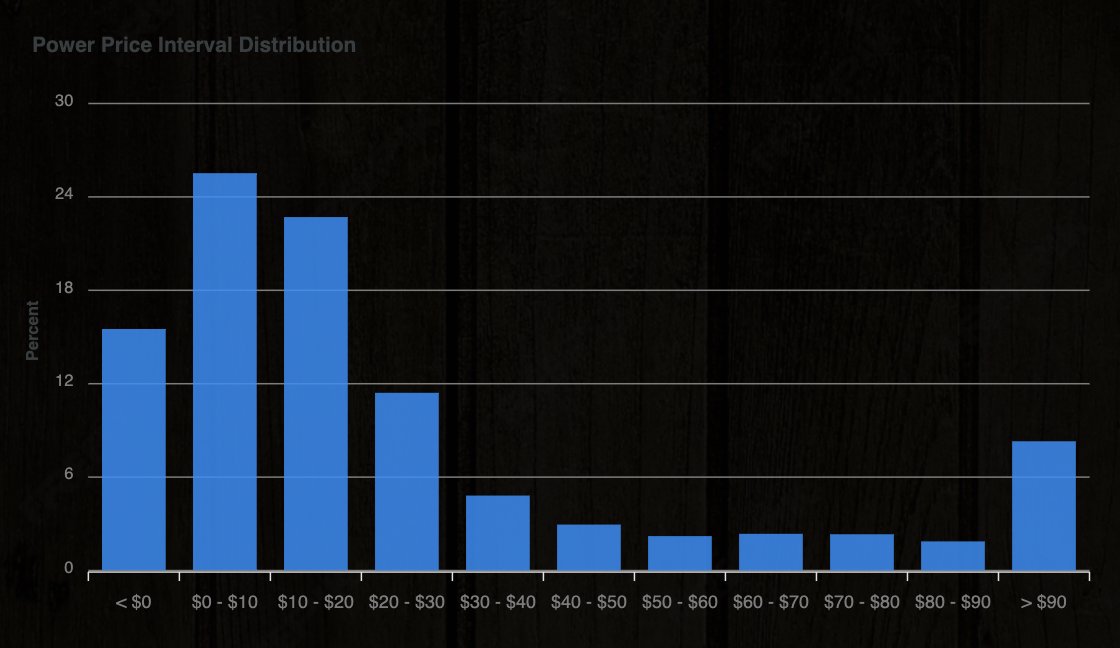
Despite the fact that many loads account for numerous other factors besides 5 min price prints when formulating a curtailment strategy, the results of the analysis still shed light on the diverse approaches to "price responsiveness" among large flexible loads in ERCOT. (4/5)
There is a big winter storm crossing the country right now. This storm will put a strain on power grids
If prices get above $.1 - $.2 per kWh 95% of the bitcoin mining load will be offline across Texas, as usual. Let’s have a look at the storm & take a trip down memory lane 🧵