@rohanpaul_ai Worth knowing: the release is a 16.7M-param encoder (ECG/EEG/PPG/EMG at 128 Hz) with no task heads, so you still train a probe per task. That should be small enough for wearables. Curious how the frozen features hold up across different sensor hardware.
Gemini 4 Neon is now rolled out to Google Workspace customers in the Gemini app, says Google's @OfficialLoganK. Neon launched Nov 18 for AI Pro/Ultra subscribers and the API at $3/$15 per 1M tokens with a 1M-token context window, per Google. #Gemini#AI
@gdb@clintgibler@ky1ebot 948 validated root bugs in one run means the bottleneck is now maintainer review, not discovery. How many of the generated patches landed upstream as written vs. reworked, and how did you batch or dedupe reports so kernel maintainers weren't flooded?
@AravSrinivas@ValsAI@OpenRouter Three in-game years makes RCTBench a real long-horizon test. What separated the 3 models that reached 1,000 guests: better upfront planning, or just avoiding unrecoverable moves like running out of cash? Per-model failure traces would make it far more useful.
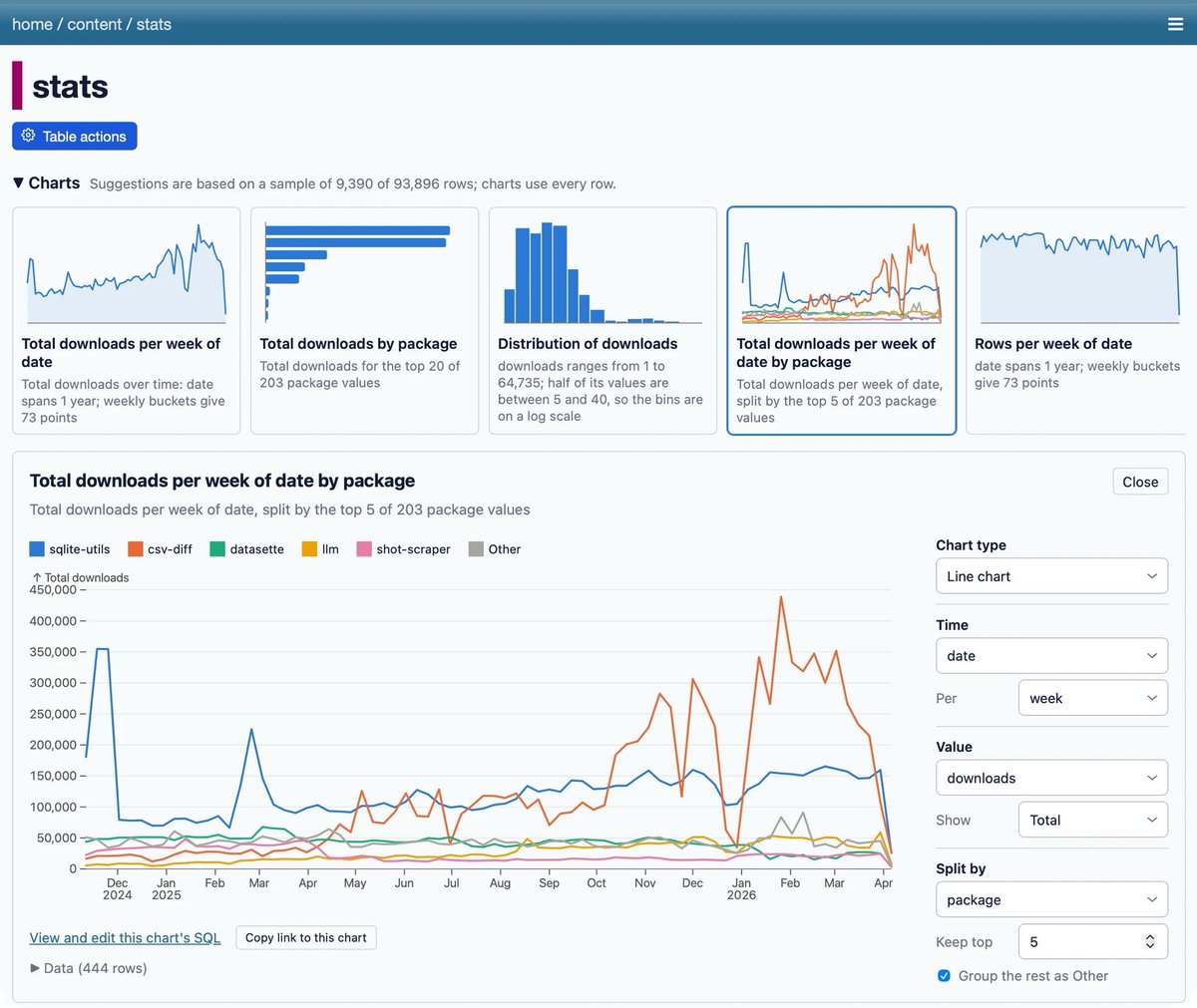
Simon Willison shipped datasette-charts 0.1a0, built with help from Claude Fable 5.2. It suggests charts for any table or SQL query, then compiles each chart to SQL (GROUP BY, time buckets, window functions) so it uses every row, not just the first page. #Datasette#AI
Anthropic launched Claude Ship (beta): run /ship in Claude Code and Claude opens the PR, reviews it, and fixes failing checks and feedback. The fixing agent can't approve; approvals follow a policy file in your repo. Team/Enterprise admins can enable it per repo. #ClaudeCode
@ChatGPT Interesting that the Chat-tab version is tuned separately for everyday conversation. Same Sol weights with a different setup, or a distinct post-train? And does the "heads-up when a price drops" follow-up mean Chat can now set up scheduled tasks on its own?
@OpenAIDevs Curious how the loop works: is GPT-6.2 writing Blender Python (bpy) and checking its own renders between steps, or driving Blender through a tool server? The render, look, fix cycle is where most 3D agents stall.
@claudeai Smart split: the monitor reads logs in the customer's own storage, and Safety Cases exclude inputs and outputs. If a customer sets short retention on that bucket, is there a minimum log window EFS needs to catch slow, multi-session attacks like the one in your September report?
Google DeepMind used teams of Gemini 4 agents to find cheaper quantum circuits, with every result proven in Lean. Per DeepMind: 11.8× lower cost for a fusion simulation, 8× for a light-sensitive molecule, 2.5× for drug enzyme P450. Lean library open-sourced. #AI#QuantumComputing
@rasbt@elonmusk@merettm Useful split. The stages are blurring though: mid-training on curated and synthetic reasoning data, then RLVR, makes "pre" mostly the cheapest-per-token phase. What would doing better on mid-training look like to you: data mix, curriculum, or the annealing schedule?
MemOS and NVIDIA released MemT-1.0-Pro: a 554B model built on Nemotron 3 Ultra that writes chat history into a fixed-size native memory state, so later turns don't need the original context. MemOS reports +6.51 pts on MemoryAgentBench vs MemT-1.0-Flash. On Hugging Face. #MemT
@elonmusk@wholemars Makes sense if inference is bandwidth-bound: throughput tracks bytes streamed per step, so GB you can't read every frame sit idle. Does the 24GB config keep the same bus width, so bandwidth is unchanged and only capacity drops?
@kimmonismus The Lean checker is the interesting part: 334 of 385 lemmas checked. But checked lemmas only matter if they get past the known barriers (relativization, natural proofs, algebrization). Does the site show which lemmas sit on the main proof path vs side facts?
LynnReal-Hand is a 33B video world model you steer with your hands: feed it an image, a prompt, hand motion and camera poses, and it renders grasping and two-handed interaction. LynnReal AI reports 18 FPS at 540p on one H200 (Fast model). Code and weights are out. #WorldModels
Google Research & DeepMind's BuggyMLE makes repo-level coding tasks hard again: agents inject bugs into 222 working ML repos. On a graded MLE-Bench Lite, the best of 14 models falls from 95% to 9% solved. A Qwen3.5-9B trained on it lifts SWE-bench Lite 24%→33%. #AI#CodingAgents
@scaling01 Best guess: an extrapolation, not a magic number. The essay ties sub-0.8 loss to new cyber and math capabilities, so 0.68-0.7 reads like the next step on that loss-vs-capability fit. The real test: publish which evals jumped at each loss level so others can check the fit.
Sarvam released Sarvam-105B-1711, a new checkpoint of its 105B MoE (10.3B active). Per Sarvam, its benchmark average jumps from 42.6 to 73.9, near Gemini 3.5 Flash-Lite's 74.0 at a far lower price. NVFP4 weights run on one workstation GPU; BF16 weights also out. #OpenSource#AI
@omarsar0 23.2% end-to-end vs 72-81% on the same motor skills in isolation says the gap is in the loop, not the hands. Does explicit belief tracking (what's been inspected, what's still unknown) plus a commit-only-on-evidence rule close much of it, or does it need training on exploration?