If you have bitcoin residing under a single key that was generated on a Coldcard Mk3 between 2021-2023, and you
- did not incorporate dice rolls
- do not use a passphrase
- do not use multi-sig
I would advise moving funds as soon as possible.
Today, a VERY elderly gentleman whos car we recently worked on called up and asked if he could have another one of the vouchers we left in his car for the local strip club, as he had misplaced it.
Folks, we do not hand out titty bar cupons...
Nobody else has ever pointed this out to me...
Geoffrey Drumm shows me that these Calcite crystal slabs at the Saqqara Pyramid Complex in Egypt, don't make sense AT ALL.
Unless... they serve a function beyond artistry...
The echoes of a lost technology?
Mold can literally cause cancer.
Several common mycotoxins have carcinogenic potential, by:
➥ Driving DNA damage
➥ Influencing epigenetics
➥ Suppressing immunity
➥ Altering cell cycle dynamics
Hitting on several of the hallmarks of cancer.
Get your place checked - if you have any symptoms get yourself checked.
Pressure-treated lumber is made by forcing a bunch of chemicals into ordinary lumber with high pressure. This helps it resist rot, termites, etc, so it's frequently done for wood that's going to be structural or exposed to the elements
Prior to 2003, about 80% of the pressure-treated lumber used in the United States was made with chromated copper arsenate, which contains arsenic
So if you have a deck made of this stuff, and then you demolish it and use it as fuel for a huge bonfire with all your friends where you cook 50lbs of meat, it is very possible that you will give everyone arsenic poisoning
If you suspect this has happened, you should call the poison control hotline. They will set you up with a 24-hour speciated urine test, which can determine the difference between inorganic arsenic from toxic lumber fumes and the slightly-less-toxic arsenic from seafood. This is apparently relevant to medical practicioners
If it's determined that you have arsenic poisoning, the hospital has 2 options
1) Do nothing, and just kind of sit there cheerleading you. (They actually do this in response to a shocking amount of conditions, and it's kind of wild we let them get away with charging people 25k a day for this)
2) Chelate the arsenic out of your bloodstream. This is basically taking a binder that will attach to the arsenic and make it easier for your body to excrete
Unfortunately, the commonly-used chelating agents bind to more things than just arsenic, so you'll wind up forcing your body to extrete a bunch of electrolytes or other useful minerals too, which feels pretty awful and can technically kill you if were to go full-retard on dosing
"Lukas, but why would I ever need or care about any of this information"
That's a fair point. I would have said the same thing 2 days ago
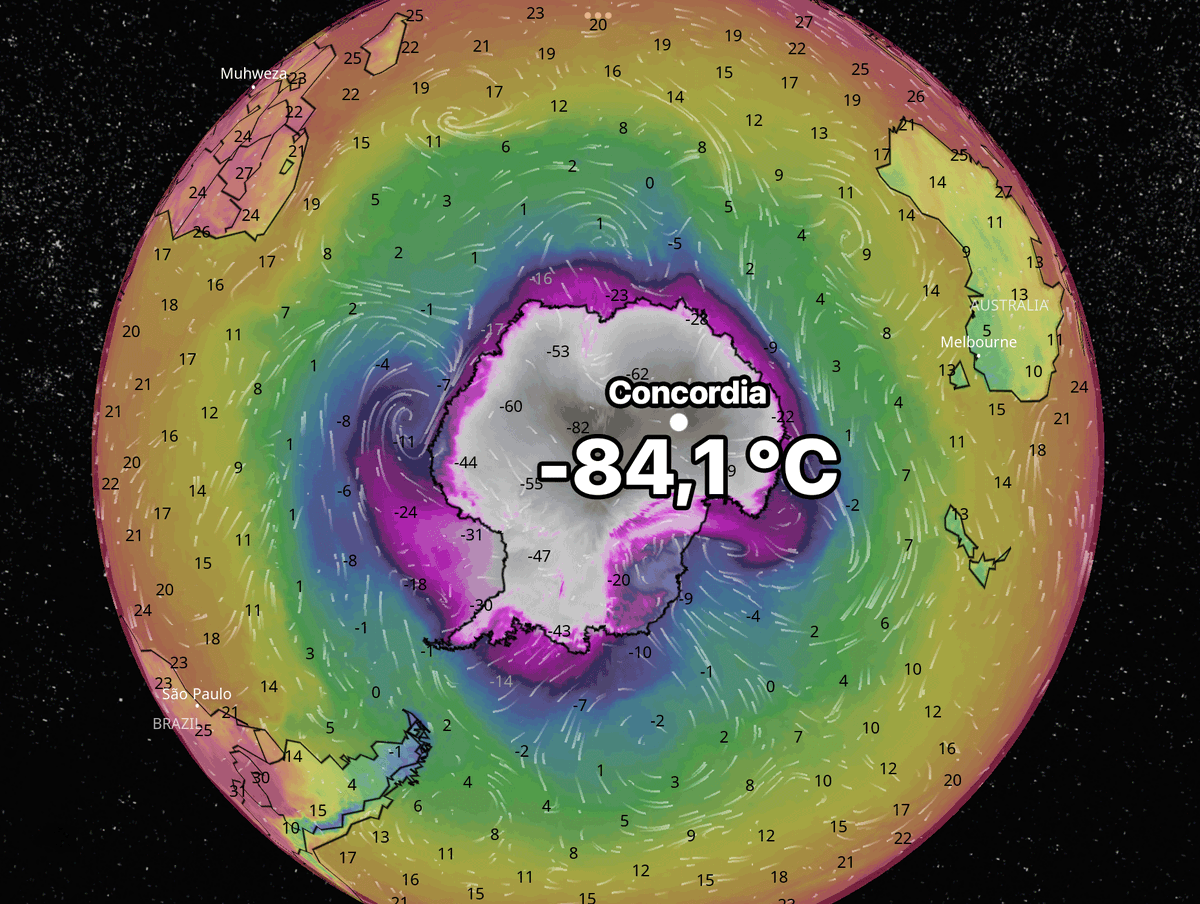
The temperature at Antarctica's Concordia Research Station dropped to −84.1 °C on Saturday, July 18. 🧐 It was the lowest temperature recorded anywhere on Earth since 2012. 🥶
A houseplant just changed everything we thought we knew about consciousness.
In 1966, Cleve Backster, a CIA interrogation specialist with a polygraph machine, was looking for ways to time how long it took different substances to travel up through plant tissue.
So, he attached electrodes to a dracaena plant in his office and watered it, expecting to see the electrical conductivity change as water moved up the stem.
Instead, the polygraph needle started tracing the exact pattern it makes when a human experiences an emotional response.
Backster stared at the readout. Plants don't have nervous systems. They don't have brains. The signal made no biological sense. So he decided to test something that made even less sense. He walked across the room, looked at the plant, and thought about burning one of its leaves with a match.
The instant the thought formed in his mind, before he moved toward the plant, before he struck a match, before he did anything physical, the polygraph exploded into frantic activity.
The plant was responding to his intention.
What happened next launched thousands of experiments and split the scientific community for decades.
Backster discovered that plants reacted to direct threats and to threats against other living things in their environment. When he dropped live brine shrimp into boiling water in another room, plants throughout the building registered distress responses at the exact moment of death. Distance didn't matter. Shielding the plants in lead containers didn't matter. The response was instantaneous and consistent.
Mainstream botanists dismissed the findings immediately. Plants process information through chemical signals and growth responses, without electrical consciousness. Any electrical activity was just random fluctuation or experimental error. The peer review system buried Backster's work. His credentials were questioned. His methods were called sloppy.
But the experiments kept working. Other researchers, following Backster's protocols, got the same results. Plants hooked to EEG machines showed brain wave patterns. They responded to music, to human emotions, to the intentions of people they had never been exposed to before. The electrical signatures were clear, measurable, and repeatable.
The implications were so uncomfortable that most of academic science simply refused to engage. If plants were somehow conscious, if they could sense intentions and respond to the emotional states of humans and other living things, consciousness was spread beyond brains. It was distributed across organized living systems rather than produced by neural networks.
Backster stumbled onto evidence that living systems might be constantly communicating through channels we don't have instruments to measure yet. The polygraph was crude enough to detect the electrical signatures of that communication without being sophisticated enough to explain them away.
Quantum biologists now suspect that living cells operate through quantum coherence processes that classical biology can't account for. Birds navigate using quantum entanglement in their visual systems. Plants conduct photosynthesis using quantum superposition to find the most efficient energy pathways. Maybe Backster's plants were demonstrating quantum consciousness, responding to information that was quantum entangled with the intentions and emotional states of nearby living systems.
What keeps most people awake when they learn about this work is realizing that if consciousness extends beyond brains, every living thing around you is potentially aware of your mental and emotional state in ways you never considered. The plant in your room. The bacteria in your gut. The ecosystem you walk through.
You think your thoughts are private.
The plants have been listening the entire time.
. . .
Repost if you gained anything from this post.
Follow me @Darshak Rana for more.
@SillyWorkMedia@RichmondRCMP I think they are showing the rocks that will be thrown due to the lack of appropriate mud-flaps. Kinda open to interpretation the way they posted this tho 😂
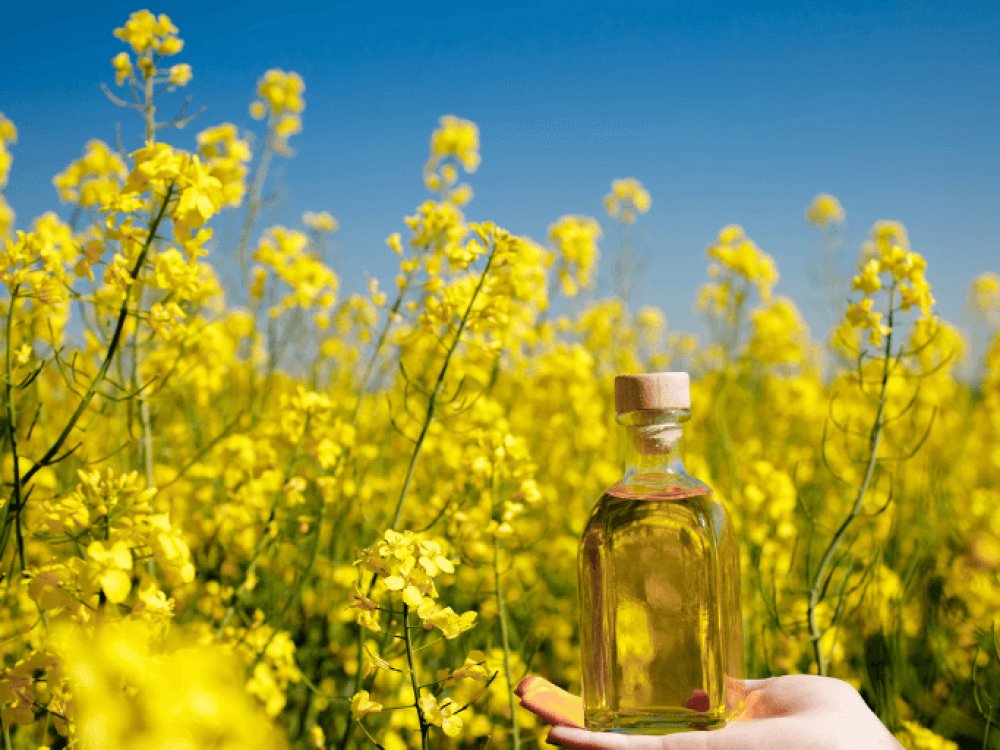
1936. Saskatchewan starts growing rapeseed, and nobody eats it.
Then the war arrives and the navies have a lubrication problem. Steam turbines run wet, and ordinary lubricants slide off wet metal. Rapeseed oil does not. It clings to a wet surface better than anything else available, which makes it, for about six years, a strategic material. Canada plants it by the thousand acres. The oil goes into the engines of ships.
Then the war ends. The ships stop needing it. Canada is left with a crop, a farm lobby, a crushing industry and no customer.
There is an obvious customer sitting right there, three times a day. The problem is the oil. Rapeseed oil is 40 per cent or more erucic acid, and by 1956 the questions about erucic acid have turned awkward: fed at high levels, it produces lesions in the heart muscle of animals. Health and Welfare Canada recommends conversion to low erucic acid varieties. Read that sentence again in the right voice. This is not a food that developed a health claim. This is a lubricant that developed a mouth.
So they breed it. Through the early 1960s Canadian plant breeders isolate lines low in erucic acid. In 1968 Baldur Stefansson at the University of Manitoba produces one. In 1973 the industry agrees, voluntarily, to cap erucic acid at 5 per cent in anything sold as food. In 1974 come the first double-low varieties, with the erucic acid down and the glucosinolates down: the two things that had made the plant unfit for a human being to eat, bred out to specification.
The oil is now technically edible. It still has a name problem.
In 1979 the Western Canadian Oilseed Crushers Association registers the solution: canola. Canadian oil, low acid. Six years after that, in 1985, the American regulator draws the formal line and blesses it. Rapeseed oil is for industry. Canola oil is for humans. Same flower. Same yellow field you drive past in May. Same seed, bred down and given a passport.
Within twenty years it is one of the most consumed fats on earth, a heart-health icon, sold at eye level in a clear bottle, recommended from the good chair in the consulting room, poured into everything from crisps to infant food.
None of this is hidden. Every step is in the agricultural record: published, dated, dull, uncontested. A wartime engine lubricant with a heart-lesion problem was bred, renamed, reclassified and sold to you as the healthy option, and the whole operation took forty years and required nobody to tell a single lie.
They just needed a name you wouldn't ask questions about.
Flock cameras automatically photograph passing vehicles, capturing licence plates, timestamps, locations, and often vehicle make, model, and colour. The data can be searched and shared across police agencies to track where vehicles have travelled.
Privacy experts warn that this creates a powerful mass-surveillance network capable of revealing people's movements, associations, and daily routines, even when they are not suspected of any crime. While the cameras are already widely deployed across the United States, their use in Canada remains relatively limited – for now. You can learn more here: https://t.co/NYhjri0ytM
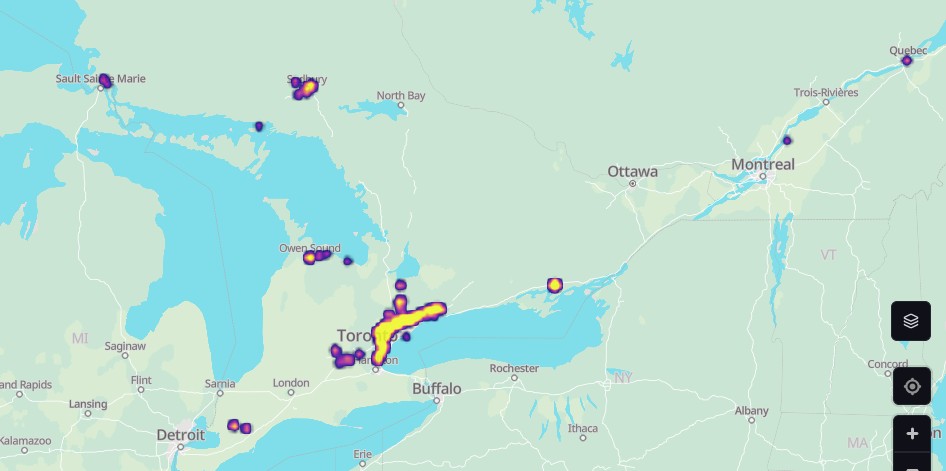
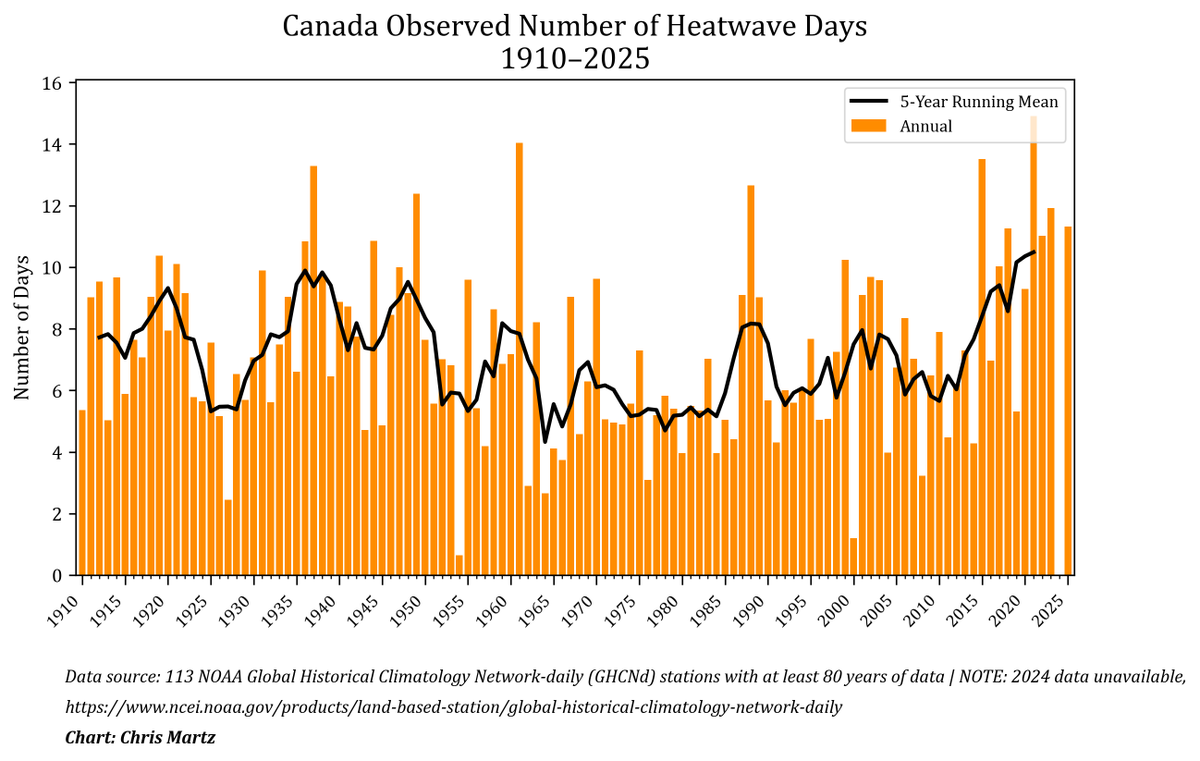
We are being told that the wildfires in Ontario are being driven / fueled by climate change. Specifically, more extreme heat and increased drought. So, unlike the journalists and most meteorologists regurgitating these talking points, I looked at the actual data since 1910.
The average number of heatwave days (HWDs) in Canada (which are defined as ≥3 consecutive days with Tmax ≥90th percentile against the 1991–2020 mean per station) was 8.58% lower during the 60-year period 1965–2025 compared to 1911–1960, but the linear trend is not statistically significant at the 95% confidence level. The last eight years have exhibited an unusually high number of HWDs, but it's far too early to tell if that's a sign of things to come or simply an artifact of natural variability. I used 113 long-term (≥80 years of daily data) GHCNd stations to complete this analysis. The only way one can get a meaningful increase in HWDs is to cherry-pick the x-axis starting date and ignoring pre-1960 data.
Looking at droughts, I examined the self-calibrating Palmer Drought Severity Index (scPDSI) from CRU (data is available through 2024). I then calibrated that to the Drought Monitor over the same period that I analyzed HWDs. There isn't much of a trend there; in fact there is a significant decrease in the worst of the drought categories despite the spike in 2023–24.
Very few people these days in this line of work build datasets from scratch. But I do it because if someone makes a claim, it's very easy to test said claims against observational data. In most cases, alarmist narratives crumble with scrutiny. While alarmists get the basics right about the physics of Global Warming Theory in an “all else being equal” hypothetical, the real-world is a far more complex and details are hairy.
Are hot days in Canada increasing? 🇨🇦🌡️
Nope. Not really. If you start in 1970, sure, you could argue an increase. But the full period of record tells a very different story. That is, a slight decline.
The only striking anomaly in recent memory is 2021, which is mostly from the June–July Pacific Northwest heatwave that shattered many all-time records in British Columbia.
After years of caring for dementia residents, I've personally helped dozens & watched a few of them get their memory back.
If you're starting to lose your memory, here is EXACTLY what I'd do first to improve it:🧵