Friends, I am beyond happy! I'm starting a new position as Full Professor of #MachineLearning at the University of Fribourg @unifr 🇨🇭! With #SwissAI and many other initiatives, I am taking my research at the intersection of #geometry, #topology, and #MachineLearning to a new level 🚀. This #SwissNationalDay will thus hold an even more special meaning for me—thanks for this wonderful chance, my dear confederates!
The past few years have been a veritable roller coaster 🎢, with ups and downs. Through it all, I was sustained and supported by my family, for which I am eternally grateful.
As much as we like to believe it in academia, 'no man is an island,' and I have tons of people to thank, foremost among them my postdoctoral adviser @kmborgwardt, as well as my long-term collaborators @KrishnaswamyLab and @mrguywolf. I am also indebted to my great research group at the AIDOS Lab. Working with all of you is a pleasure! 🙏
Finally, I am grateful for the advice of my mentors and role models @stefanabauer, @mmbronstein, and @guennemann (plus many others—you know who you are).
It's time to give back now and make academia better!
PS: 🔥I'm hiring soon! 🔥Please share widely and direct any inquiries to my e-mail or DM.
Btw, we just released OCLF, a flexible codebase for object-centric learning research, containing the code for DINOSAUR and much more. Thanks to @ExpectationMax for the huge amount of work on this!
https://t.co/P1TNTOzrqI
🔖New preprint: https://t.co/dt56Lxmrrm
Answering some (not all!) questions about the expressivity of #topology in the context of #MachineLearning for graphs.
TL;DR: persistent homology is awesome and can 'simulate' a corresponding WL test (even for higher orders). 🤯
🧵1/6
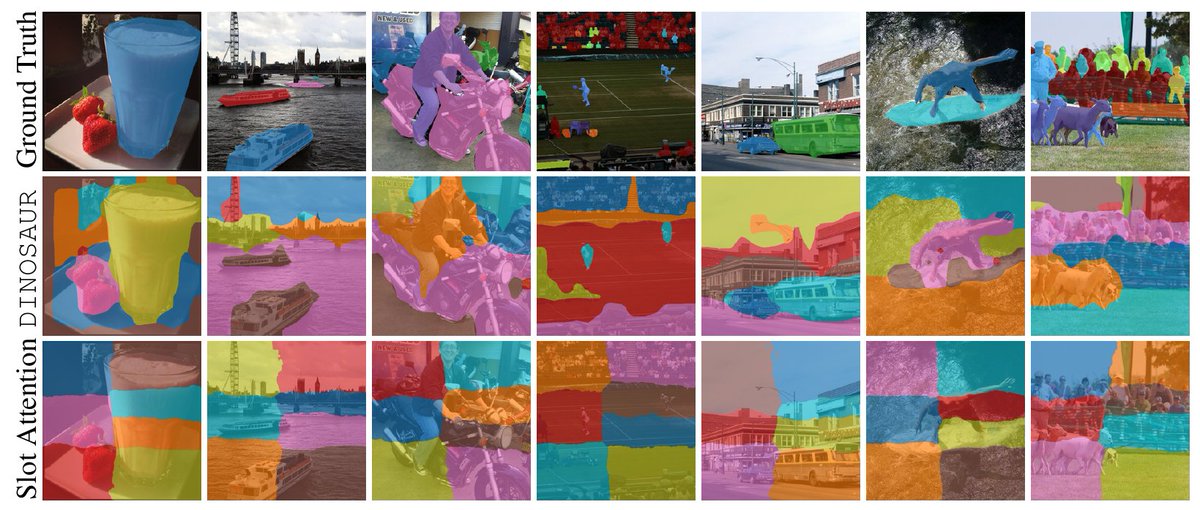
A bit late, but still: I'm super happy that my paper on scaling unsupervised object-centric representation learning to the real-world got accepted to #ICLR2023.
Our method, DINOSAUR, takes a big step towards open, complex image datasets like PASCAL and COCO!
Excellent summary of Neil Stephenson’s books. A great resource for anybody into sci-fi and looking for some new material. Thank you for compiling this @Pseudomanifold !
In our new paper we conduct a large scale study on out-of-distribution robustness. We evaluate insights around robustness, domain generalization, architecture biases, uncertainty quantification and adversarial examples in a unified setting. https://t.co/WG2jd7XoDB
Looking forward to presenting our work on 𝗧𝗼𝗽𝗼𝗹𝗼𝗴𝗶𝗰𝗮𝗹 𝗚𝗿𝗮𝗽𝗵 𝗡𝗲𝘂𝗿𝗮𝗹 𝗡𝗲𝘁𝘄𝗼𝗿𝗸𝘀 in the upcoming #ICLR2022 poster session from 11:30am CEST.
Join us on https://t.co/Ib9uvvyyK3 if you're into #topology and #MachineLearning.
https://t.co/tpl43yr5re
Looking forward to presenting our #ICLR2022 spotlight paper Evaluation Metrics for Graph Generative Models: Problems, Pitfalls, and Practical Solutions at the poster session on Thursday at 11:30 CEST.
https://t.co/0YsSUHQZ90
@Pseudomanifold@ExpectationMax@kmborgwardt
Some said an open-world experience this immersive wasn’t possible. But it’s already here. And you don’t even need silly VR headsets.
Introducing, ✨Icelandverse✨
#icelandverse
Congrats to Bastian and all the best for his new adventures!
Working with Bastian is and was an amazing experience🤩
To anybody looking for a position: Don't miss this unique opportunity!
[1/8] Excited to share our preprint on #calibr8, a Python package for calibration modeling: https://t.co/8IVHMfiT40
It is a bottom-up story about data-generating processes: Where do measurements come from? What role do calibration models have for quantitative data analyses?
{{einsum}} - my new R package just published on CRAN to express complex array multiplications using the concise Einstein summation notation 🎉🥳
https://t.co/wdrkB5zLuR


![theCake's tweet photo. [1/8] Excited to share our preprint on #calibr8, a Python package for calibration modeling: https://t.co/8IVHMfiT40
It is a bottom-up story about data-generating processes: Where do measurements come from? What role do calibration models have for quantitative data analyses? https://t.co/l4xwu7erCL](https://pbs.twimg.com/media/E5icV_uX0AI7kBP.jpg)





![theCake's tweet photo. [1/8] Excited to share our preprint on #calibr8, a Python package for calibration modeling: https://t.co/8IVHMfiT40
It is a bottom-up story about data-generating processes: Where do measurements come from? What role do calibration models have for quantitative data analyses? https://t.co/l4xwu7erCL](https://pbs.twimg.com/media/E5icXsJWYAg28cP.jpg)


