13 minute complete course to learn how to automate YouTube channels with AI
the clearest tutorial I've seen.
idea → script → video → views → money
Bookmark it for later…..
Anthropic Engineering: "At Anthropic, we don't write prompts anymore. we build loops"
in 42 minutes, she shows how the Claude team creates loops that prompt themselves
if this cost $400, people would call it the best agents course of the year
it's free
watch it, and Bookmark.
had a crazy idea today
for the past two months i've been building a pretty massive app
and truth be told, i often play catch-up on architecture, because features move so damn fast
so today i asked claude (opus 5.5, high)
"I have a weird task for you. I want you to look at the app and create, for lack of a better word, a canvas that I can zoom in and zoom out and move around to see how our architecture actually works."
(full prompt in first comment)
this came out pretty great and it truly visualized, with steps and connected graphs what everything does
10/10 would recommend
This 50-minute lecture by Jeff Bezos will teach you more about business than a 2-year MBA program.
Bookmark it and give it 50 minutes today, no matter what.
Eric Schmidt (ex-Google CEO): “if you really want to make money, it’s actually easy. found an agentic AI company.”
If I had only 30 days to do that , I'd begin here and save this:
Agent Architecture
https://t.co/Xyy3e9AjAQ
Claude Code 101:
https://t.co/tZbHeRDWkj
Claude Code in Action:
https://t.co/RDYEVbydhW
Prompt engineering (official):
https://t.co/aYQzAWmObh
Interactive prompt tutorial (hands-on):
https://t.co/5k9My0hYgY
CLAUDE.md & how to give Claude memory:
https://t.co/gtmOGKAvDe
Skills, teach Claude reusable workflows:
https://t.co/DJFqh3E6OB
MCP, time connect Claude to Slack, GitHub, Drive:
https://t.co/XbRdmmcYmP
Routines (automate tasks 24/7):
https://t.co/LGbhOeWWdJ
Claude Code Ultimate Guide (community):
https://t.co/56DAmEuqH8
Awesome Claude Code (skills, hooks, plugins):
https://t.co/jUIBuxvV5K
All 13 Anthropic Academy courses (free certs):
https://t.co/rHn0gDmtGH
Claude Code full docs:
https://t.co/KYHnapDdHG
All of this is for free at $0/month
Then read this guide by this builder
I asked @danmartell to walk me through every level of making money with AI.
He gave me the most simple, practical advice I've ever heard on this subject.
Level 1 - Making $0 - $100k
Level 2 - Making $1m - $10m
Level 3 - Building a $10m++ enterprise.
0:00 Only 5% of the World Has Ever Paid for AI
0:46 The Easiest Thing to Sell With AI Right Now
1:56 The Marcus and Sophie Framework
4:24 Theory of Constraints (Right Problem to Solve)
5:33 What Is the Number One Business Constraint
7:13 How to Leave Your Job and Go All In
8:27 Business Is Simple Find a Problem and Solve It
9:08 Stop Getting Ready to Get Ready
9:33 The Sarah Story One Text and $10K
9:53 Pull Up Your Phone and Message Your Contacts
11:05 Dan's Son Gets His First Client at $800/Month
12:41 Best Employee vs. Best Employer
13:59 What Other Services Can You Sell With AI
14:44 Sales Is Not Talking It's Asking
17:01 What to Do When You Hate Your Business
18:40 Pain and Pleasure Are the Only Two Motivators
19:13 They Haven't Made It a Must Yet
20:29 Make It a Must Not a Nice to Have
21:06 The Jen Story and the Gasping Moment
22:17 How to Find Your First 10 to 15 Clients
28:38 The Personal Brand Play
33:06 Vision Is What AI Cannot Do
34:55 Hard for Computers Easy for Humans
36:13 Level 2 Making Your First Million With AI
37:18 The Replacement Ladder Framework
37:39 Admin First Then Delivery Then Marketing
39:09 Why Marketing Is the Biggest AI Category
39:32 Why You Should Keep Sales for Yourself
40:00 Level 5 Leadership and AI Agents
41:41 What a Fully AI Systems Business Looks Like
43:13 The Gym Owner With Three Locations
46:16 Shutting Down the Company for Two Days
46:37 Teaching the Whole Team to Code in Claude
49:28 Wayne the 62 Year Old Who Made $12K a Month
52:38 I Only Share What Actually Works
53:21 Whisper Flow and Talking to Your AI
56:41 Claude Chat Claude Coworker and Claude Code
57:57 The Claude Browser Extension
58:49 Claude Code Is Not Just for Developers
1:00:06 How to Migrate Your AI Memory Across Tools
1:01:08 Level 3 $1M to $10M and the Brand Play
1:02:05 Nobody Buys AI They Buy Trust
1:03:25 Brand Is Association and Association Is Trust
1:05:12 A Million Followers Is $10M in Activated Revenue
1:07:03 How to Keep AI From Becoming Slop
1:07:42 Human in the Loop
1:08:16 The 10 80 10 Rule and Why AI Is Now the 80
1:10:01 The Team FIRED Themselves
1:11:45 Dan's Free AI Curriculum for Your Team
Anthropic engineer:
"You're not supposed to watch Claude Code work. You're supposed to wake up and review what it shipped."
In 22 minutes she builds the entire workflow live on camera.
Most people close their terminal and everything stops.
This setup keeps shipping while you sleep.
Watch the video, then save the exact setup below👇
A man spends 50 years teaching at MIT.
He knows his time is running out.
So he records one last lecture — everything he knows, distilled into a single hour.
He died 5 months later.
This is that lecture.
The most important hour you'll watch this week. 👇
Bookmark it for later
I'm giving away a FULL course on how to build a managed AI agent business solo using Hermes Agent, Orgo, Obsidian, Codex, Claude Code etc.
Here's everything (47 minutes):
1. The offer: unlimited agents, unlimited usage, all infrastructure and security included. The customer gets a digital employee. They never think about tokens or models. You handle everything.
2. Don't niche down too fast. Try marketing agencies, law firms, insurance, manufacturing, real estate. See where the market pulls you. Then go vertical. Diverge first, converge later.
3. Every executive has the same problems regardless of industry. Too many emails, too many meetings, too many follow-ups, too many open loops. Solve those first. Then layer in vertical-specific skills.
4. The stack: Hermes Agent for the agent harness. Codex or Claude Code desktop to build and configure. Orgo for cloud computers so every agent lives in its own sandbox. Composio for one-click authentication across thousands of apps. Agent Mail to give every agent its own email. Obsidian for the knowledge base.
5. Use agents to build agents. Don't stress about setup. Use Claude Code or Codex to install and configure Hermes inside a VM. Use Perplexity MCP, Context7, and Exa for up-to-date docs. Your agent sets up your customer's agents.
6. GPT 5.5 is the best model right now. Efficient with tool calls. Doesn't eat tokens like Opus 4.7. For cheaper tasks, GLM 5.1 from ZAI is the best open source option.
7. Set up watchdogs for gateway crashes so they auto-restore. Have agents email you when cron jobs break or skills fail. Your customer should never have to tell you something is broken.
8. Get customers through content. If someone jumps on a call and already knows who you are and what you sell, that's the position you want. Content is the most leveraged thing you can do in 2026.
9. Keep scope tight. One to two requests at a time, delivered in under 48 hours. Use Trello for customer-facing project management. Send Loom updates at random hours to show you're always working on their agents.
10. If you can set up Claude Code, Hermes, or OpenClaw, you have a skill that 99% of business owners don't have and would pay $5k/month for. You're probably not giving yourself enough credit.
shoutout to @nickvasiles from @orgodotai for coming back on @startupideaspod and sharing the full playbook. tools, stack, fulfillment, everything.
this type of episode isn't shared anywhere on the internet. this is the alpha people keep for themselves.
i will keep sharing if you keep watching.
you could watch netflix or you can watch this (link below)
https://t.co/Z4PM5I7d0S
watch
Google Cloud AI engineer just showed how they go from idea to deployed app at Google in 30-minutes using Claude.
26-minutes. free. by Google AI team.
one person + Claude + Google Cloud = a full engineering org running on a laptop.
worth more than any $500 vibe-coding course.
🚨 Anthropic's own team just showed how to actually use Claude Code properly.
30 minutes. free. the person who created Claude Code.
watch the workshop. bookmark it.
worth more than every $500 course you almost bought.
you've been using Claude without knowing 40 of its commands.
Then read the guide below.
how to build a bootstrapped startup without funding:
1. pick a problem you personally have. if you don't use your own product daily, quit now
2. skip the pitch deck. open your code editor. ship something ugly in a weekend
3. charge money from day 1. free users give you nothing but support tickets
4. use boring tech. PHP, SQLite, vanilla JS. frameworks are a trap that mass waste your time
5. host on cheap VPS ($5-20/mo). not AWS. you don't need kubernetes for 1,000 users
6. do customer support yourself. it's the fastest product feedback loop that exists
7. automate everything you do more than twice. cron jobs > employees.
8. grow on Twitter/X by building in public. your journey IS the marketing
9. keep your burn rate near zero so you never need to raise. ramen profitable > series A
10. say no to investors, cofounders, and "advisors" who want equity for intros
i've been doing this for 10+ years now. no employees, no funding, no board meetings
the entire VC game is designed to make you think you need permission to start
you don't
vertical AI agents are going to be a BIG opportunity in 2026 and here’s why (save + read this 2x):
the market is flooded with horizontal tools trying to do everything. bloated. generic.
and most are TERRIBLE.
the real money is in specialized agentic systems that solve one bottleneck in one industry.
here are some examples:
• an agent that handles client intake for personal injury firms. qualifies leads, books consults, sends follow-ups. replaces 15 hours/week of admin work.
• an agent that processes RFQs for construction companies. reads specs, pulls pricing, generates quotes. cuts response time from 2 days to 2 hours.
• an agent that manages patient scheduling for dental practices. handles cancellations, fills gaps, sends reminders. no more front desk phone tag.
each system sells for $10K+. deploys in weeks. and copies across every similar business in the vertical.
why vertical wins:
• easier sale. “built for law firms” beats “built for everyone.”
• higher prices. specialists charge more. always have.
• less competition. everyone builds generic. nobody goes deep on HVAC or assisted living.
• faster delivery. build once, deploy dozens of times. 80% code reuse.
• compounding expertise. you learn the edge cases. you fix problems before clients notice.
horizontal AI is commoditized. vertical is wide open.
TLDR: pick an industry. find the bottleneck. build the agent. own that niche.
RT + comment “ALPHA” and I’ll send a playbook on selling AI to businesses (must follow so I can DM)
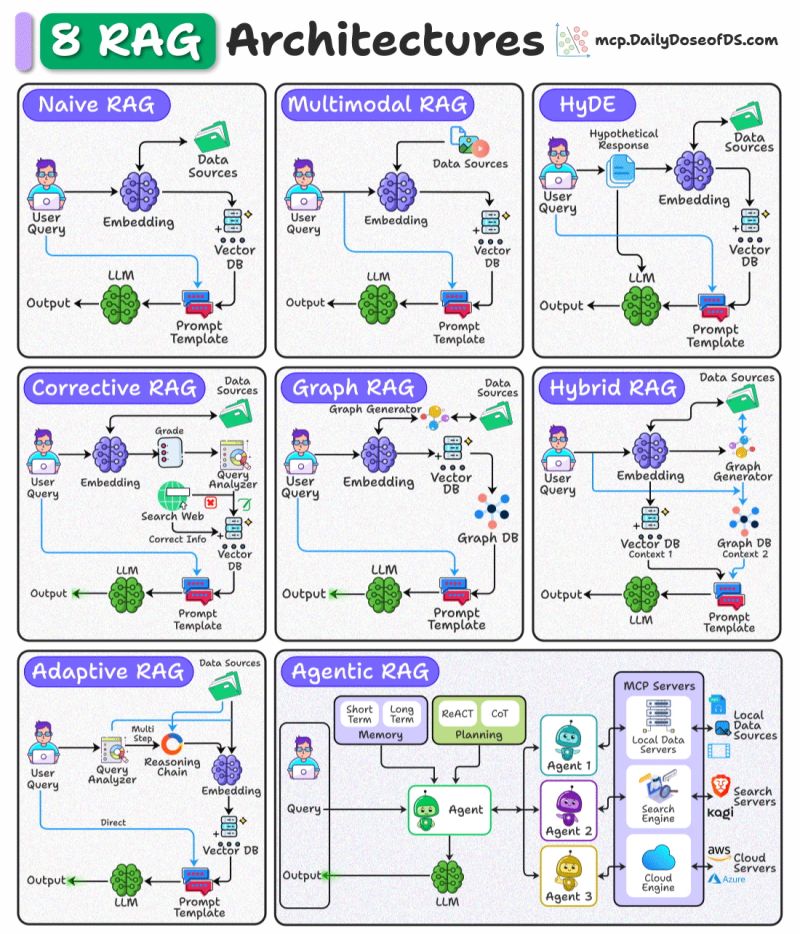
8 RAG architectures for AI Engineers:
(explained with usage)
1) Naive RAG
↳ Retrieves documents purely based on vector similarity between the query embedding and stored embeddings.
↳ Works best for simple, fact-based queries where direct semantic matching suffices.
2) Multimodal RAG
↳ Handles multiple data types (text, images, audio, etc.) by embedding and retrieving across modalities.
↳ Ideal for cross-modal retrieval tasks like answering a text query with both text and image context.
3) HyDE (Hypothetical Document Embeddings)
↳ Queries are not semantically similar to documents.
↳ This technique generates a hypothetical answer document from the query before retrieval.
↳ Uses this generated document’s embedding to find more relevant real documents.
4) Corrective RAG
↳ Validates retrieved results by comparing them against trusted sources (e.g., web search).
↳ Ensures up-to-date and accurate information, filtering or correcting retrieved content before passing to the LLM.
5) Graph RAG
↳ Converts retrieved content into a knowledge graph to capture relationships and entities.
↳ Enhances reasoning by providing structured context alongside raw text to the LLM.
6) Hybrid RAG
↳ Combines dense vector retrieval with graph-based retrieval in a single pipeline.
↳ Useful when the task requires both unstructured text and structured relational data for richer answers.
7) Adaptive RAG
↳ Dynamically decides if a query requires a simple direct retrieval or a multi-step reasoning chain.
↳ Breaks complex queries into smaller sub-queries for better coverage and accuracy.
8) Agentic RAG
↳ Uses AI agents with planning, reasoning (ReAct, CoT), and memory to orchestrate retrieval from multiple sources.
↳ Best suited for complex workflows that require tool use, external APIs, or combining multiple RAG techniques.
👉 Over to you: Which RAG architecture do you use the most?