What’s funny is the last time they tried to privatize was pre-UK wealth sale so sale accretion would accrue to the partners. If they sell it as a pubco, there will then be value leakage to public shareholders.
Not sure what it’s worth. Hard to even guess. Really comes down to how long you think the IB/equities franchise can produce super-normal earnings and what multiple you want assign to the normalized stream.
Signed on for a new role in institutional equities based in NY. Will be moving in the next month or so. If you're based in NY and like talking stocks (particularly Canadian cyclicals) would love to connect. DM's open
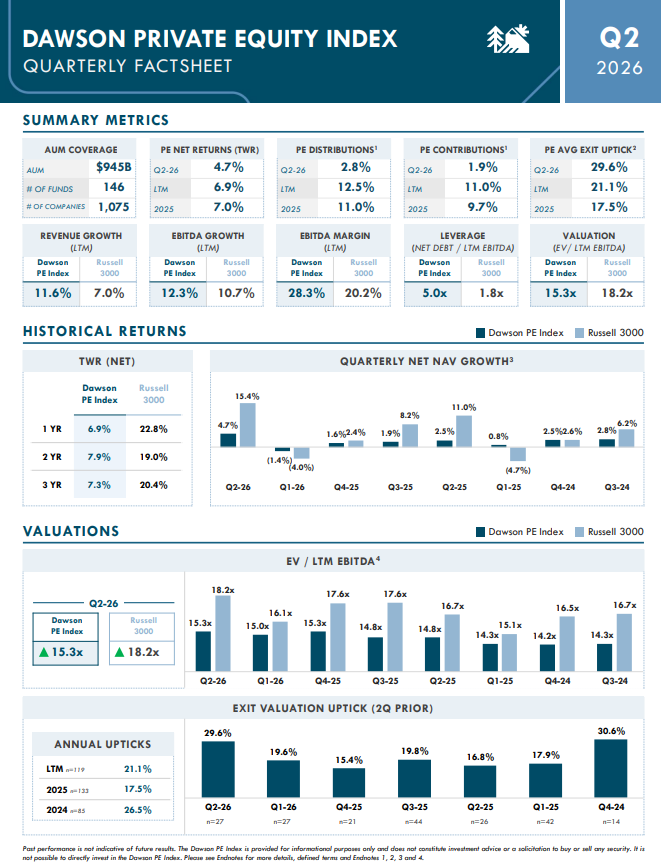
Sharing what I think could be a useful tool for investors especially if you are across both public and private assets.
A free quarterly PE performance report with some interesting data transparency compiled by a secondaries firm in Canada. They were (relatively) early to the secondaries game so cover a wide swath of AUM. No affiliation, just found it interesting and helpful. Link in comments.
The equity vehicles $BIPC, $BEPC are rate sensitives. The $BN balance sheet has a ton of legacy RE including office exposure. $BN via wealth solutions also probably experiencing a bit of a hangover from the recent private credit/insurance headlines (this last one I view as a bit of an opportunity, see previous posts). But, not exactly a slam dunk esp. given that $BAM by its nature is a global investment organization.
Signed on for a new role in institutional equities based in NY. Will be moving in the next month or so. If you're based in NY and like talking stocks (particularly Canadian cyclicals) would love to connect. DM's open
I like a good bear thesis (see previous posts) but, I find the current bearish discourse around the private equity-backed insurance companies either alarmist or disingenuous.
We must acknowledge that the PE-backed insurer portfolios are:
1. opaque
2. used by sponsors for value transfer to the AM and PE businesses
3. liabilities carry surrender risk in a sharp rate move
4. funding sources are not truly "permenant"
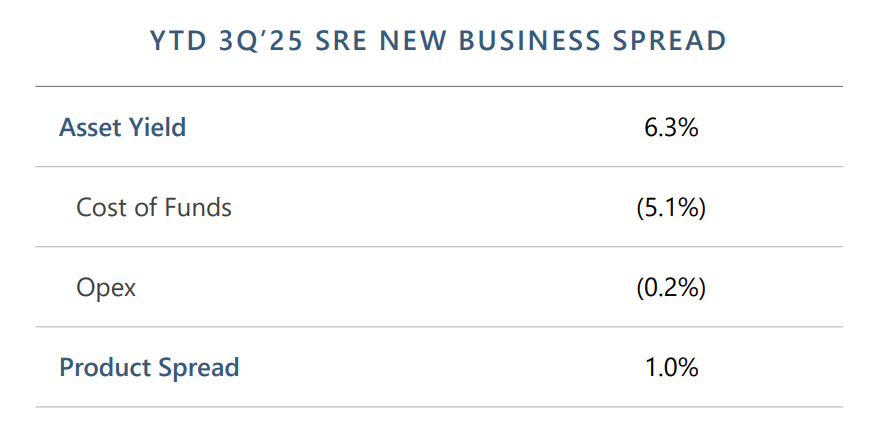
But, to say that opacity by its nature leads to systemtic risk is alarmist. The issuers are deliberately taking on asset variance as opposed to underwriting variance compared to say P&C insurers. The real magic in the business model is that they are able to convince ppl to buy annuities at a 3.5-4.0% cost of capital.
On surrender (redemption) risk in the face of rising rates. Annuities are not demand deposits. Policies are subject to both a surrender charge (up to year 10) and a MVA charge. The latter passes part of the interest-rate mark-to-market loss to the departing policyholder. This is all before accounting for the friction that would occur in the sales channel given the incentives provided.
Let's use a worked example on the asset side. $APO's Athene is run-rating ~3-3.5B of SRE. Let's assume that ~20% or ~$63B of its book is private credit. At a 50% recovery rate, 10% of that entire bucket would need to default to consume one year of spread earnings.
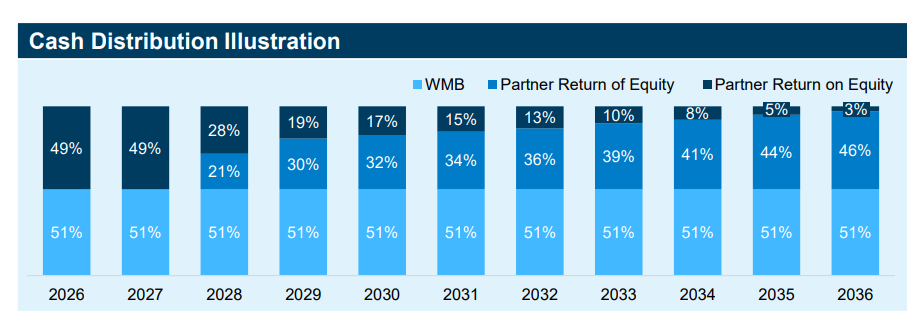
Recent deals also seem to have built in additional cushion. Both the $BX / $WMB and $APO / $OKE deals allow for cash flow outperformance above cost of capital to serve as a return of capital which would serve to cushion the book during volatility (BX schedule below).
@LeylaKuni@KeyserSozeThree At an all-in cost of 7% would assume most of it ends up on the Athene balance sheet (5% cost of capital). There might be a sliver of equity in the cap stack
@GHBurnsCFA@SuicideBlonde_2 Didn't see a rate in the ENB press release but, OKE pricing at a slight premium to WMB feels at least ordinally correct to me. More to come I'm sure. May all midstream PE sponsors rejoice.
No catch, I don't think. Even through its positioned as equity capital, its really debt (insurance) capital from Athene. I would guess that 1% of the cap structure is actually equity but importantly, the rating agencies treat it as equity.
For $APO its really just a spread trade, they even call it "Spread Related Earnings". They fund it with annuities which have a ~5% cost of capital. The repayment mechanic helps them reduce duration in case rates keep rising so they can redeploy and actively manage their spread.
No position in the stock, but $CRWV flagged an A100 recontracting out to 2029. I've been noodling on who the counterparty could be, and my theory is it's $NVDA. A couple of reasons why I think this makes the most sense.
It's clear the hyperscalers are trending away from GPUs as they scale their TPU ecosystems. That creates both urgency (see NVDA's $500B deal with the mega-cap PE firms) and incentive for NVDA to help the neoclouds scaling inside the NVDA ecosystem to defend its moat. Recontracting A100s out to 2029 can dramatically improve the neoclouds' cost of capital (equity and debt) especially when CRWV management is light on the details.
On IR callbacks, CRWV said the A100s are "inferencing for a customer." That could just be NVDA running internal research workloads. Who else could be so certain they'll still want an A100 in 2029? How about the guys best placed to optimize for it. It would make sense that NVDA keep building more efficient versions of Nemotron that can best leverage older-vintage GPUs, and point them at the internal coding workflow.
If NVDA does turn out to be the counterparty, the market shouldn't read this recontracting as a broader uplift in GPU terminal values because NVDA has a clear incentive to prop up the neoclouds to defend against the $AMZN and $GOOG TPU ecosystems.