The thing most teams get wrong about thundering herd: they think caching solves it.
Caching protects future requests, the ones that arrive after the first response is stored. But the window between cache miss and cached response is completely unprotected. During a launch or a viral moment, hundreds of requests hit the same cold endpoint simultaneously. Everyone goes upstream independently.
That window is what deduplication closes.
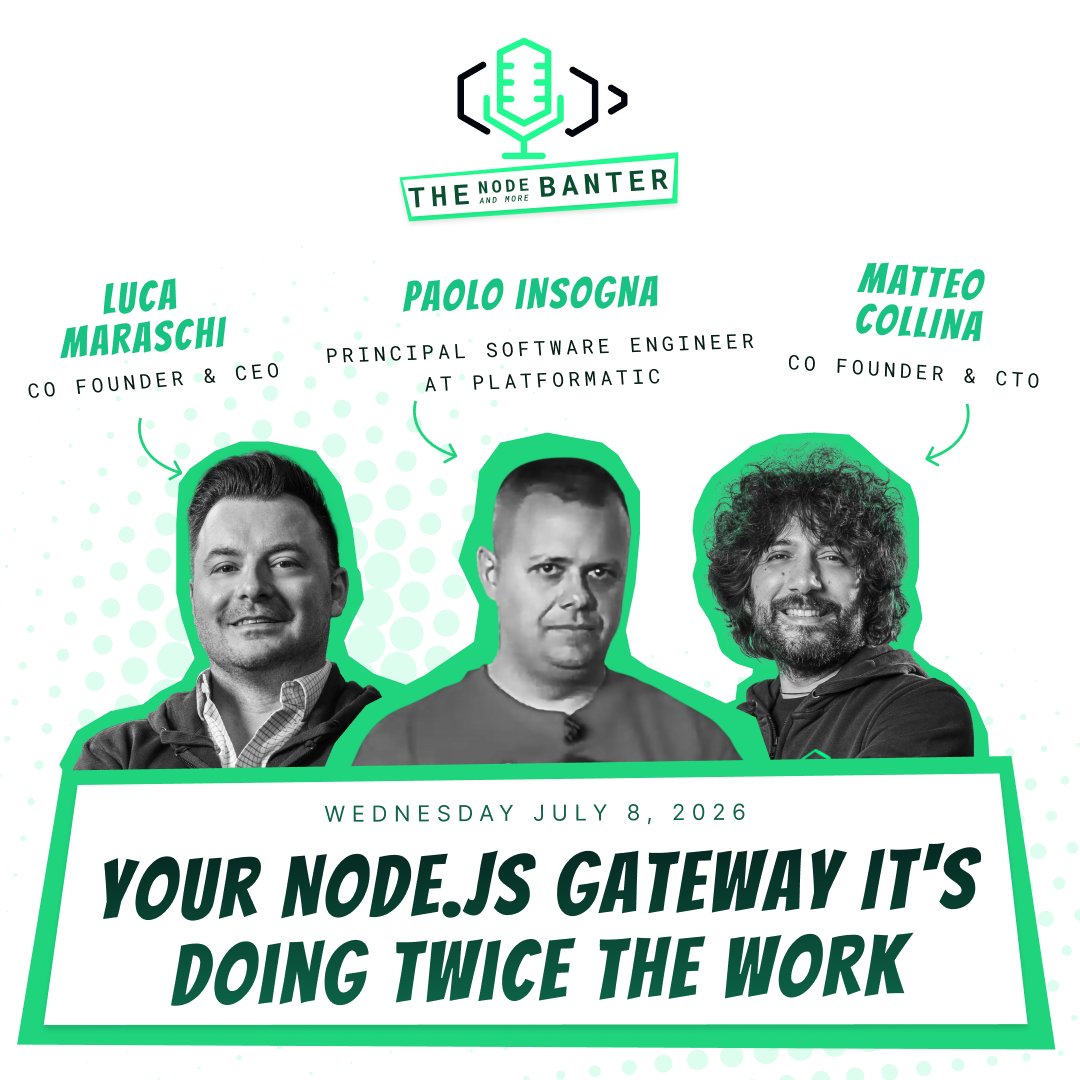
Next Wednesday, @matteocollina and I are joined by @p_insogna (Platformatic Principal Engineer + Node.js TSC member) to break down how gateway deduplication works, leader/waiter model, memory vs Valkey, and the production metrics.
Without touching a single line of your app code.
Wednesday 8:00 am PT / 5:00 pm CEST → https://t.co/uk6cp412E5
Caching doesn't protect the window between a cache miss and the first response.
10,000 concurrent req to the same uncached endpoint:
❌ Without dedup: 10,000 upstream calls
✅ With dedup: 100 upstream calls
https://t.co/jhvRsOrG5H
We did something unusual... and we're happy about it! No guest. No studio. Just
@lucamaraschi & Sam Pirzadeh, sitting poolside and talking capital. We discussed why summers are not as slow as they seem.
https://t.co/Gs6MGOaScB
"Zero downtime deployment" means your server never went offline.
It says nothing about the users already on your site when you shipped.
They're running old JS bundles, old React state, against a server that's already moved on. Next API call hits an endpoint that no longer exists. Checkout fails. Form resets. Zero downtime. Broken session.
Version skew isn't a bug. It's structural. It happens on every deploy.
The fix isn't preventing it; it's building systems that let multiple versions run together. Cookies, ingress routing, replica set management, and a control plane that handles the rest.
Building this with @matteocollina on Wednesday.
8am PT / 5pm CEST → https://t.co/UzaSw8oEfe
This is the default for most Medusa teams: backend, storefront, admin, and image optimizer split across separate repos. Four Docker builds. Four pipelines. Every internal API call burns time and resources crossing the network.
𝐁𝐮𝐭 𝐡𝐞𝐫𝐞’𝐬 𝐭𝐡𝐞 𝐫𝐞𝐚𝐥𝐢𝐭𝐲: 𝐧𝐨𝐧𝐞 𝐨𝐟 𝐭𝐡𝐚𝐭 𝐢𝐬 𝐚𝐜𝐭𝐮𝐚𝐥𝐥𝐲 𝐧𝐞𝐜𝐞𝐬𝐬𝐚𝐫𝐲.
@platformatic flipped the script.
The entire stack runs as a Watt monorepo on Kubernetes: one workspace, one build, one deployment artifact. Server-side requests from Next.js to Medusa stay internal, using thread communication. No network hops. No gateways. Just speed.
React is pinned once at the root. The image optimizer reuses the storefront codebase with a config swap. Internal and public URLs live side by side, all in one place. Misconfiguration? Now it’s much harder to get wrong.
The multi-repo e-commerce stack is just a default, not a requirement. There’s a better way.
How many deployment pipelines are you running right now? And what if you could cut that number in half?
https://t.co/BYQFj4bjq8
I’ve deployed @platformatic Watt for our new loggedout page, excellent multithreading performance with observability. Have you tried multithreaded @nodejs yet?
🎙️ 𝐄𝐩𝐢𝐬𝐨𝐝𝐞 6 𝐢𝐬 𝐨𝐮𝐭 𝐧𝐨𝐰!
@lucamaraschi & Sam sat down with Reza Sanaie.
From $100M Exit to Building Again: What AI Is Doing to Tech Finance.
https://t.co/GAqZy8x6xY
AWS ECS autoscaling reacts after the problem starts.
We benchmarked AWS ECS Target Tracking & Step Scaling against our ICC's predictive scaling.
Results:
Up to 97.8% lower p95 latency
Up to 95.4% fewer scaling actions
Better handling of traffic spikes
https://t.co/hnE21oPfCz
🔥 NEW BANTER: "Requests, Limits, and the Throttling Trap: K8s Resources for Node.js"
Your node has CPU to spare. Your pod is throttled to a crawl. Both things are true at the same time.
@lucamaraschi and I go into the kernel to explain why.
📅 May 27th
🔗 https://t.co/OICJWnornZ
Running Node.js on K8s & seeing slowdowns?
CPU limits might be throttling you, even when the node has capacity to spare.
→ Requests vs. limits. Not the same thing
→ How throttling actually happens
→ QoS classes + how to size limits for Node.js
https://t.co/MB4RcT8vVK
Kubernetes can silently corrupt your workflow data during a deployment.
Not crash it. Corrupt it. No errors. Just wrong results.
Here's the exact mechanism, and why most teams don't know they're exposed.
What would it take to actually migrate your Node runtime this quarter?
Most teams say "too risky." The risk isn't the migration.
It's not having the test coverage to trust the result.
Bun ported an entire runtime with AI. 98% tests passing. That worked because of the test suite. Not the model.
Same lesson applies to every team stuck on Node 12.
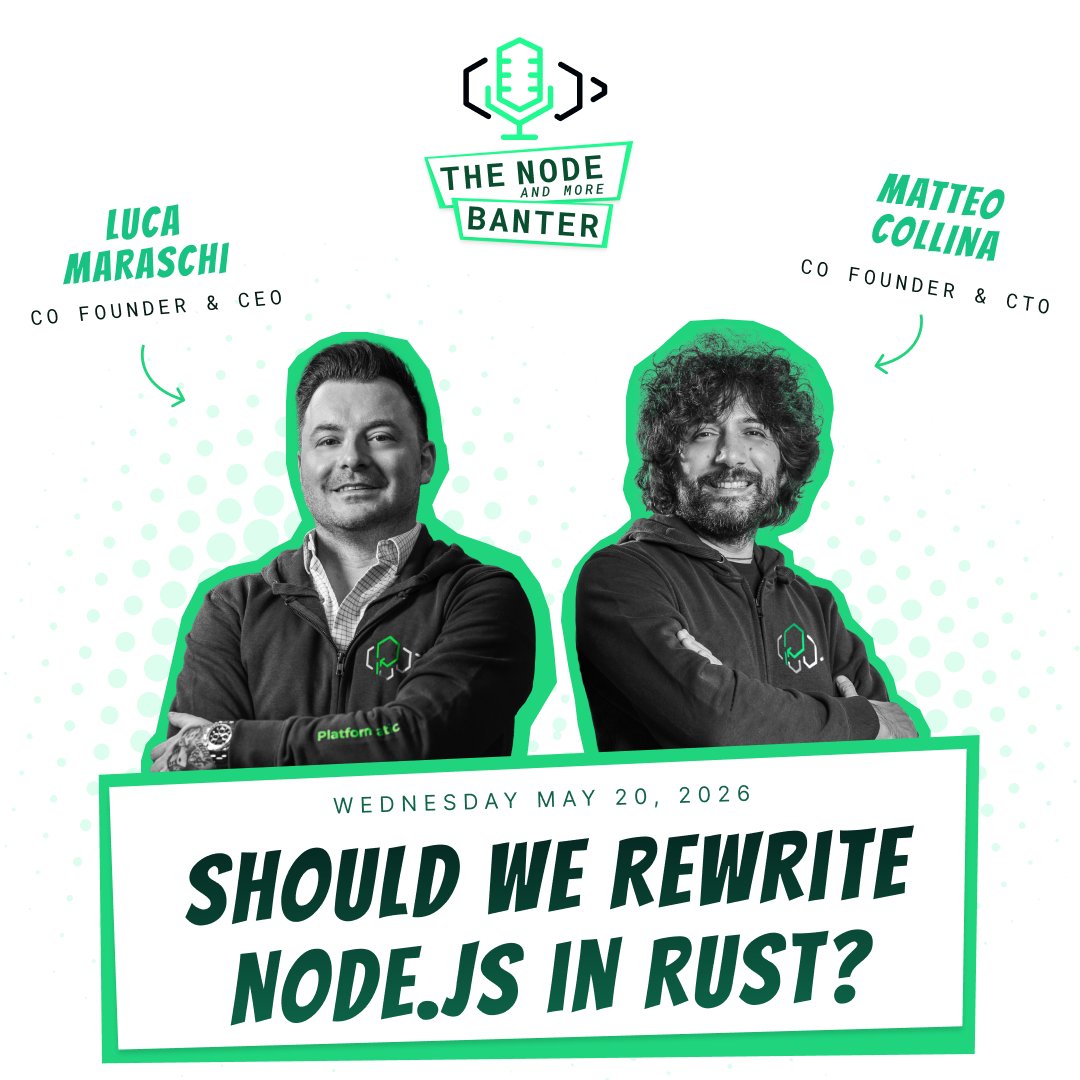
@matteocollina and I are unpacking this Wednesday on a new episode of our @platformatic podcast.
May 20th, 8:00 am PT / 5:00 pm CEST → https://t.co/1DMDl5DPuY