@realEstateTrent Not answering the call is not the issue. I can honestly say I am that busy. However, not returning the call on the same day is inexcusable.
@MrFamilyOffice “Family Offices are the only group of people who pay publicists to remove public information about them”.
A partner of mine said this while discussing our typical client for a PE fund raise we’re doing with a B/D yesterday. So true - and I don’t blame them one bit!
@chernobelskiy We’ve been raising for over 14 months in preparation for what’s happening now. Our goal is to save as many LPs in struggling deals as possible. I’d love to talk with you more about it if you think any of your clients would be interested in saving the deals they invested in.
Who is playing offense next year?
What happens when a large portion of the $13,800,000,000 worth of multifamily properties purchased in 2021 with highly levered, 3-year, floating rate debt starts maturing in 2024?
Opportunities ahead.
More details in my newsletter tomorrow.
Office was the first commercial real estate asset class to enter distress this cycle.
Class B & C Multifamily in the Sunbelt is the next shoe to drop.
Too many of these properties were purchased between 2020-2022 at extremely low cap rates that buyers were able to make pencil by using significant rent growth assumptions and turning units, with the intention to flip out after only a couple of years in the deal..
In addition, they underwrote these investments with a 3-5 year hold with exit caps in the 4’s and 5’s.
Problem is, the rent growth has stopped and over the past 12 months is starting to go negative.
Markets that were crazy hot, markets like Austin, Phoenix, Vegas, Nashville, Raleigh, Orlando, etc are now experiencing YOY rent declines, while operating costs are rising rapidly, especially insurance.
Furthermore, exit cap rates are 100+ bps higher and climbing. Will likely be in the 6’s and 7’s, not 4’s and 5’s.
Almost all buyers were GPs using LP money they raised for the acquisition promising mid to high teen IRRs.
Here’s the problem; on the surface it appears that they can’t sell, they can’t refinance, and they can’t raise more money.
They will try all three, but more often than not won’t be successful.
It will be difficult to sell, because cap rates have moved and they likely haven’t turned enough units and pushed rents enough to compensate for the value loss from the higher cap rate.
It’s challenging to refinance, because to start the lender likely doesn’t want to stay in the deal. But regardless of lender, the DSCR is totally jacked up because interests rates are in the 6’s and 7’s, AND lenders have increased their DCR from 1.15-1.20 to 1.25-1.30.
The LTV with these numbers are so low that it will likely necessitate a capital call every time.
And it’s incredibly hard via capital call to raise money because most LPs don’t want to put good money after bad, so capital calls are very challenging and optically not ideal for a GP.
So all of these factors; lower values, softening rents, challenging lending environment and pessimism about values falling further are in the process of creating a surge of loans that will mature in ‘24 and ‘25 that will not be able to be refinanced or paid off via a sale.
While the culture amongst lenders and special servicers is to work it out with the existing owner as long as there is good behavior, not everything can go that way.
Not every owner behaves well when they digest the fact they worked hard for multiple years on an asset and will effectively make zero dollars.
Either because the lender has to take back the asset, or an owner throws them the keys because they have no money left in the deal and the loan is non-recourse, expect a material increase in distress in class b & c “value add” Multifamily.
There will be some fantastic buying opportunities coming down the pipe.
Having your capital and lender lined up ahead of time is paramount.
In addition, having your deal flow pipeline via the brokerage community as well as acquisition personnel is essential.
Fwiw many of these fundamental truths apply to Class A multi in these markets as well. But those deals tend to have a little more cushion to absorb loss than the pure value add deals did.
Office was the first. Multi will be the second….who wants to take a guess at the third?
One of the largest syndicators has this on their website
"Returns are all net of fees and promote. As of March, 31st 2022."
Good news: I love the transparency!
Bad news: today is November 22, 2023
I have analyzed over 250 multifamily deals, spoke with dozens of brokers, lenders, and other operators across the country this year.
The last 6 weeks is materially different.
Multifamily pricing this year is already +25% of peak values. Now, nearly every marketed deal is missing pricing expectations by +20%. This month alone represents 5-10%.
That means what was a $40m deal in 2022 is now asking $30m and receiving bids at $24m - IF they catch a bid.
There is an entire class of deals throughout the sunbelt that can’t even get equity interest until the lender takes over. We are talking deals worth $.50 on the debt for an appropriate risk-adjusted return.
This covers core urban towers to class C suburban garden-style deals.
Equity expectations has shifted to year-1 positive leverage at minimum for a well located class B deal. 6 months groups were ok taking 100bps of negative leverage. So what was a 5% cap is now a 6% cap.
From a pricing standpoint, that 1% of cap rate movement (the difference between positive and negative leverage in this instance) would represent about a decrease of $10m on a $40m (now $30m) deal.
Brokers are no longer trying to save face about this issue. They are well aware of pricing expectations. Furthermore, since volume is down 50-70%, they have no time to waste. The focus is now finding willing market sellers. They don’t want to process deals that sellers will pull if pricing misses what they think - because it inevitably will miss.
The issue is most of these “willing”, now forced, sellers aren’t actually in the driver seat. The equity on their deals is worthless. Zeroed. It’s now up to the lenders on how to process. But most haven’t foreclosed yet.
Lenders have kept it cool up until about 4 weeks ago. They refused to acknowledge the elephant in the room. Now news is breaking on restructurings, foreclosures, fraud, and missed pricing expectations. Up to this point, lenders have been current on loans.
Now they are not. Lenders are waking up. They realize if they do not move right now then the issues only multiply. We are just starting to receive loan sales. But this is just the beginning because fundamentals in the market have remained relatively strong. But things are changing.
Operators are in full asset management mode. Rents are slipping, expenses are up, and loans are maturing. The goal today is maintain quality occupancy and fight against delinquency. Most operators have stopped high-end renovation plans as the premiums are commanding the same rents pops as the past. What was a $10,000 interior renovation for $200 rent pop is now a $13,000 renovation for a $100 pop. It just isn’t worth it.
Once (if) we start processing the bubbling issues in the broader economy, and the glut of supply releases at the same time as fundamental softening, there will be massive issues near term in the multifamily space.
Get ready because it is about to get spicy 🌶️
Anyone predicting exit cap rates right now is fooling themselves
Underwrite the deal. What purchase price gets you to a stabilized yield at which you’d be willing to hold the deal unlevered?
That’s where you should be a buyer. All other analysis is mostly noise right now
Hearing rumors about a 20 property multifamily portfolio going back to the bank
The first thought that pops into my mind is all the LP capital that'll be lost - half of them probably have no idea that the news is coming
Don't DM for the GP name, I won't give it out
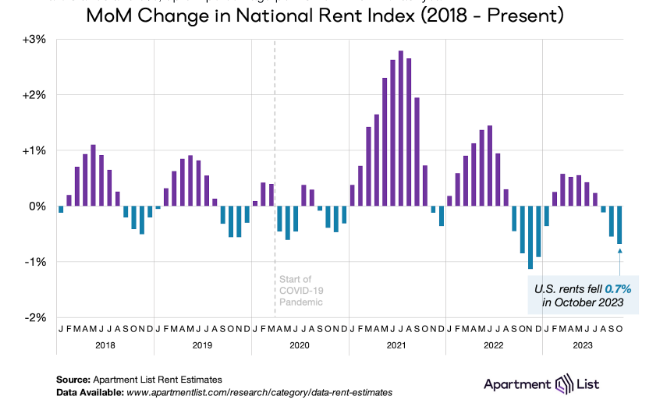
Nationwide rents fell another 0.7% in October, the third consecutive month of decline. A relatively weak rental market has now persisted for well over a year, characterized by increasing vacancy rates that are keeping rent growth in check. Year-over-year rent change has stabilized at -1.2% and is negative in 66 of the nation’s 100 largest cities. @ApartmentList
The Real Deal’s October issue is live for digital subscribers and soon to hit mailboxes across the country.
Get the inside scoop on real estate's hottest headlines here: https://t.co/xk6ta4aVVE
@MultifamilyMark Not detracting from mf brokerage community in the slightest, but I feel like this applies to any professionals in consultative selling. It takes 6+ mth to cross the goal line. Sometimes it feels like everyone is trying to tackle you. No better feeling than pts on the board.
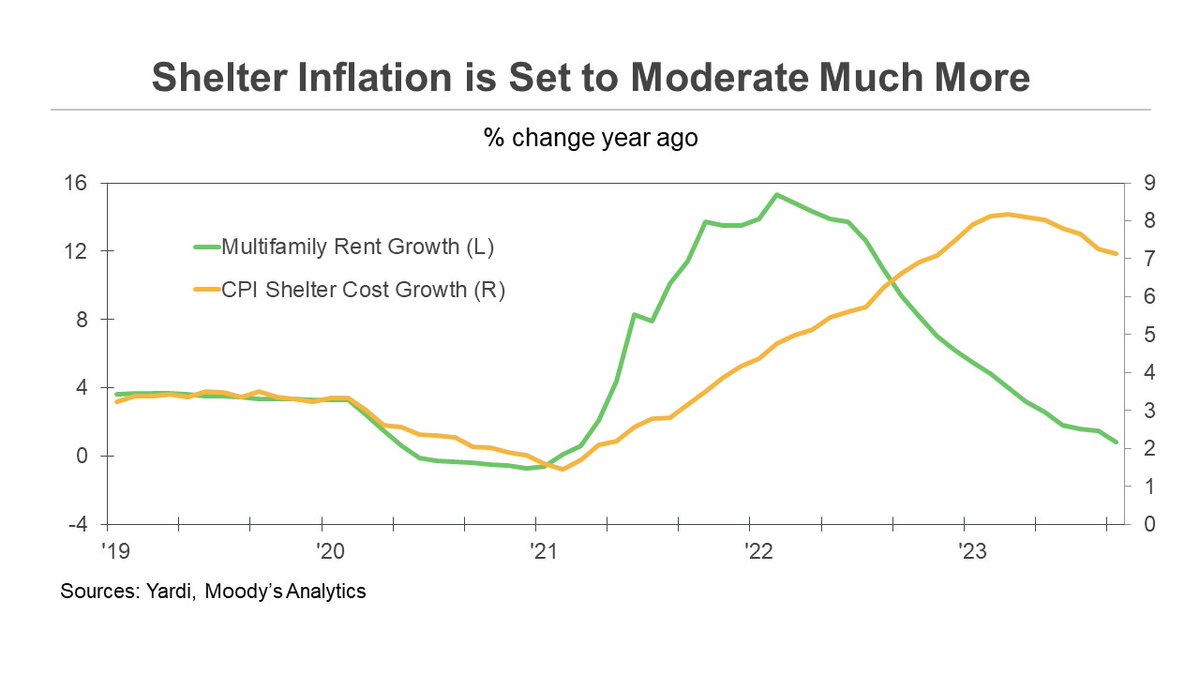
As a professional economist, I do lots of forecasting. Some forecasts I’m confident in, some not so much. I’m confident that the growth in consumer prices for shelter is headed much lower and that this will push overall inflation back near the Fed’s target by this time next year.