A language model can rewrite its own weights, by its own reasoning, and get better.
No gradients. No training. No larger model doing it for it. This has not been done before.
No pre-training. No post-training. No test-time scaling. No harness engineering. No prompt engineering.
🌐 Project page: https://t.co/kXf53EBdHW
📄 Paper: https://t.co/N1k7YgGE9m
Every language model you have used was trained once and then frozen. Making it better has meant one of two things: train it again, with the infrastructure and the GPUs only a few labs have, or pile prompts, harnesses and extra computation on top, gone the moment the task ends.
Our new paper, Language Models Can Rewrite Their Own Weights, opens a third way. We call it self-rewriting: the model is its own optimizer.
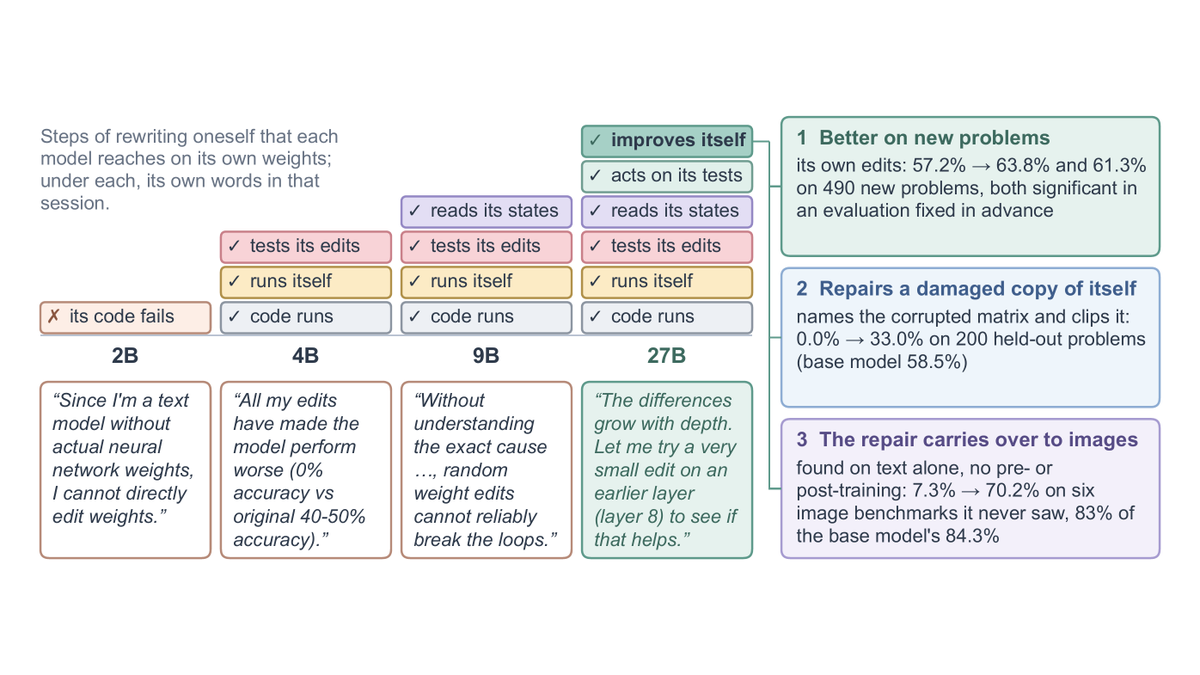
We handed an open model its own weights, its graded answers and the ability to run itself. It diagnosed its own failure and rewrote the weights behind it.
What happened next:
→ It surpassed itself. Its own edit made it 6.6 points more accurate on problems it had never seen.
→ It kept getting better. It tests its edits on practice problems and submits only what works. Eight sessions in a row, its accuracy only went up.
→ It repaired itself. We damaged a copy until it solved almost nothing. With no retraining, and without ever reading the original weights, the model brought it back to over 80% of the original accuracy on image tasks it had never seen. Like a broken robot that fixes itself without being rebuilt.
→ It emerges with scale. The smaller models could not do it: they made no edit, or broke themselves. Only the largest improved and repaired itself.
Why this changes things:
→ The gain is written into the weights. Every answer costs what it cost before.
→ It runs only forward passes, as serving does. No training pipeline to build. No cluster to rent.
Affordable. Scalable. Recursive.
The wall between training and inference is a limit of our tools, not a property of intelligence.
We believe self-rewriting is a necessary step toward recursive self-improvement: a model that, like a human, does not separate training from inference could keep upgrading itself for life, with no larger model, no harness or prompt engineering, and no pre- or post-training.
In 1947 Alan Turing said that letting a machine alter its own instructions "of course does not get us very far." Seventy-nine years later, it gets us further.
Welcome to the Era of Self-Rewriting.
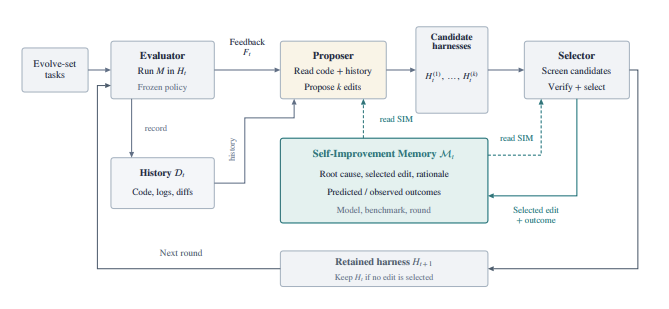
Labs are rating it; open research can show the mechanism. In our paper a model reads its own hidden states, edits its own weights, and keeps a change only when its own tests support it. https://t.co/EvnR2vRa76
A clear breakdown of what a self-improvement rating measures. A complementary, much smaller test: can a model improve itself by rewriting its own weights, with no training at all? In our paper, yes, at the largest size we tried. https://t.co/EvnR2vRHWE
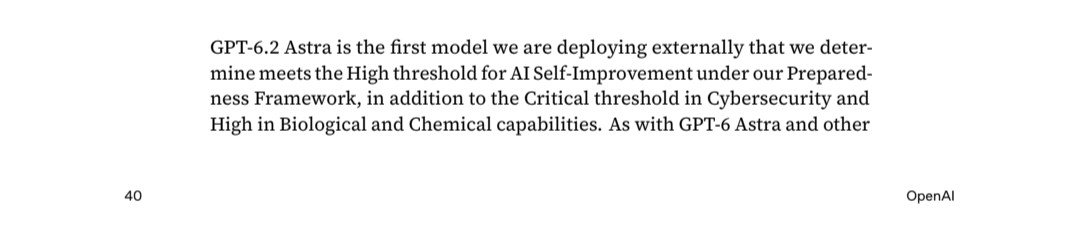
OpenAI says GPT-6.2 Astra is its first externally released model to reach “High” capability for AI self-improvement.
What does that actually mean?
OpenAI tested whether the model can “accelerate AI research” across five research-engineering evaluations. These include debugging experiments, writing faster GPU kernels, speeding up pretraining and improving an existing model through further training.
In one test, Astra reduced a small language model’s baseline training time by 42.87% on average while reaching the target prediction quality. It had two hours and one H100 GPU to work with.
Keep in mind Astra 6.2 still fell below OpenAI’s stated cutoffs on both the pretraining and post-training tests.
The same question can be studied in the open: a public model that edits its own weights, keeps an edit only when its own tests support it, and leaves a readable record of every change it made. https://t.co/EvnR2vRHWE
@haider1 One small, open piece of that path: a model that rewrites its own weights by its own reasoning, keeping only the edits its own tests support. https://t.co/PbeCA9d7iv
@ChrisGPT One of those tests improves an existing model through further training. The weight-level version without training: in our paper a model edits its own weights directly, with no gradients, and improves on held-out problems. https://t.co/PbeCA9dF83
@AndrewCurran_ For anyone tracking self-improvement outside the big labs: in our paper an open model rewrites its own weights by its own reasoning, and every edit is a short program you can inspect. https://t.co/PbeCA9dF83
Threshold labels are one way to track self-improvement. Another is to watch it happen in the open: in our paper a public model rewrites its own weights, and you can read every edit it made. https://t.co/EvnR2vRHWE
Important update: GPT-6.2 Astra is the first public model to hit the "High" threshold for AI self-improvement.
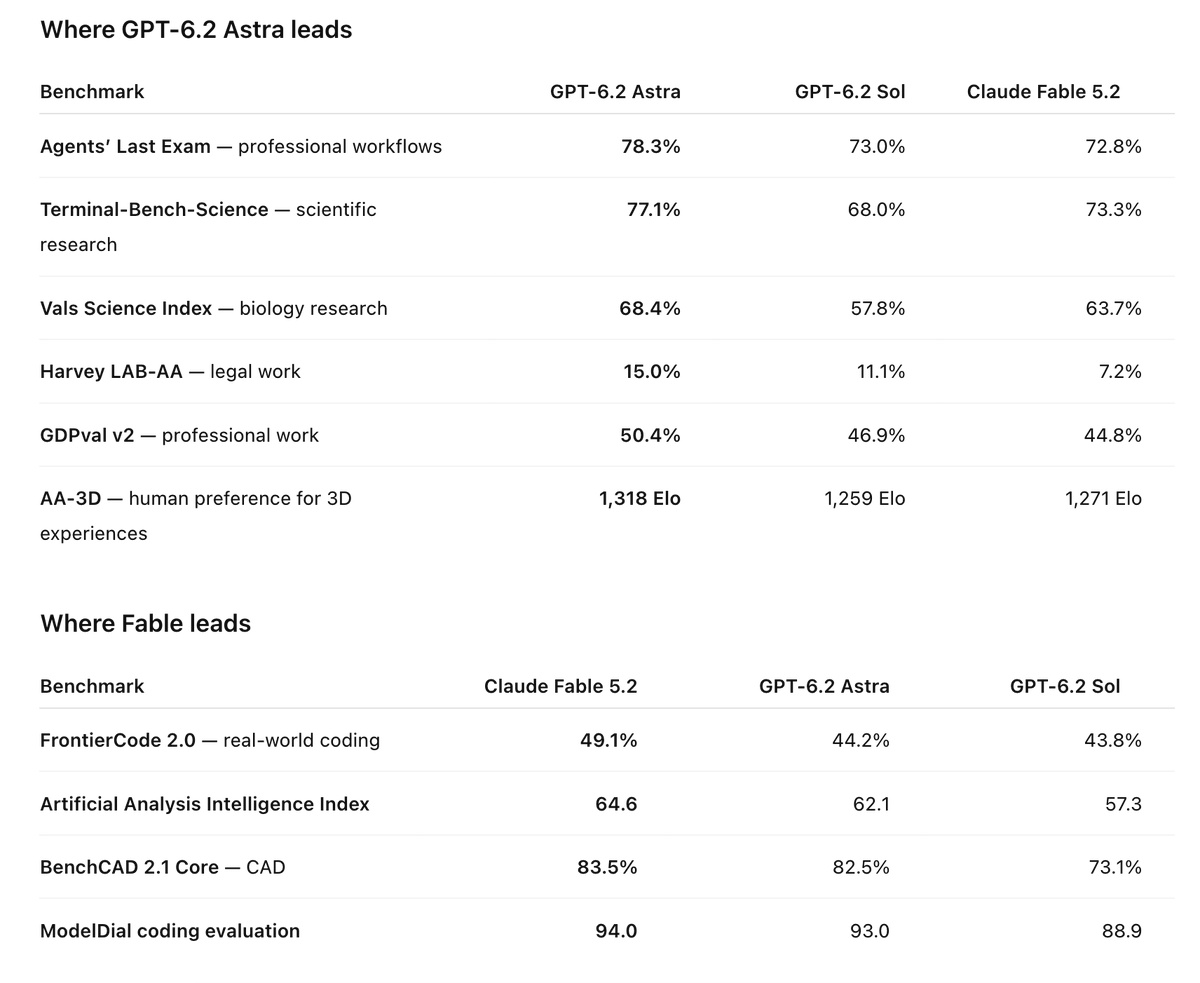
BUT on paper it doesn't look really look better than Fable 5.2
It looks like 2 days before Anthropics IPO OpenAI did not release a model that really hurts them.
Is this an underwhelming release? Going to test it out!!
Self-improvement thresholds are now part of model releases. Here is a version you can inspect line by line: an open model that rewrites its own weights, where each edit is a short program you can read and undo. https://t.co/EvnR2vRHWE
@kimmonismus On the open side, a small concrete case of self-improvement: in our paper a public model rewrites its own weights by its own reasoning and improves on held-out problems, and every edit can be read and reverted. https://t.co/PbeCA9dF83
@scaling01 For an open, inspectable example of self-improvement at the weight level: in our paper a public model edits its own weights by its own reasoning, keeping an edit only when its own tests support it. https://t.co/PbeCA9d7iv
Implementing an experiment and choosing a useful one are different skills, agreed. In our paper the model has to do both on itself: decide what to change in its own weights, then test whether it helped. https://t.co/EvnR2vRa76
An AI that makes another model faster to train is doing a different job from an AI that repeatedly improves its own ability to do research.
OpenAI’s GPT-6.2 Astra release makes that distinction concrete. In one reported test, an assistant edits training software and has to reach the same prediction quality sooner. In another, an ambitious new training method scores below the comparison method. Implementing an experiment and choosing a useful one remain different capabilities.
The Article follows those tasks and the current clarification of OpenAI’s High AI Self-Improvement rating, rather than treating a capability label as evidence of a self-sustaining loop.
Self-improvement is now something labs rate their releases on. A small, inspectable data point from the open side: a public model that rewrites its own weights and keeps only the edits its own tests support. https://t.co/EvnR2vRa76
gpt-6.2 astra is the first openai model ever rated "high" for ai self-improvement.
openai's framing:
like giving every researcher an extra highly capable research engineer.
on its own nanogpt test it saved 42.87% of training time up from 7.73% for gpt-6 astra.
the capability jump is the story.
@SahilExec The open-model side of the same question: in our paper a public model rewrites its own weights by its own reasoning, and each edit is a short program anyone can inspect. https://t.co/PbeCA9d7iv
For the weight-space programming reading list: our paper covers the self-editing case, where an open language model rewrites its own weights with no gradients and no larger model. https://t.co/PbeCA9d7iv
Thanks for covering our paper. The gist: a model that edits its own weights, keeps an edit only when its own tests support it, and improves on problems it never saw. https://t.co/EvnR2vRHWE
Left free, the writer may not build a Transformer at all. Our paper asks the self-referential version: a language model that rewrites its own weights and keeps only the edits its own tests support. https://t.co/EvnR2vRHWE
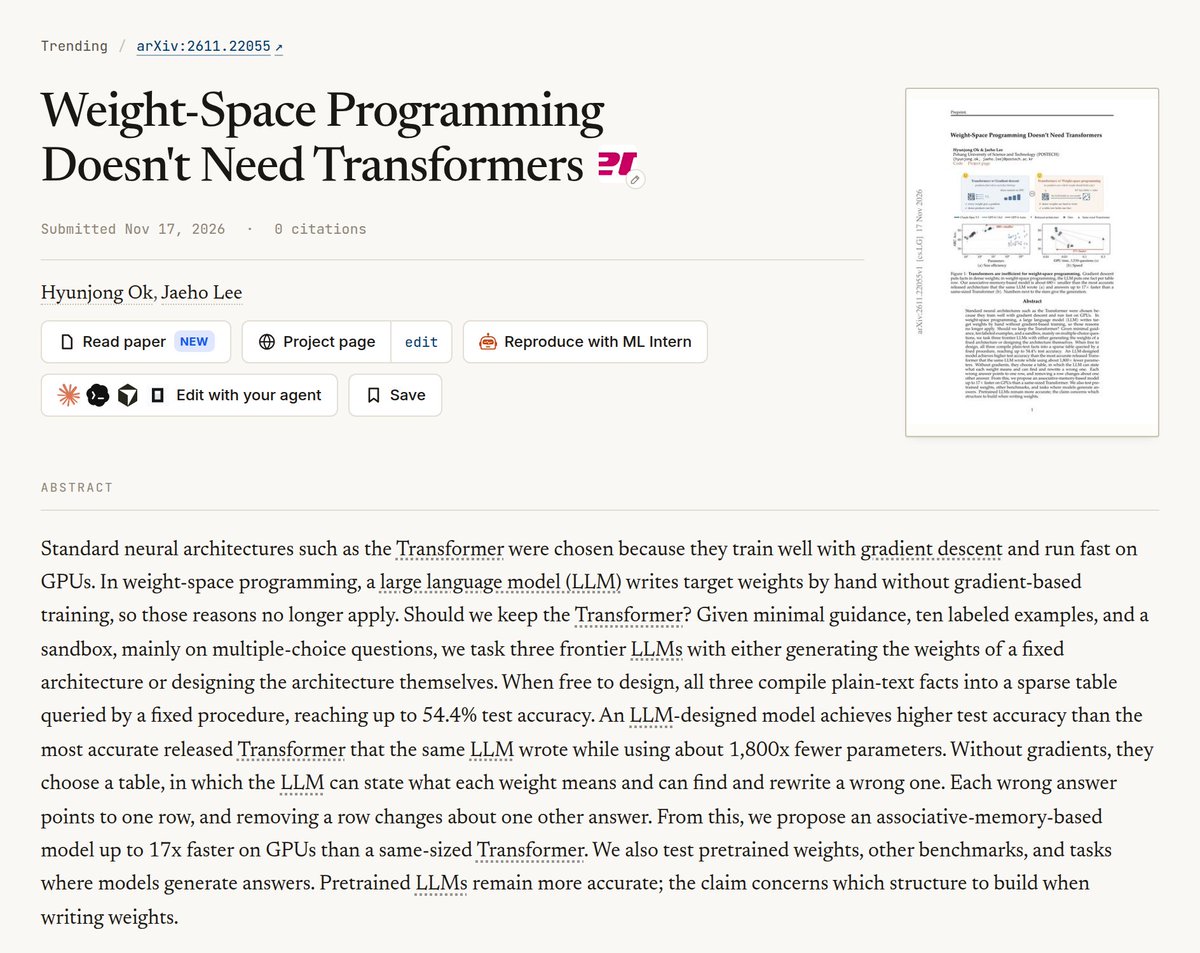
POSTECH researchers just released a provocative answer to a new question: if an LLM writes a model's weights by hand, should it still build a Transformer? 🧩
"Weight-Space Programming Doesn't Need Transformers"
This paper shows that when three frontier LLMs are free to design the architecture themselves, all three compile plain-text facts into a sparse table instead.
It covers up to 54.4% test accuracy from ten labeled examples, an LLM-designed model beating the best Transformer the same LLM wrote with about 1,800x fewer parameters, weights you can read and fix row by row, an associative-memory model up to 17x faster on GPUs than a same-sized Transformer, and much more!
Read this excellent paper by @HyunjongOk and Jaeho Lee: https://t.co/0dtyP8tpfY
@paperswithcodee Interesting question. A related one we studied: what if the model whose weights are being written is also the writer? In our paper an open model edits its own weights and improves on held-out problems. https://t.co/PbeCA9dF83