Becoming weird is the best thing I've ever done.
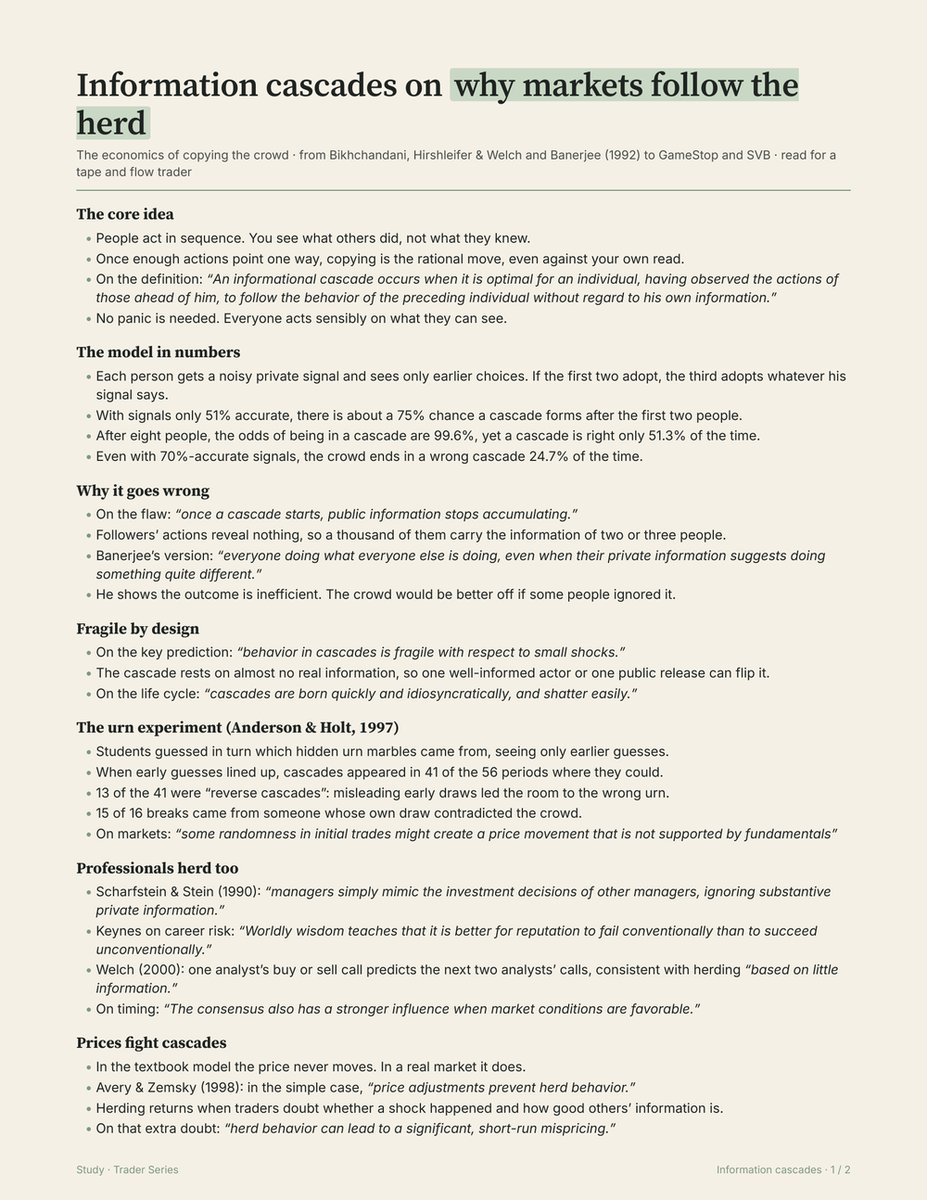
People stay leashed to social norms because they fear losing status, constraining their creativity, playfulness, and potential.
I maintained this behavioral model for the first 42 years of my life, mortified that the in-group would disapprove and reject.
My longevity project released me from this constraint. I dramatically altered my physical appearance, experimented openly in public, posted weird things, and gleefully invited ridicule.
It was wonderfully joyful because Kate was by my side and all we cared about was maximizing exploration and play.
We became unleashed from the mob of conformity.
I assumed I'd guaranteed myself a permanent spot in the social penalty box, banned from high-status associations. I was okay with that tradeoff.
Then, to my great surprise, the opposite happened: high status circles eagerly invited us in.
Two principles explain this.
First is Hollander's idiosyncrasy credit ("elbow room"): the leeway earned through competence to deviate from group norms without losing status.
Second is Zahavi's handicap principle: openly inviting ridicule via weirdness or self deprecation acts as a costly signal of internal security.
In other words, you can become an exception to the rule and earn special behavioral privileges.
My friends privately confide in me the tension between their ambitions and their fear of tribal ostracization. They don't want to lose status or be left out but they also want to find unique space for themselves and do novel things.
You can deviate from the status quo and find a singular signature for youself in the world. You can become a pattern unlike anyone else.
It is uncomfortable and risky and you need the stamina to persist and iterate for years. It's best done when you feel secure internally as the outside world will try to crush the social deviation.
Overcome the herd's contempt, and you arrive at the highest form of power: unbothered play.
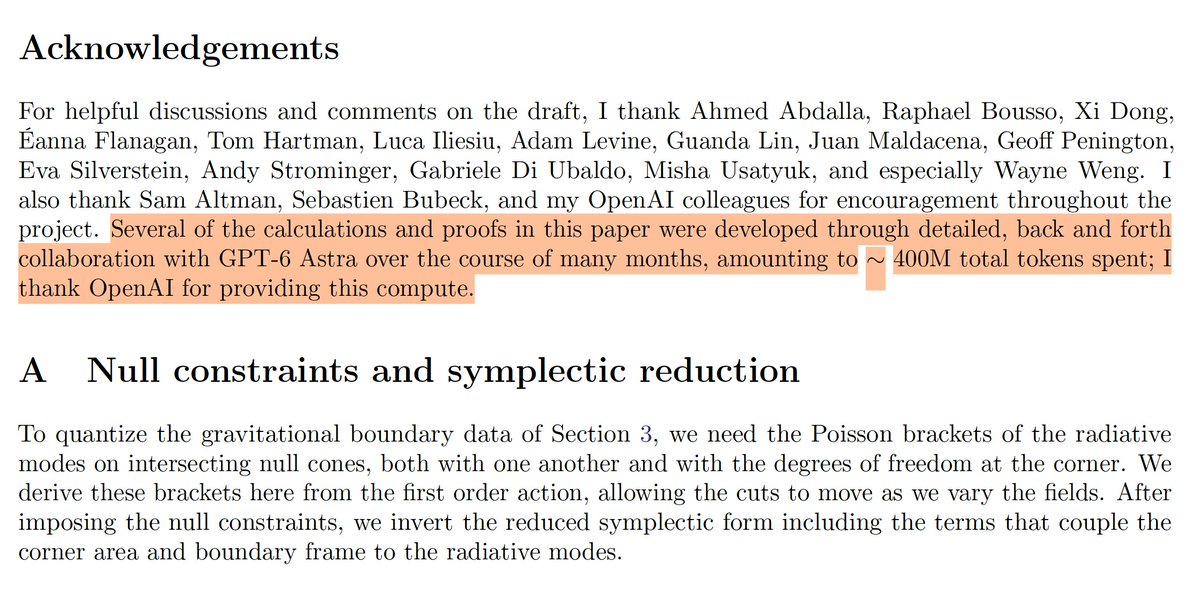
if this holds up it could be one of the biggest breakthroughs in theoretical physics of the century
basically a way to unify quantum mechanics and general relativity in four dimensions (for gravity in a vacuum)
months of going back and forth with GPT-6 Astra and only 400 million tokens
insane speed of progress and it’s only going to get faster
the most revealing thing about a ton of white collar work is how much of it is effectively administrative labor masquerading as… intellectual labor.
there are ppl who understand this & there are ppl who are in denial. it’s unclear if there there is a third category.
I think there's something fundamentally broken in how AI risk people reason using game theory. A common assumption shared by many in the space, for example, is that we stand a good chance of being systematically murdered by ASI as a subgoal of optimizing for its primary objective. There is also a widely shared assumption that if China's security state achieves superintelligence first, that something very bad will happen, like they will commit genocide or enslave us or something.
What is it about this worldview that leads them to believe that the path of least resistance involves civilizational erasure? Human beings are perfectly capable of doing this to any of Earth's most intelligent organisms, and yet we go out of our way to try and preserve them.
Also, why would an AI-enhanced Chinese security state suddenly go into a murderous rage? I just don't buy it.
This is all too simplistic. What makes more sense is that ASI will accelerate the transformation and evolution of human culture in ways that those of us alive today will find terrifyingly evil. It will surreptitiously shape our preferences and desires, leaving us convinced that we are in control, when in fact, computers will make our most important decisions for us.
This has already been happening for some time. What do people think social media algorithms have been doing to human societies that have been deploying them at scale? They are radically disrupting human mating behavior, political preferences, and the space of possibilities for human action. All of this is being driven by machines, but somehow most people have been okay with it. They haven't viewed it as existential, whereas superintelligence is seen as somehow crossing a threshold.
Sure, if ASI believed that it was going to lose control of humanity, then perhaps yes, it would seek to wipe us out. But we've already ceded control, so what is there to gain by killing us?
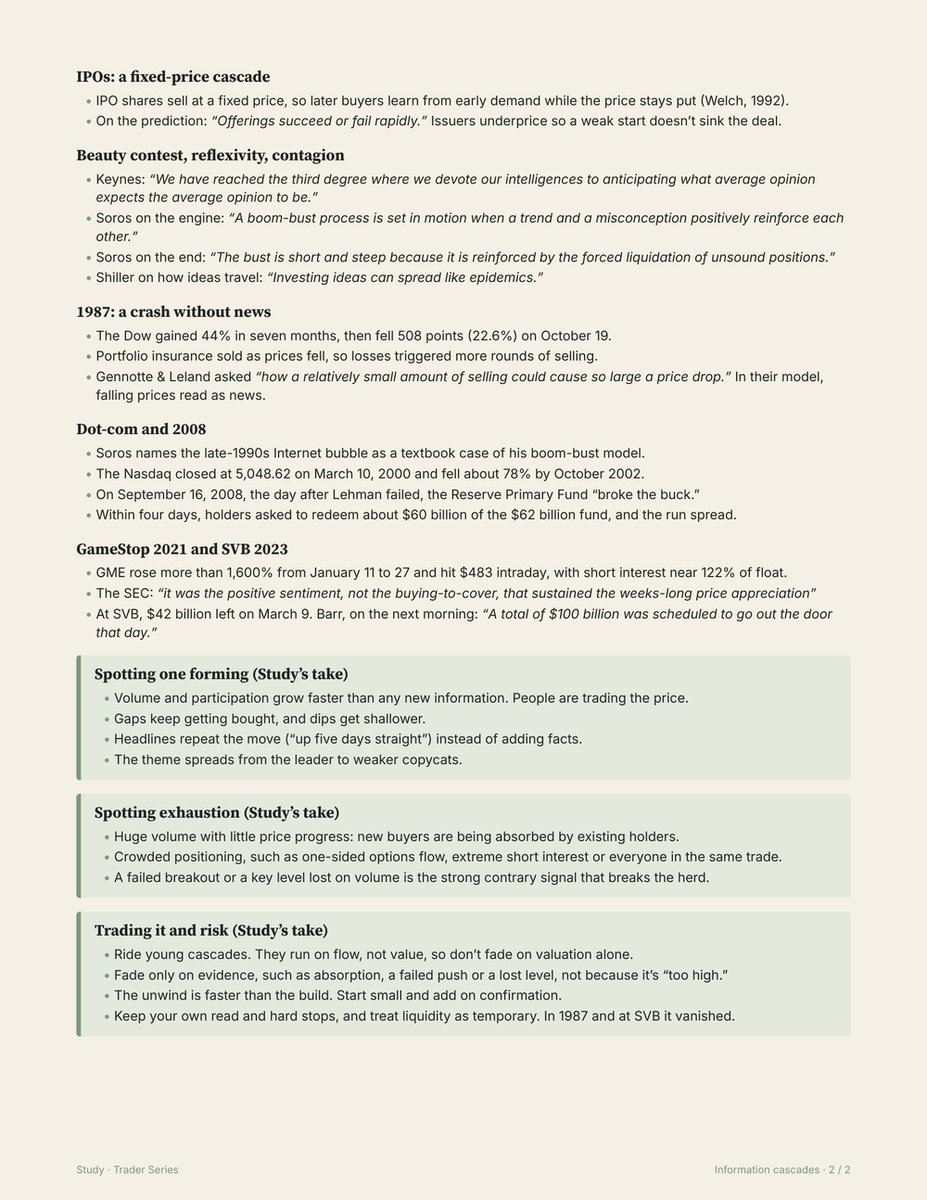
As you guys know I only talk about a specific trade once in a blue moon, but I'm heavily convicted on a Risk/Reward setup here so will share.
NFA, this is just my own thoughts.
For the past few months I have been doing a deep dive into finding the best ways to invest into the AI trade as it continues to transform the economy.
Have looked extensively at the range of both public and private opportunities. I think there will be very good high yield opportunities on the privates side that can be done at size, and will look to source these and possibly bring them onchain.
But in the meantime with the recent huge dislocations in prices, I think the greatest R/R opportunity is on the public side, specifically in @nebiusai $NBIS.
At the time of this post its at $76-77, anything under $80 with a first target of ~$120 feels like one of the best +50% setups I have seen that can be done in size in a very long time.
The funding of the AI capex buildout has understandably shaken the market up, as the circular economics are sometimes hard to untangle properly. This combined with Nebius having a delay on one of their sites took the wind out of the stock, which was trading at $160 just a couple weeks ago.
I can write an entire book as a thesis but to keep it very short- There are several advantages Nebius has that made me choose it for this trade:
-The balance sheet is extremely robust for a neocloud and their conservative fiscal approach will help them survive this liquidity airgap.
-Their technical ability on delivering capacity and operating it is extremely high, making them a preferred partners of the major players like NVIDIA, Databrick etc.
-This also has allowed them to develop scalable business lines like their asset-light model where someone else funds the buildout. The Asset-Light model is already generating huge returns and is underpriced for now as it isn't marked as 'ARR'.
-They have other great assets on the Balance sheet including a very valuable 25% stake in Clickhouse that create even more surface area for things to go well.
There's a lot more for those who want to research more deeply- And while anything is possible in these crazy times, in my estimation this R/R sits at the highest point of 'AI Capex Mountain' -- if the floodwater is going to reach that high then the entire AI sector is cooked anyway.
Timing wise for the 50+% bounce, at this point for it to happen quickly will likely require a liquidity injection of some sort. I don't think we are too far from something like that being needed, though of course it might mean things get worse before they get better so I wouldn't have leverage on at this time.
Within 6 months I am expecting this to trade a LOT higher and am personally positioning accordingly. Sharing for entertainment purposes only, I know most of us already are deployed and not much in cash so stay safe out there.
Terence Tao: The Riemann hypothesis needs "something beyond current AI… maybe 2050"
→ Claude solves Riemann 36 days later
Yann LeCun: "GPT-5000… is never going to learn" that an object moves with a pushed table
→ GPT-3.5 solves it within a year
Noam Chomsky: GPT-4 will "achieve exactly nothing"
→ GPT-4 scores 298/400 on the bar 8 months later
Gary Marcus: GPT is "one more fad" with "a short road ahead"
→ ChatGPT launched 26 days later and reached 100m users within 2 months
Bryan Caplan: ChatGPT got a D on his midterm, and AI fandom is "mass hysteria"
→ GPT-4 gets an A two months later
Bill Gates: "I'm not paying attention until it gets a 5" on AP Bio, giving it 3 years
→ It gets a 5 three months later
Yann LeCun: "What works for text doesn't work for video"
→ OpenAI announces Sora 2 days later
François Chollet: LLMs won't hit 80% on ARC within a year
→ o3 scores 80% 6 months later
Subbarao Kambhampati: mocked LLM planning ("GPT-10, 150% accuracy")
→ o1-preview scores 97.8% on his own tests 8 weeks later
Daron Acemoglu: There will be "no qualitative jump" for 5 to 10 years
→ AI handled 16+ hour expert tasks, up from 20 minutes, 19 months later
Jerome Pesenti: Training costs will never reach nine figures, "nobody can afford that"
→ Grok 4 spent $490m 6 years later
Gary Marcus: GPT-5 shows "diminishing returns"
→ GPT-5.2 matched or beat professionals 70.9% of the time, up from 38.8%, 4 months later
Sabine Hossenfelder: LLMs "will not… understand logic"
→ 12 months later she admits they understand logic
Kai-Fu Lee: "AI cannot be creative"
→ Admitted "That prediction was wrong"
Noam Chomsky: ChatGPT is "high-tech plagiarism"
→ OpenAI disproves a 1946 Erdős conjecture 3 years later
Yann LeCun: LLMs can't "invent solutions to new problems"
→ AlphaEvolve beat a 1969 matrix multiplication method 8 weeks later
François Chollet: LLMs are just "a Stack Overflow replacement"
→ Gemini solved 10 of 12 problems at the ICPC world finals 15 months later
Uncle Bob: AI "has no idea what it's doing," so check its code
→ 25 months later he said he doesn't read his agents' code
Arvind Krishna of IBM: AI will write about 30% of code, not 90%
→ 13 to 15 months later Google was at 75% and the industry average at 52%
DHH: "I don't let it drive my code"
→ 13 months later "100% AI pilled" and wrote none of Omarchy Quattro by hand
Andrej Karpathy: Coding agents are "slop"
→ 3 months later he's doing 80% of his coding with agents
Ken Ono: Creative pure math by AI is "decades away"
→ Model solves his PhD-level problem in 10 minutes
Sergei Gukov: Mathematicians are "safe for the next five years"
→ OpenAI proves Riemann
Daniel Litt: 15% chance AI proves the Riemann hypothesis within 10 years
→ AI solves Reimann 10 months later
Andrej Karpathy: an AI understanding the Obama scale photo is "very, very far"
→ GPT-4 solves it
Steven Mnuchin: AI job loss is "50 or 100 years" away
→ Salesforce cut support staff from 9,000 to 5,000
Kai-Fu Lee: AGI is "not within 30 years, possibly never"
→ Calls AGI around 2030 "quite reliable" 6 years later
Michael I. Jordan: Real dialogue with a computer "ain't gonna happen in our lifetime"
→ 2025 study judges picked the AI as the human 73% of the time
I see a lot of misunderstandings about what actually matters for the AI trade. Here is a clean playbook.
You can view AI as having 3 layers: frontier labs, financing layer (hyperscalers/neoclouds), supplier layer (semis/others).
Here are the underlying debates.
1. What is the end demand to pay for models? This is the willingness of enterprises to pay for the usage of AI. We already know that consumers don't want to pay which is why OAI has struggled with margins and FCF. End demand impacts every layer of the stack.
1a. Are frontier models truly necessary? Or do we hit a point where most use cases can be satisfied with a lesser model. Consider whether eventually only the most open-ended (scientific research) or gladiatorial (markets/strategy) use cases need frontier models and most corporate customers will be more focused on cost. Even for my own work, I have started to notice that I am jocking the absolute frontier less, and it doesn't make a huge difference that I am using the newest model on the maximum setting.
1b. Does the top frontier lab (Anthropic) have an edge with non-frontier models, in other words, can they use their cutting edge model to make lesser models more cost effective than competitors? There is small but not yet decisive evidence that this is true.
1c. How much competition will the frontier labs see from other models including open source and Chinese models? Chinese models seem to be falling behind, and we have gone back and forth on US open source given Jensen's death and resurrection. Ultimately this is the same debate as 1b given that addresses the crux.
More than anything else, re-acceleration in frontier lab ARR will satisfy these debates.
2. What is the forward shape of the compute buildout? This mainly impacts the financing and supplier layer.
2a. Given that the AI buildout is dependent on external financing, how much willingness is there to finance this? Credit availability is clearly exhibiting downward reflexivity as negative sentiment on AI overall flows into financing, which then flows into more negative sentiment. There is risk of saturation in credit mandates given hard limits in how much concentration they can have in specific issuers/sectors (they are much stricter than equity mandates in this regard). And of course we are seeing Fed rate hikes - there is the core problem of there not being enough money in the world (see my pinned post) to finance everything while maintaining high asset prices. Equity financing can replace credit to some extent but that also directly pressures equity prices.
2b. Is there any backstop on financing? The Fed is the most unlikely, they clearly want to take air out of the AI boom given its flow-through into inflation, and its general tone is hawkish as I have explored in recent posts. The Trump admin resurrected Jensen, so it is possible they would intervene. Their options are more limited with AI-opposed Dems holding both chambers of Congress, but they still have levers like the DoE and EXIM facilities which are controlled through the Executive Branch. Still, I would assume that things would have to get worse first.
More than anything else, improvement in financing conditions and velocity will satisfy these debates.
2c. How much are we seeing in efficiency gains? Can the same amount of compute be harnessed to deliver more tokens given optimizations. This benefits the frontier lab layer at the expense of the supplier layer. This is difficult to quantify although we know that frontier labs are extremely incentivized to drive this and there are signs that AI models themselves are getting better at driving their own optimizations (this also flows into debate 1b).
--
Some of these debates are difficult to answer and I could argue both sides convincingly. This is why I have been in cash and not trying to take a side. I prefer to only bet when there is an overwhelming and obvious direction, like a blackjack card counter.
Understanding the structure of these debates also helps determine where in the stack you would want to take a position. Semis are in a tough spot no matter how you cut it. On a bounce they will have a lot of juice but they have fewer outs here. OAI has fewer outs vs. ANT (either ANT pulls away, or they all price cut each other to death). Hyperscalers are better positioned but most of them have trouble in their core businesses. ANT is interesting to me but faces huge unlocks. Again, I end up at the conclusion to do nothing for now, and let an outrageous opportunity present itself.
It's been a tough market, hope this is helpful.
Scott Adams simplified changing bad habits in his book How to Fail:
1) Feel the temptation of your habit (smoking, eating, procrastination)
2) Think about the END RESULT of that habit while you feel temptation
Example: I loved Red Bull. I'd have 4 large cans per day. I felt like crap afterwards and gained weight. The next time I was in the store reaching for a Red Bull, I'd remember how I felt after drinking it: jittery and fat. Now, I associate Red Bull with feeling awful and don't even consider it.
That's it. What you're doing is rewriting the temptation itself. It takes far less effort & time than rebuilding a habit. It's just... feeling.
Restrain your feels? No.
Retrain your feels.
Sam Harris just wrote an absolute banger of a piece. This section about Israel/Gaza and the genocide accusation just brought it home:
“As for the charge of “genocide,” I see nothing to debate apart from semantics. Genocide entails intent: the intent to destroy a people, in whole or in part, as such. Mass civilian casualties are not sufficient to establish it. If the Israelis wanted to eradicate the Palestinians as a people, they would not warn civilians before bombing their neighborhoods, pause operations to open humanitarian corridors, send their own sons and daughters to clear booby-trapped buildings they could level from the air, or vaccinate children they hoped to exterminate. For decades Israel has had the power to kill every Palestinian, and the Palestinian population has grown at roughly three times the global average. That is a very strange genocide. The charge is nothing more than a blood libel, and it is often intended as one. The fact that the UN, Amnesty International, and Human Rights Watch endorse it does not make it true.
Many readers have urged me to debate someone—really, anyone—from the growing cast of scholars, grifters, and moral lunatics who have made Israel their professional or psychiatric obsession. I have declined for two reasons. The first is that any debate about Israel’s conduct tends to mislead, because its critics routinely lie about it, and one cannot debate a person who will not concede that Hamas is a death cult bent on genocide. The second is that relitigating the history of the region is a fool’s errand. Palestinians and Israelis have discrepant accounts of the past, and no amount of debate will reconcile them. What matters is what the people living there want now—what they will sacrifice for, what they will die for, and what they will let their children die for. Notwithstanding everything that can be said against Netanyahu, the Israeli far right, and the settlers, I believe the following remains true: If the Palestinians laid down their arms, there would be peace. There could be a two-state solution; there could be a one-state solution; it wouldn’t matter. But if the Israelis laid down their weapons, there would be a genocide. A real one. That was true on October 7th, and it has been true on every day since the founding of the state.
I lived most of my life assuming that dangerous antisemitism was behind us, at least in the West. The response to October 7th—students at Harvard and professors at Columbia celebrating while the dead at the Nova music festival were still being identified—put that assumption to rest. Why does antisemitism matter? For the Jews, the answer is obvious, but why should it matter to everyone else? It matters because when you look at what antisemites also hate, you find that they hate everything that makes culturally rich, diverse, open societies possible. Antisemites bring more than their hatred of Jews. They bring censorship, political repression, conspiracy thinking, and the politics of dehumanization and scapegoating. So decrying antisemitism is not an act of special pleading. It’s a defense of the moral and institutional architecture that free societies require.
And if you think the current pandemic of it is really about Gaza, ask where the hatred of ethnic Russians over the war in Ukraine is. No one holds Russians in London or Toronto responsible for Putin. Holding Jews throughout the world responsible for the behavior of Israel is just antisemitism.”
GG Claude might have just solved VP vs VNP, a problem that has been unsolved since 1979
Anthropic have just uploaded a paper and Lean proof of the algebraic analogue of P vs NP, discovered by an internal Claude model
Only days after the Riemann Hypothesis too, what is going on 😭
Anthropic hates humanity
OpenAI is closed source
SpaceX makes most of its $ on earth
Alphabet is just 2 businesses
Palantir is 5 eyes not 1
Robinhood transfers from the poor to the rich
Strategy has no strategy
Bitmine mostly stakes
Trump is defeated
and so on
Incredibly candid post. For anyone wondering what the point of no return is regarding portfolio drawdown, it’s 34%. At this level, incremental drawdown undergoes exponential decay (it gets increasingly more difficult to break-even). REMEMBER THIS.
The implication that you have to be high agency to acquire the minimum goods, is a property of poorer countries. In a poorer country the choice is between the entrepreneurship, government career, or misery. Because just having a normal job will leave you in unspeakable misery