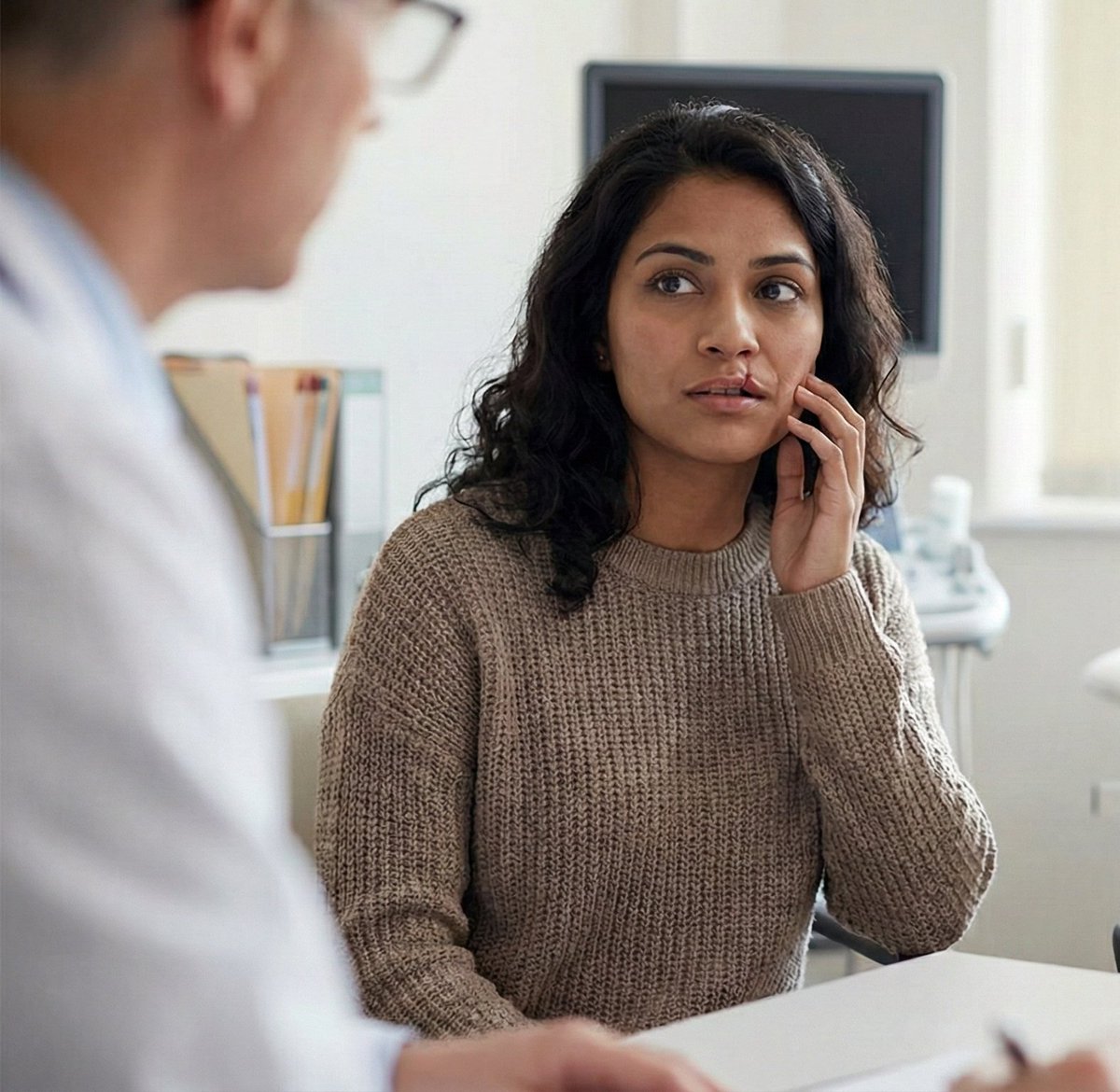
Mita first came to see me nearly fifteen years ago.
Mita was a young graduate student then-quiet, determined, living with epilepsy since childhood. Over the years, I watched her life unfold. She completed her education, built a career, became financially independent, and learned to manage her seizures with discipline and resilience. By any objective measure, she did well.
Mita was also born with a cleft lip and palate. Surgery corrected it early in life, but a subtle asymmetry remains on the left side of her face; something most people would barely notice, yet something the world never quite lets her forget.
During a routine OPD visit today, Mita spoke not as a patient, but as a woman carrying a long, unspoken ache.
“My two younger sisters received good proposals. They got married. They have children now,” she said. “I am still waiting. Maybe it’s because of how my face looks. Maybe because I have epilepsy.”
She paused, then added softly, “I can’t do a love marriage. I’ll wait for a proposal. And if it never comes, I can manage my life on my own.”
There was no bitterness in her voice. No anger. Just acceptance-quiet, dignified, and heartbreaking.
As a doctor, I often think about seizures, medications, EEGs, and MRI scans.
But moments like these remind me that epilepsy is not just a neurological condition. It is a social label. A lifelong shadow that follows women more than men, especially when marriage enters the conversation.
Why does a controlled medical condition still raise doubts about a woman’s worth as a partner?
Why does a minor facial difference, after corrective surgery, become a lifelong marker, silently judged in matrimonial meetings?
Why do we celebrate resilience, education, and independence in theory, yet reduce women to appearances and medical histories when it comes to marriage?
This woman is competent, financially secure, emotionally grounded, and medically stable. She contributes to society. She manages her health responsibly. Yet she feels compelled to explain her unmarried status as if it were a personal failure.
The tragedy is not that she may remain unmarried. The tragedy is that she believes the reason lies in her face or her illness; and that society has quietly taught her to accept this as normal.
Discrimination does not always shout. Sometimes it whispers, through delayed proposals, awkward silences, and unasked questions.
And until we confront these whispers, many capable, accomplished women will continue to wait; not because they lack worth, but because society fails to see it.
Dr Sudhir Kumar
Neurologist, Hyderabad
@hyderabaddoctor
(Note: Image is AI-generated; The name has been changed to maintain privacy)
"How do I find a 'good' specialist?"
As a doctor, this is the question I am asked most frequently. Whether it’s for a cardiologist, an orthopedician, or a fellow neurologist, everyone wants the "best." But how do you actually measure a doctor’s quality?
Most people look at the wrong things, or things they simply can’t verify.
Here is a breakdown of what matters, what doesn't, and what is usually hidden.
1. The "Hidden" Metrics (The Black Box)
We often wish we knew a doctor's NEET rankings, MBBS marks, or specific awards won during training. While these show academic brilliance, this data is rarely in the public domain. Similarly, success rates and the exact number of procedures performed are hard to find. These are "nice to haves," but you likely won't find them on a website.
2. The "Visible" Stats
Years of experience is the one thing almost everyone knows. It’s a solid baseline, but remember: 30 years of experience doing the same thing poorly isn't better than 10 years of staying at the cutting edge of science.
3. The "Social Proof" Trap
Google Reviews: Proceed with caution. Fake reviews (both glowing and bitter) are everywhere.
Word-of-Mouth: This is the gold standard. A recommendation from a patient who had a similar condition is worth ten 5-star Google ratings.
4. The "Proxy" Metrics (Do they equal quality?)
High Fees: Does a higher consultation fee mean a better doctor? Not necessarily. It often just reflects the hospital's overhead or the doctor's seniority.
Long Wait Times: A crowded OPD might mean the doctor is popular, but it can also mean they are overbooked and rushed.
Appointment Difficulty: Sometimes the "best" doctor is just the one with the best marketing.
5. The Real "Gold Standard": The Consultation
This is where you truly find out if a doctor is right for you.
A great specialist is defined by:
Listening: Do they let you finish your sentences?
Explaining: Can they explain your diagnosis without using jargon?
Time: Do they spend enough time to address your concerns, or are they looking at the door?
Access: Are they reachable in an emergency? While not every doctor can give out a personal cell number, having a clear channel for follow-ups is a huge green flag.
✅The Bottom Line:
A degree from a top college and 20 years of experience gets a doctor in the door, but communication, empathy, and the ability to listen are what make them a great physician.
How do you decide which doctor to trust? Let’s discuss in the comments. 👇
Dr Sudhir Kumar
@hyderabaddoctor
Sleep is not optional: Neurologist reveals why it matters more than you think
Sleep is a biological necessity, not a luxury, and getting 7–8 hours of consistent, high-quality night-time sleep is crucial for long-term health and longevity
https://t.co/1JWBYOzwqn
My latest article published today in @TheWeekLive
💡Pro Tip: ⚠️
During a cyclone, if suddenly rain stops, winds calm down and sky appears to clear - never assume it is end of cyclone.
It can just be an interval between two severe episodes. 🌀🌀
⚠️#SevereWxAlert ⚠️
#Hyderabad
- Continuous light/moderate rain can commence in the city from morning of 13-Aug.
- Intensity of rain can gradually increase by afternoon/evening and can become continuous moderate/heavy rains.
- Between 13-Aug evening to 14-Aug evening, heavy/very heavy spells of rain is possible in the city.
- Upto 80mm rainfall is possible at many places. Some places may even record close to 100mm.
- Due to persistent nature of rain, localized water logging and inundation is possible.
- Please take care and avoid stepping out as much as possible.
@GHMCOnline@DRFHYDRAA
#WxOutlook
There is much discussion and several questions on the quantum of rainfall between 13-Aug and 18-Aug especially in #Hyderabad city.
Here are my thoughts:
- It has been advised that we need to be well prepared for widespread heavy rainfall conditions during this period over Telugu states.
- However we cannot take rainfall accumulation charts of weather models by face value. Weather is an evolving phenomenon and forecasts too will evolve with time.
- This rainfall situation is a result of LPA in BoB and LPAs can change paths easily in a matter of days or hours. Any slight deviation in path can change rainfall pattern drastically. Thus models and forecasts will also keep changing.
- Therefore let better preparation prevail over panic and keep patience with changing forecasts. Take the latest forecast seriously.
I was lucky to have a great life and many wonderful memories, but they’re bittersweet. I can’t recall a time without having an infection or the feeling of one, I now know it was PEM & #MECFS. I endure severe, constant suffering because I was never warned. This is still the norm.
I've been wanting to write about living with this crazy extreme level of noise & light sensitivity in very severe ME but @mamagalen does it beautifully. We have new languages too - silence and Makaton signing #ThereforME
https://t.co/mnXst8UIX2
Hey @RobertKennedyJr, please look into #MECFS, a devastating illness that's been neglected for decades by the NIH. Millions suffer from this most underfunded, under-researched disease. Patients are left alone, battling systemic suppression & a dire need for research. Share!🙏❤️
🧵
"Ignored, blamed, & sometimes left to die – a leading expert in ME explains the origins of a modern medical scandal"
https://t.co/5tycVeUtd8
There's an audio version of this long but highly recommended article at link
This is a thread with some extracts
#MEcfs#CFS#pwME
1/
It says a lot about #MECFS and #LongCovid that there could not be an ME/CFS Olympics...Because if we tried to push our limits like that, all the winners would die…
⬇️ Excerpts from my post below
New post on my blog:
https://t.co/5ruQsqRpxm
This Professor describes to a Public Inquiry what I went through with my daughter.
I was totally alone, calling for help for 9 months. Nobody helped. My only child. @DevonCC accused me of causing her symptoms.
Her only diagnosis was #MyalgicEncephalomyelitis#ME
Great thread. Madness that this isn’t being covered more by media or talked about by government.
Pretty hard to achieve GDP growth targets if significant percentage of your workforce is off sick.
Here are some reflections on my daughter’s experience with #hEDS and #MECFS and implications for future research from a talk I gave at @U2Fight_World. I’d welcome feedback on the hypotheses I propose and research to probe these underexplored areas. 1/7
We cannot just accelerate ME research by increasing funding…and assuming all the other issues will be gone.
We need to also address WHAT is researched, and HOW that research is designed and executed to finally get the most meaningful answers.
The IBS Surprise: Mast Cells not the Main Culprit + Introducing the Nociplastic Disease Club (ME/CFS, FM, IBS, Long COVID, etc.) #MECFS#FM#IBS#longCOVID https://t.co/c6gaHJzGZB