I’ll only say this once.
These 10 stocks will be remembered as the opportunities everyone ignored before 2030:
1. IonQ – $IONQ
2. QuantumScape – $QS
3. Rigetti Computing – $RGTI
4. BlackSky Technology – $BKSY
5. Lightwave Logic – $LWLG
6. Enovix – $ENVX
7. Amprius Technologies – $AMPX
8. Eos Energy – $EOSE
9. Redwire – $RDW
10. Bloom Energy – $BE
🔥 These setups are sitting in front of moves that can rewrite portfolios. Save this list—the people who act now will look brilliant later.
Hedge funds are dumping US tech stocks at a record pace:
Hedge funds have sold information technology stocks in 6 of the last 8 weeks.
This brings total 8-week sales to the largest in at least 10 years.
Last week alone, technology was the most-sold US sector among hedge funds.
As a result, tech exposure as a % of total market exposure is down to its lowest since February 2026.
At this rate, tech exposure could fall to its lowest in at least 5 years as early as next week.
Hedge funds are rapidly moving to the sidelines.
🇺🇸 The U.S is quietly splitting into two economies.
On the surface, everything looks fine. Stocks are pushing higher, credit markets are calm, and Wall Street barely reacted even after 372 large U.S. companies filed for bankruptcy in the first half of 2026, the highest first-half total since 2010.
But look beneath the headlines and it's a completely different story.
Commercial Chapter 11 filings jumped 28% in just one year, small-business reorganizations surged 50%, and total commercial bankruptcies climbed 13%.
These aren't Fortune 500 giants; they're the companies that don't have billion-dollar lifelines or easy access to refinancing.
The biggest corporations can still kick the can down the road, but smaller businesses can't.
Years of high interest rates have created a system where Wall Street can refinance its debt while Main Street is left to drown.
Even private-credit defaults hit a record 9.2% last year, with the pain concentrated among smaller borrowers.
The real warning isn't the record number of bankruptcies.
It's that the market is acting as if nothing is wrong while the cracks underneath keep getting wider.
Sources: Reuters, Bloomberg, @shanaka86 / Writer: Ian
Tech returns are nearing 2000 Dot-com levels:
The information technology sector has returned an average of +9% per year over the last 10 years, the best performance of any US sector.
This annualized return has doubled since the 2020 pandemic.
This also matches the peak performance of the communication services sector during the recovery from the 2008 Financial Crisis.
By comparison, tech stocks delivered a 10-year annualized return of +13% during the 2000 Dot-Com Bubble.
The IT sector has now been the best-performing US sector for 7 consecutive years, the longest streak since the 1960s.
Tech continues to rewrite market history.
Sell-off continues in Chip and Tech stocks
Over $350 BILLION has been wiped out from Asian stocks as the US continues strikes on Iran for the ninth consecutive day.
Japanese markets are closed today in observance of Marine Day.
Everyone wants US stocks.
Foreign private sector net purchases of US stocks rose +$35.2 billion MoM in May, to $121 billion, the 2nd-largest inflow on record.
This marks the 2nd consecutive monthly increase.
By comparison, the record monthly inflow was ~$130 billion in November 2024.
Year-to-date, foreign private investors have purchased ~$270 billion of US stocks.
To put this into perspective, foreign investors dumped -$31 billion and -$28 billion of South Korean stocks in June and May, respectively, the two largest monthly outflows on record.
Furthermore, foreign investors also sold -$18 billion of Taiwanese stocks in June, the 2nd-largest sale on record.
Global capital continues to favor US equities over the rest of the world.
$MU $SNDK and $DRAM
Don't let the next opportunity pass you by. I am still bullish on memory stocks for the future.
All my buy and sell signals in Discord @ https://t.co/OX1nG4cX8V.
Unprofitable small-cap stocks are skyrocketing:
Russell 2000 companies with negative earnings per share (EPS) have returned +154% since mid-2025.
Over the same timeperiod, firms with positive EPS have gained just +34%.
Year-to-date, unprofitable companies in the index have surged +45%, beating the +18% gain of profitable firms.
As a result, the Russell 2000 has rallied +20% so far in 2026, on track for its best year since 2003.
By comparison, the S&P 500 has risen +11% while the Magnificent 7 has gained just +4%.
This comes as the best-performing small-cap stocks have been technology and infrastructure companies positioned to benefit from AI spending.
The market is rewarding AI exposure, regardless of profitability.
@MPelletierCIO Crazy volatility. Markets can overshoot in both directions, and these moments often reveal where the real opportunities are forming. Patience and discipline matter.
@stocktalkweekly Exactly. Short-term pain doesn’t erase long-term progress. Strong investors know how to manage volatility and stay focused on the bigger picture.
@RyanDetrick Exactly — market breadth tells the bigger story. A rally supported by broader participation is a much healthier sign for continued momentum.
Retail is cashing-in tech profits:
Retail investors sold -$125 million in SanDisk, $SNDK, stock last week, the largest sale among any stock.
This was followed by Apple, $AAPL, at -$120 million, and Tesla, $TSLA, at -$105 million.
Furthermore, retail investors sold -$65 million in Nvidia, $NVDA, -$40 million in American Airlines, $AAL, and -$22 million in Meta, $META.
This brings 2-week retail sales volume in $TSLA and $AAPL up to -$200 million.
Meanwhile, the total retail turnover in single stocks rose to a record $370 billion, up from $220 billion at the start of 2026.
Retail investors are locking in gains following a historic tech rally.
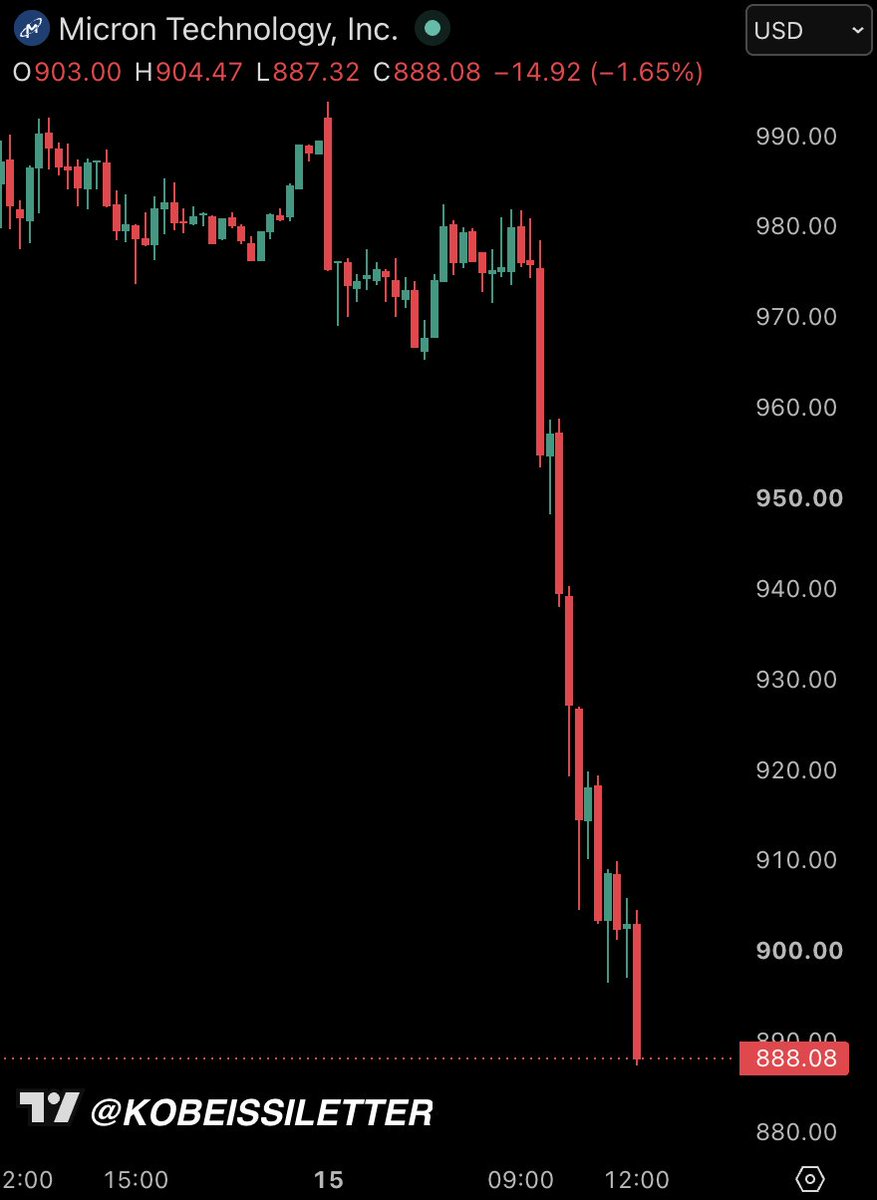
BREAKING: Micron, $MU, extends losses to -10% on the day as the selloff in memory stocks gains momentum.
The stock has now erased $110 billion in market cap today.