After years of telling visitors to Brisbane what an awesome place it is for fun* adventures, I've decided to make a list in the order I remember them of my favourite places to go for ease of reference. Here goes ...
(*definition of fun may vary)
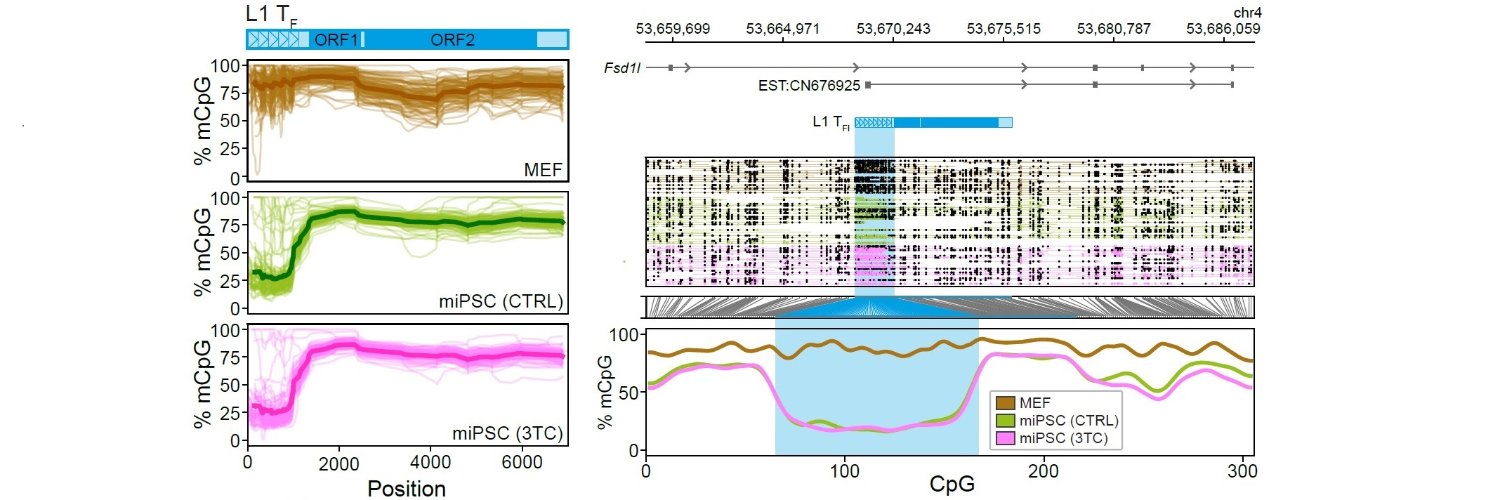
@TeamLINE1 @TrinaKarabi@SDStatePharmacy Congrats on this important work (am catching up on reading today). Do you know if Tgf21 has the YY1 mutation you note in the Gf1 monomer? The 75% reduction is consistent with what we saw in humans after YY1 site truncation (https://t.co/a7aOeCPmXQ) so could be cell type specific
Reposting comment on preprint of this @Dev_Cell paper. Stats done on technical replicates of L1 KD to make small absolute changes seem significant. Biological replicates were available but not used for stats, why? Because p>0.05? I don't understand this.
https://t.co/DMsoTLzr3S
I doubt the stated phenotype here is due to changes in L1 mRNA. The ASO and CRISPRi KD approaches (Figs 1, S1, S2) reduce L1 expression by <10% and these small changes are noted as efficient and significant KD. Stats were done on tech reps to give p<0.05
https://t.co/npX6YyPLXq
@PRAndersen@RippeiH More interesting reading here and food for thought too, thanks. Also, as per Maslow's hammer, a lot of these systems likely evolved to control transposons in some way but now work somewhat differently on genes.
Thoughtful and rigorous work from @RippeiH and @PRAndersen teams looking at PAF1C and transcriptional termination. Interesting for me to look at "the other end" of transcription for a change. I wonder what brings tTAF and tPAF together?
https://t.co/sryrqH1eWo
1/ Our lab’s first preprint found a wonderful journal home! 🎉
Our paper explores the role of testis-specific transcription factors in Drosophila and reveals broad functional connections between tissue-specific paralog proteins.
📝: https://t.co/Qr09ScxueX
🚀 Join the CRG as a Junior Group Leader in Quantitative Cell Biology! 🧬
We’re seeking passionate leaders to tackle fundamental biological questions using cutting-edge multidisciplinary approaches. Enjoy generous core funding, state-of-the-art facilities, and a collaborative environment.
📅Apply by Oct 15!
ℹ️Details: https://t.co/25WRC7lKEQ #CRG
I doubt the stated phenotype here is due to changes in L1 mRNA. The ASO and CRISPRi KD approaches (Figs 1, S1, S2) reduce L1 expression by <10% and these small changes are noted as efficient and significant KD. Stats were done on tech reps to give p<0.05
https://t.co/npX6YyPLXq
@MRSantosLab Hi Miguel I have some questions:
In Fig 1D, S2A and S2E what is each data point? A cell?
What is the absolute change in L1Hs expression caused by the ASO or CRISPRi?
In Fig S2C what is the mean value for each of the 3 groups, instead of Z-score?
Thanks.
I am looking for a motivated PhD student who is interested in understanding the fundamentals of gene regulation. They will be working directly with me on a DECRA funded project (scholarship guaranteed for domestic students). DM me if you know of anyone interested, including you
interested in 3D genome organization during early development? want to understand how it is shaped by RNA? you like data analysis and developing new computational tools? 🧬💻🧐
With @golobor we are recruiting a PhD student/intern to work with us at @IMBA_Vienna
Delighted that this is finally out! Thanks to @Faulkner_Lab@todd_macfarlan and the other reviewer for good and constructive comments that arrived in my inbox the day after my second child was born... paper here https://t.co/YfN3uIo7XI. Short reflection on new stuff...
Calling all emerging scientists - it’s time to send us an application! 😉😎 Lead your own #MaxPlanck Research Group w/ €2.7M in funding over 6 yrs, full independence & resources to hire staff. State-of-the-art infrastructure awaits you!🌟 Apply today➡️https://t.co/cHxPLyRj9x
Preprint on "BWT construction and search at the terabase scale". We can compress 100 human genomes to 11GB in 21 hours, find SMEMs with it, do affine-gap alignment and retrieve similar local haplotypes. 7.3Tb commonly sequenced bacterial genomes ⇒ 30GB https://t.co/DiRwZNHVVa
1/11 Welcome to our August ECR spotlight! This month we get to know Charles Bell @charles_bell92 who works in the Faulkner lab @Faulkner_Lab at the Mater Research Institute @MaterResearch and University of Queensland.