This has been a while in the making, but I’m happy to share a pre-print of our latest investigations into the nucleus accumbens, dopamine, and the motivation to do stuff. https://t.co/0Y2PsHUamI. 1/n
The dumb fucks at ICE or whatever agency who do this will make it impossible to host major scientific conferences in America for a long time. Nobody with any sense will want to risk being subjected to this on a random temporary visit to the US.
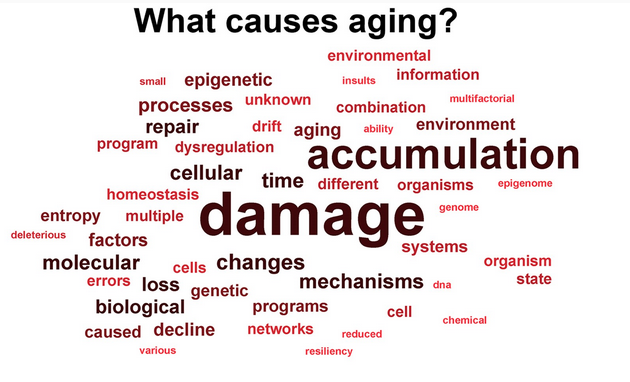
Why is aging (not) about damage accumulation?
A recent expert survey paper indicated damage accumulation as a primary cause of aging (https://t.co/aMy2P5aIPM). I think this belief is nothing more than a confusion and harm to longevity research. And this is why.
First of all, does damage happen in aging organisms? Of course, it does. Pretty much everything deteriorates as we age! So, can aging be interpreted as a damage accumulation process? It can be viewed this way, along with almost any other healthcare problem.
For example, infectious diseases can be defined as damage accumulation caused by pathogens. Diabetes is damage accumulation caused by wrong blood sugar concentration. Sickle-shaped anemia is damage accumulation caused by blockage of blood flow by deformed erythrocytes. In all these cases, damage is readily detectable. However, it is caused by well-defined biological factors, and it is not a primary cause of these diseases anyway.
Are there diseases caused by damage? Yes, something like food poisoning or broken legs. This is a very special class of health problems, and including aging in this group requires very strong arguments. Can we find such arguments somewhere in the scientific literature? Not really.
In 1963, Leslie Orgel proposed a model focused on the accumulating errors in the protein translation machinery. Errors are occurring evenly across all the proteins. However, those that hit proteins responsible for protein synthesis may elevate the number of errors, resulting in further deterioration of fidelity and an error catastrophe (https://t.co/FHFXNteOjC). Unfortunately, this ingenious idea was found wrong. It can be easily tested by treating cultured cells with drugs that increase levels of errors (e.g., ribavirin). An exponential damage accumulation upon drug removal was never demonstrated.
Another compelling damage accumulation model claims somatic DNA mutations as a reason for aging (see, e.g., https://t.co/RQ8w02vGIU). Indeed, DNA encodes the primary information on how our organism functions. If this information gets damaged with time, it can be a good model for aging. Accordingly, somatic mutation rates correlate with lifespan if we compare different mammalian species (https://t.co/LBVdntk3y2). However, whether these mutations cause sufficient damage to explain aging is still unclear. Moreover, this model drops out short-lived animals such as worms or insects that clearly cannot accumulate enough mutations within several weeks of their life. Why do these animals age?
The two above models are somehow specific. But much more often, scientists refer to damage accumulation as an esoteric entity that does not require a firm definition. Some damage hits some cells and some molecules, and that’s it – we age. Vadim Gladyshev tried to formalize this with his deleteriome model (https://t.co/K8GophOmfd). However, I am still not convinced we have any evidence supporting these views.
Would placing animals or humans into some ideal environment, protected from damaging factors, stop or dramatically delay aging? Of course not! Moreover, mild stressors prolong lifespan instead of shrinking it, as damage accumulation models suggest. This is called “hormesis.”
Many more, much more significant caveats exist in all the damage accumulation models. For example, aging can be regulated. For instance, in eusocial animals such as bees or ants, queens may live 50 times longer than workers while sharing exactly the same genome. How does damage affect queens 50 times less than workers? And it is not the whole story. If the queen dies, workers sometimes gain the ability to lay eggs. In these cases, they also age much slower, and their lifespan can increase fold times (https://t.co/AHFc0mzP7L). Why does damage start affecting them so much less?
You may say: “this is in insects, who cares about them.” However, similar patterns were also observed in eusocial rodents, such as Fukomysmole-rats (https://t.co/qPeRp1kaMO). Effects are less pronounced, and the system is studied less, but the trends are clearly the same as in insects.
How can we explain such things with damage accumulation? Even if we try to be as merciful to this model as possible, we can only hypothesize that not damage per se but downregulation of damage control mechanisms is the primary cause of aging. So far, what we see is more consistent with the model that these mechanisms are switched off as we age. But why do they? This question remains unanswered.
But why do so many scientists believe in damage accumulation? I think the reason is that this hypothesis seems intuitive: our bodies decline with age like toothbrushes or combs get worn out. However, this intuition is wrong. Unlike toothbrushes, humans eat and drink. Energy obtained with food may help us regenerate and heal the damage. Early in life, it happens, but later in life, it does not. And we don’t understand why it happens.
Summarizing this post, I believe that “aging is because of damage accumulation” is not anyhow better than “something bad happens as an organism ages.” The damage accumulation model does not increase our understanding or produce an actionable plan for further research. Instead, it creates a false impression that we understand something. It is just a placeholder for a paradigm of aging we need to assemble.
things are as they are in science because we’re letting them be, as if the norms we have are some immutable laws that descended from mt olympus
we literally can just imagine something better and choose it
look im sorry you don't get to be self righteous about either staying on or leaving twitter. it's not an action , it's literally nothing, you are clicking stuff
@mohebial My condolences to you and your family my friend. May your father and his family know peace. I never knew him but can guess to his greatness by his lasting impressions on our world 🫂❤️
The latest @berke_lab paper in @PNASNews by my bff @DuhneMariana (with some contribution by yours truly) on cholinergic pauses in the striatum and the dopamine signal... What does the silence mean?
https://t.co/12rxa4sKPS
I love watching YC invest in like 10 identical, competitive startups in every category in every batch. Since they don’t know who will win, they just bet on them all and expect 1, maybe 2 winners.
Reminds me of the Middle Ages when 6/8 children would die prematurely
I'm so excited to share my first preprint from @Lab_Pollen at @UCSF on the phylogenetic and spatial distribution of TAC3 interneurons. This story was an adventure filled with twists and turns we never saw coming. Check out the preprint and a summary below!
https://t.co/1UsHgPTNgq
New paper out in @NatureNeuro!
Collaborating with several labs, we developed genetically encoded biosensors to track opioid pharmacology in the brain & provide powerful new tools for dissecting complex circuit-specific dynamics 🔧🧠
https://t.co/d1p1lh9J8O
I am thrilled to announce that the first paper from my lab has been published! 🎉 Check it out here: https://t.co/4qk05HCCtF
Huge congratulations to the incredibly talented team, led by co-first authors @ErinBigus and @Hyunwoo_Lee5223! 1/N