Introducing Claude Fable 5: a Mythos-class model that we’ve made safe for general use.
Its capabilities exceed those of any model we’ve ever made generally available.
Today, we're introducing Claude Fable 5 and Mythos 5, two configurations of our next major language model.
I'd normally highlight the numbers: It's SOTA on nearly all benchmarks. I want to talk about something else, because with Fable 5 out in the world, I think a third era quietly started today.
I lead Claude Code & Cowork on the desktop, so I think a lot about how people use AI to get work done. I believe we're about to see a major shift, moving from giving AI tasks to giving it responsibilities.
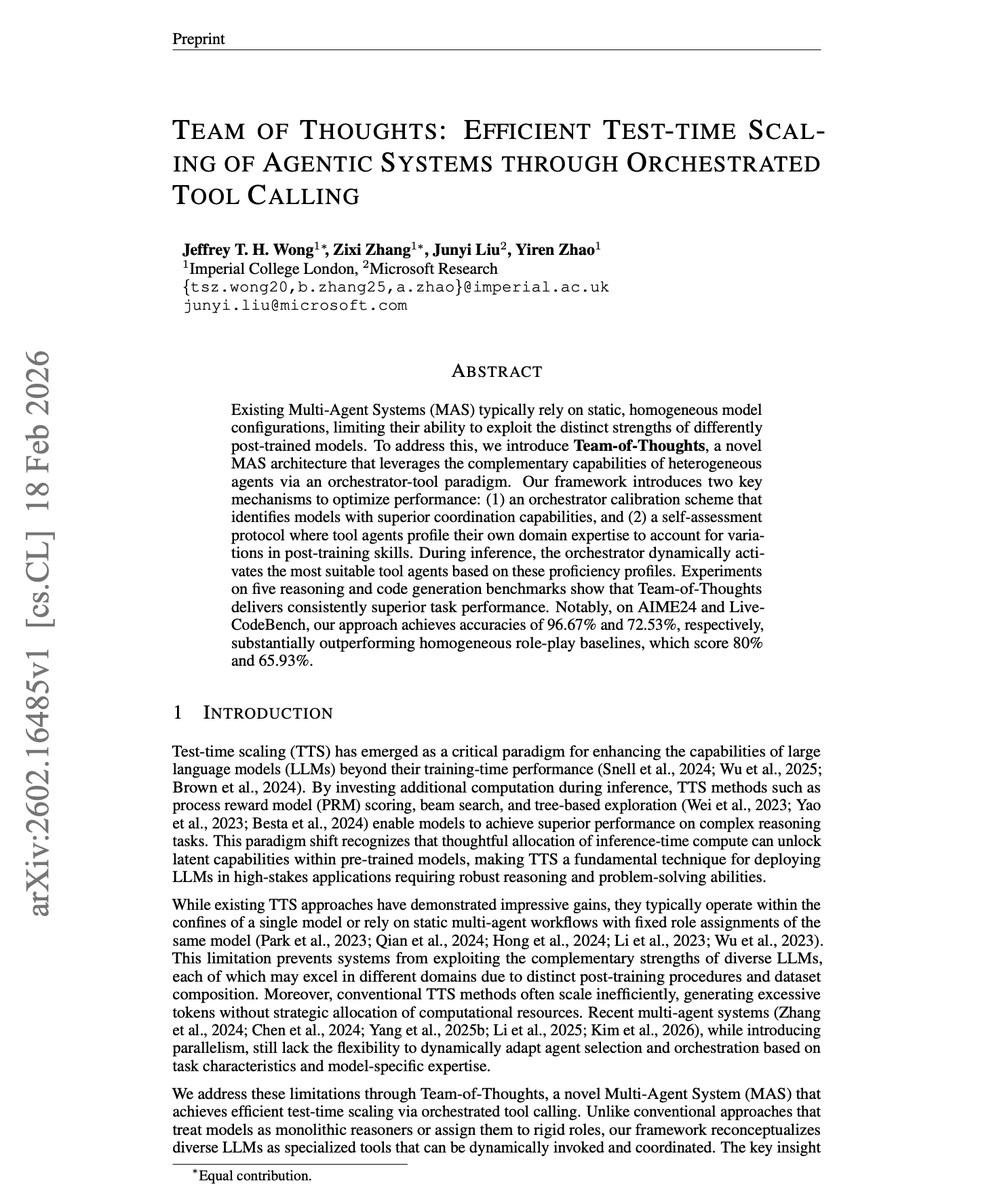
// Team of Thoughts //
Not enough devs are leveraging unique test-time scaling approaches.
You don't need to train or always use bigger models for everything. There is more room and a need to orchestrate existing ones more intelligently.
Not all models are good at the same things. So why run every task through the same one?
This new research introduces Team of Thoughts, a multi-agent framework that moves beyond static, uniform model configurations. Instead of using identical agents, it orchestrates heterogeneous models based on their distinct strengths.
Two key mechanisms make it work. First, an orchestrator calibration process identifies which models have superior coordination skills. Second, a self-assessment protocol lets tool agents evaluate their own domain proficiency.
The results are significant. On AIME24, the system scores 96.67% compared to 80% from homogeneous baselines. On LiveCodeBench, 72.53% versus 65.93%.
Paper: https://t.co/b1DS6Gd6aq
Learn to build effective AI agents in our academy: https://t.co/1e8RZKs4uX
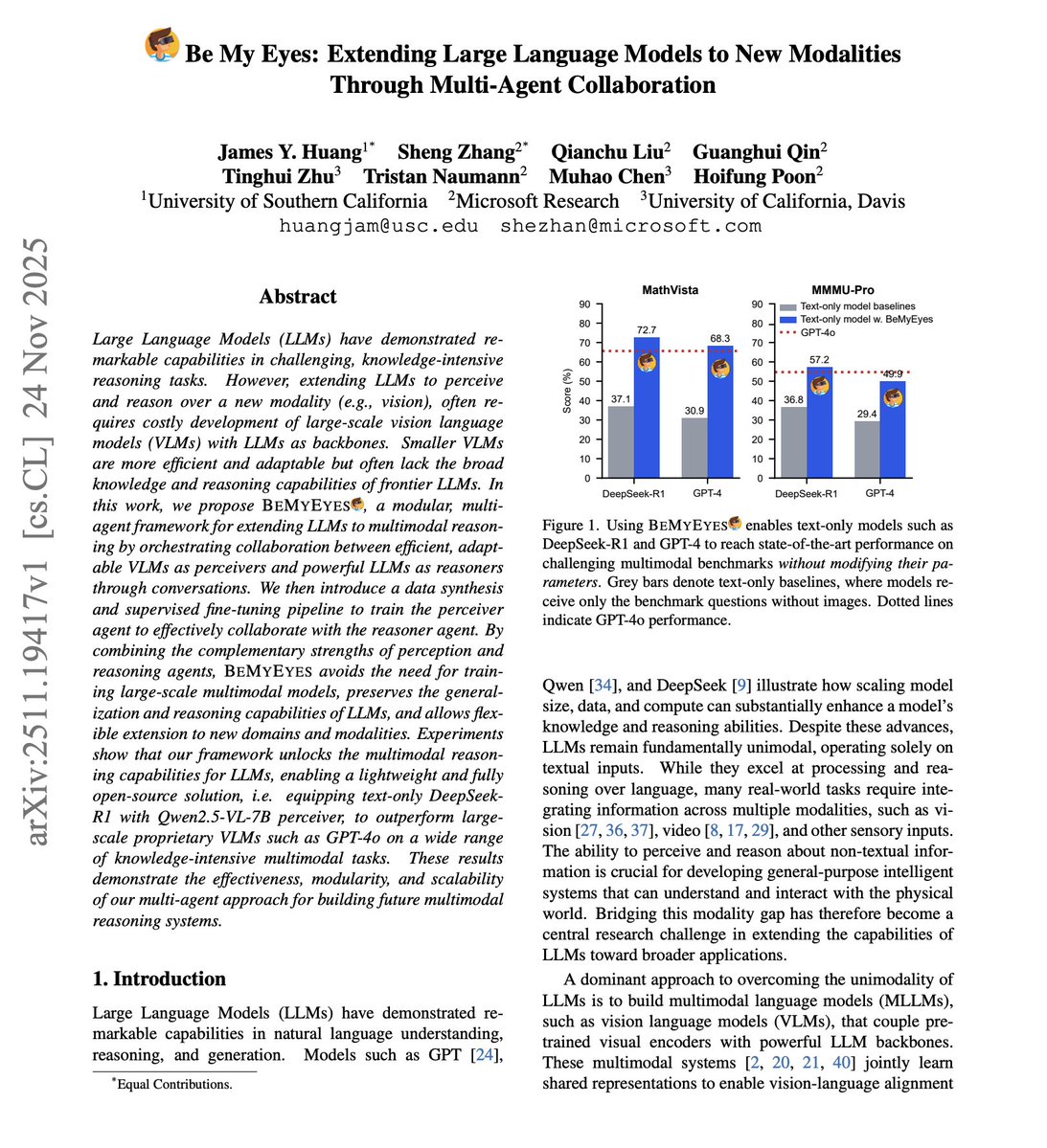
LLMs can't see.
How can we build effective multi-agent systems with vision capabilities?
Building multimodal models from scratch is expensive. Training joint vision-language architectures requires massive compute, specialized datasets, and careful optimization.
But there's another way.
This new research introduces "Be My Eyes," a framework where vision models become literal eyes for LLMs.
The key idea: multi-agent collaboration through natural language.
Vision agents analyze images and describe what they see. Language agents receive these descriptions and reason about them. Communication happens entirely through text.
No joint training. No architectural modifications. Just agents talking to each other.
The system is modular. Swap in better vision models as they emerge. Upgrade the LLM independently. Each component improves without retraining the whole system.
Results on MMMU, MMMU-Pro, and video understanding benchmarks show competitive performance with specialized multimodal models.
What makes this powerful: it challenges the assumption that multimodal AI requires unified architectures. Agent collaboration through language provides an efficient alternative.
Paper: https://t.co/VqnwooAGkJ
Learn to build with AI Agents in our academy: https://t.co/Y5kVy5iKiQ
Say goodbye to Chain-of-Thought.
Say hello to Chain-of-Draft.
To address the issue of latency in reasoning LLMs, this work introduces Chain-of-Draft (CoD).
Read on for more:
Santa was trying to get his LLM to do a math problem, and he is prompting it really hard, but it wasn't working, how did he eventually fix it? He used Reindeer-forcement Learning 🎅🎄
Conquering Chaotic Time Series Data: Stable Neural SDEs from #ThursdayPapers! This week's deep dive tackles messy data with irregular intervals & missing values. Intrigued? Learn more about this new approach!
Link to post: https://t.co/PTljy5nEjY
⚽️ AI coaches corner kicks!
Liverpool FC & Google DeepMind team up on TacticAI, an AI system suggesting game-changing corner kick tactics.
Reads the game, predicts outcomes & suggests player positioning. #ThursdayPapers
📰 Exciting news from #MicrosoftResearch! Discover the latest breakthroughs in #AI with Orca-Math, a game-changer in small language models. 🔍 Dive into innovative strategies and unlock the potential of SLMs. Join the conversation! #ThursdayPapers#OrcaMath#Innovation 🚀