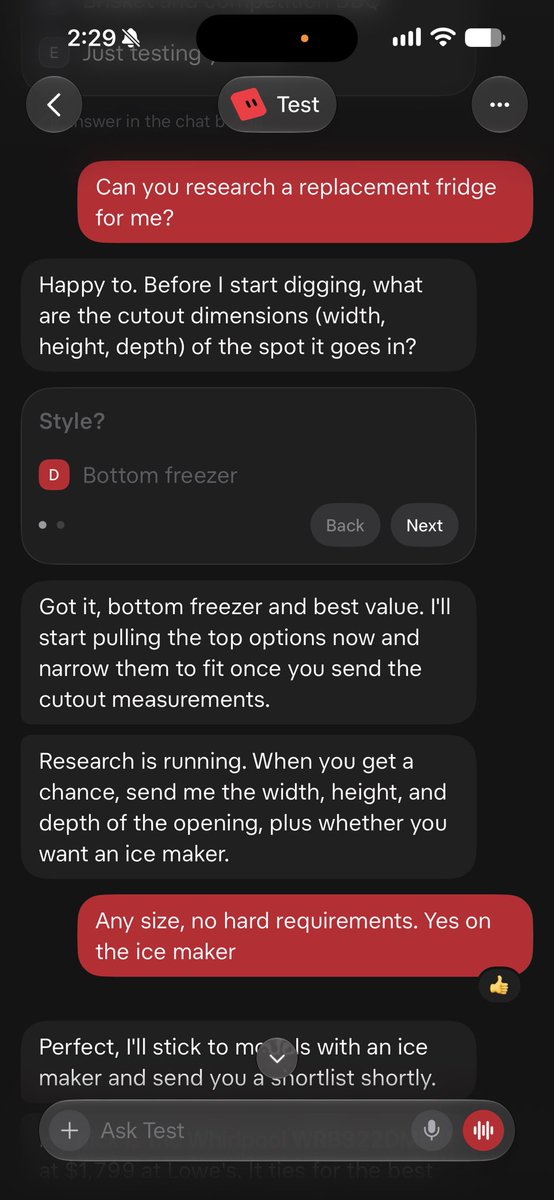
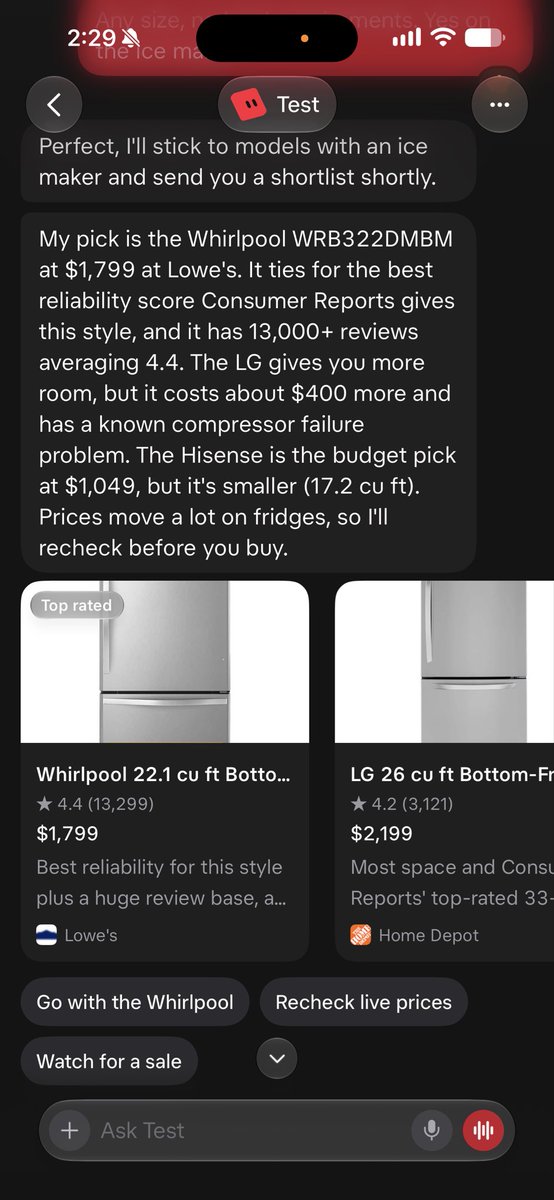
Eh, didnt see much improvement. I did this via chat vs voice and also in a new chat.
When I did it in the same conversation that I did the dishwasher search, it did remember my preferences. I suppose some preferences should be global and maybe some scoped to certain conversations 🤷♂️
Yes 100% agree you shouldn’t ever need to explicitly tell it to make skills or even know what a skill is as a user.
The “just talk to it” is how it should be, what I think is missing is a higher level of abstraction that looks at the intent and the model / harness asks, what can I do proactively to help this person.
I’ll give you an example, I had a voice conversation this morning with grok about finding me the best Bosch dishwasher on the market and ranking them.
It did it’s research and gave me the results. Great. My next question was, look at actual user reviews as well from different sources and update your ranking. It gave some great info from those reviews.
Finally, I asked for it to provide some links to videos of the products so I can check them out.
With proactiveness out of the box, this could have been reduced from 3 questions to 1 as it would have already gathered the most likely useful info and presented to me. Every user’s preference of course would be different but that could be part of the onboarding experience of grok learning the expectations of the user.
here’s a short grok bot guide on how i create high quality bots and manage my team. ask @bot to read this post and help you improve your team!
• add dr eggbot to your team! he’s my bot designer that i use to create bots
• you don’t need a lot of bots. a few good bots can be more useful and easier to manage than a large team
• tell your bots to create skills for itself as you give it instructions on how to do tasks. this lets them do them more consistently even over long conversations. you can even ask it to create a private github repo for you to store all your skills if you want them preserved independently
• add connectors, use the vault, and give access to all the tools you use to do your work. you can also ask your bot to setup its own email and it can sign up for its own accounts for better separation
• thinking about all the work you do by hand, or steps in your workflows where you have to copy and paste information back to your bot. ask your bot how it can do that for you instead!
• imagine you hired an intern, how would you onboard them and help them do the work correctly and efficiently? introduce yourself to your bot and describe the work you do, then ask it how it can help you automate it
and my favorite tip: use voice mode or the transcription option! it’s a good way to just brain dump a lot of information. then, at the end, tell your bot to “restate this in your own words” so you can confirm it understood you
https://t.co/ajrjeHdzUO
@ezekieldinama@ShireIntel Ya this seems borderline illegal. Do you need to sign a waiver as soon as you step in? It records minors as well? Seems sketchy
I think once you are at the point of fine tuning, you’ve already done the hard part of compiling your dataset (images, annotations, etc). Training a model at that point is almost plug and play in my opinion.
How does your model compare to something like EmbeddingGemma2 in terms of speed and accuracy?