Digital twins are virtual models of physical entities used to optimize business operations. Success lies in understanding best practices, defining business goals, testing via prototyping, assessing organizational readiness, and adopting an agile approach.
RT @antgrasso
Reinforcement Learning — Industrial Applications of Intelligent Agents: https://t.co/1eoKUMwp5p
Practical book with these benefits:
🔴 Learn what RL is and how the algorithms help solve problems
🔴 Become grounded in RL fundamentals including Markov decision processes, dynamic programming, and temporal difference learning
🔴 Dive deep into a range of value and policy gradient methods
🔴 Apply advanced RL solutions such as meta learning, hierarchical learning, multi-agent, and imitation learning
🔴 Understand cutting-edge deep RL algorithms including Rainbow, PPO, TD3, SAC, and more
🔴 Get practical examples through the accompanying website
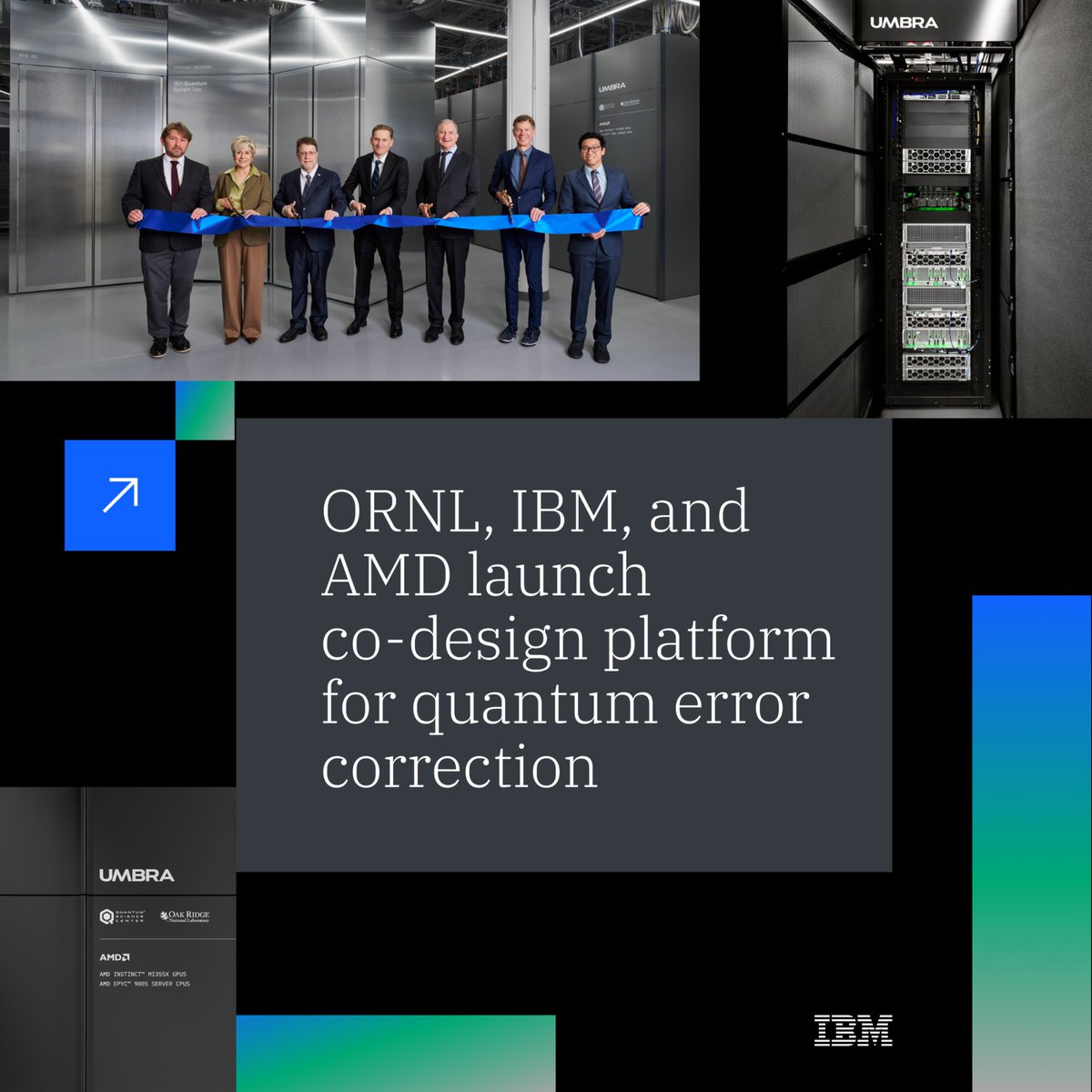
The @QuantumSciCtr at @ORNL, @IBM, and @AMD deploy a new co-design platform for quantum error correction at IBM’s site in Poughkeepsie, New York.
The platform enables low-latency quantum-classical workflows for advancing quantum computing research: https://t.co/tCI0WKswba
Every AI agent introduces decisions that teams may need to explain and audit.
This workshop explores risk classification, automated guardrails, and audit trails, with a live Enkrypt demo showing policy enforcement in action.
Watch the free workshop: https://t.co/xx1PSfRgco
See Anaconda CLI + MCP in action with Kilo Code.
We walk through setup, then use natural language to list conda environments, create one with Python 3.12, install packages from a secure channel, and run K-means clustering.
Watch the demo: https://t.co/HaL4WtfeU4
Paying a reasoning model to label a support ticket is paying for an essay when you wanted one word.
Decision models return one answer with a confidence score and hand the unsure cases to a reasoning model. Our top 10 for 2026 is in the reply below.
Wind farms, consisting of multiple turbines, efficiently convert kinetic energy into clean, renewable power, helping to reduce greenhouse gas emissions and optimize energy production.
#RenewableEnergy#Sustainability#GreenTech.
An "Access denied" message does not always mean something went wrong. Sometimes the system knows exactly who you are, and still says no.
Why should a successful login open every application to every employee?
Access permissions exist for a reason.
Microblog by @antgrasso
Authentication verifies your identity. Authorization determines which applications and information you are allowed to access.
Consider an employee who moves to another department. The company account remains valid, but some permissions associated with the previous role may no longer be appropriate.
Those permissions should change with the work.
And identity is not always the only condition. For sensitive applications, security policies may also check whether the device meets company requirements before allowing access.
So an employee can be correctly authenticated and still be denied access to a particular resource.
There is nothing contradictory about that.
People can share the same corporate network without having the same permissions. Access should reflect what each person is authorized to do, even as responsibilities change.
#IdentitySecurity #AccessControl
Today we're bringing specialized models trained using Muse Wonder to @Muse and Meta AI, giving users access to some of Muse Wonder's frontier capabilities for complex tasks at work and in everyday life.
These specialized models include Muse Wonder's Active Memory and Active Focus, helping them stay aligned with your goals as tasks unfold:
→ Active Memory helps recognize when earlier information matters and distinguish what's still relevant from what's become stale
→ Active Focus helps recover from setbacks or find alternatives when constraints change
In Muse, the improved models show a 2.4x reduction in forgetting information critical to your goals and a 67% improvement in getting unstuck as constraints evolve. That means less repeating yourself and fewer dead ends when plans change.
In Meta AI, these improvements help it break complex problems into steps, ask sharper follow-up questions and adapt when you change direction.
Read more on our research blog: https://t.co/ACWFr9xPtS
Spend your weekend on a skill that pays off on Monday.
Last days for Free Access. 750+ courses and tracks on today's top technologies: Claude, SQL, Power BI, Python, Microsoft Copilot, and more. All free through Sunday.
18 of the 20 best open models today are Mixture-of-Experts. Dense is basically over.
And yet the know-how to train a good MoE still lives mostly in the heads of a handful of teams.
So we spent 800k GPU hours running the experiments ourselves and wrote everything down. Super happy to finally release "The Ultimate MoE Training Handbook", free and open, organized around the questions training teams hit:
- how many experts, how big, shared or not?
- why is half my step spent in all-to-all, and how do I hide it?
- why is my run 25x slower with no error in the logs?
- softmax, sigmoid or sqrt(softplus) router, and why keep it in fp32?
- aux loss or DeepSeek's loss-free bias?
- upcycle a dense checkpoint or train from scratch?
- can I serve with fewer experts per token than I trained with?
⚠️ Warning: it's long (~70k words, budget a few days, sorry) but with 55 interactive figures, code you can run and numbers from our own runs.
Read it here: https://t.co/6XihlUrj92
Your employees have an org chart, and your AI agents should too. Part 4 of our CIO Confessions series covers the three things every agent needs before it goes live: an owner, a lifecycle, and an escalation path. Read now: https://t.co/gxa3ej85nu #AIConfessions
Build the dashboard instead of filing the request.
Free Access Week is your chance to answer your own business questions with Power BI and Excel. Free to access through Sunday.
ADLC helps move AI from isolated pilots to business value. Technology alone cannot deliver scale. Organizations need reusable governance and a way of working that keeps people accountable for AI decisions.
Source @nasscom via @antgrasso
Turn a single image into a 3D world you can explore with Lyra 2.0.
By combining video generation with 3D reconstruction, our researchers create environments along a camera path you choose. Lyra draws on earlier views and learns to correct accumulating visual errors, helping the world stay consistent as you explore and return to familiar places.
Paper, code, and demos: https://t.co/NbtE0I9SVc
Claude Code for Legacy Modernization — Recover Hidden Business Rules, Build Verification Harnesses, and Modernize Legacy Systems: https://t.co/o6Z0NvzNRl
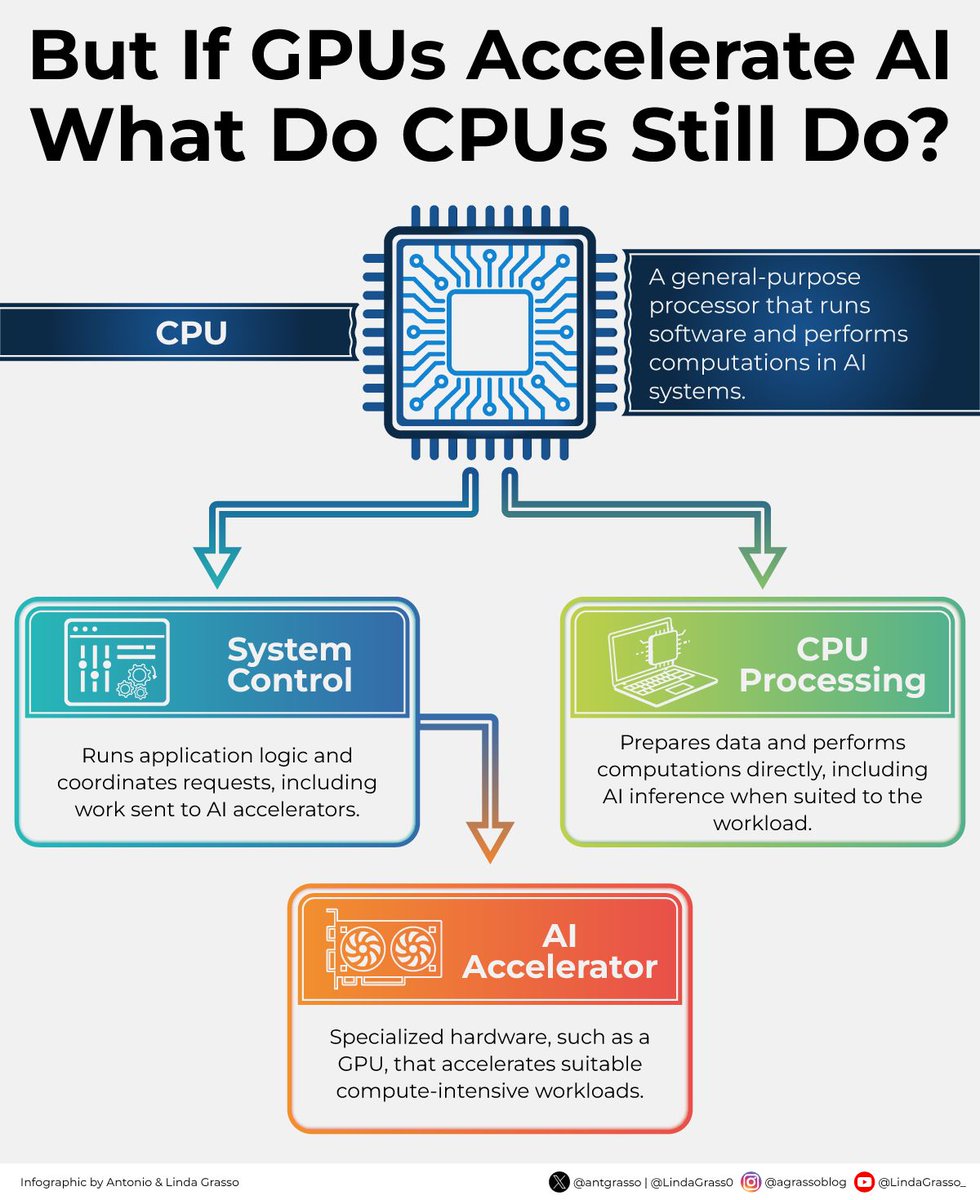
Since GPUs accelerate AI on my computer, could I save money by buying a PC without a CPU?
Not at all. The CPU still has its own job.
A GPU accelerates calculations, but your PC needs a processor to keep the rest of the system working. No saving there.
Microblog @antgrasso
An AI application needs more than the calculations accelerated by a GPU. On a typical PC, the CPU runs the operating system and application logic. It also prepares data and coordinates work sent to the accelerator.
Meanwhile, the GPU handles suitable calculations in parallel, which is why it can make many AI workloads faster.
But the CPU can perform AI computations directly, too.
For some models, inference may run entirely on the CPU. Whether that is practical depends on the workload and available hardware, not on a rule that every AI task needs a GPU.
An accelerator can make a system faster without replacing the processor that coordinates it.
#AIInfrastructure #CPU
Oxford spin-out @AlethioTx, a #biopharmaceutical company developing next-generation #therapies for myeloproliferative neoplasms (MPNs), has completed an oversubscribed €80.46 million Series A financing. 🇬🇧 🧬 🩸
https://t.co/hVSlEnntUI