I won’t be attending #NeurIPS this year, but I’m excited to share that I have a paper at the TS4H workshop. I’m interested in LLM reasoning and reliable AI for health.
I’m in the job market. If your group is hiring, I’d be glad to connect.
Website: https://t.co/Je360y7EeU
🥳 Thrilled that our multilingual interpretability work was accepted to EMNLP2025 Find! We uncover the internal mechanics behind “language confusion” in English‑centric LLMs and introduce targeted interventions to curb unintended language switches while keeping quality.
🧵(1/5)
Excited to be at #ACL2025NLP in Vienna to present our paper:
BabelEdits: A benchmark & modular method for cross-lingual knowledge editing of LLMs.
📍**Today in Hall X4 slot 296 at 16:00**
Paper: https://t.co/RnVfOIQBDc
#ACL2025
@warrenbobine@CoderNolimit En vrai vu le nombre de candidatures qu’on reçoit parfois tu peux te dire que c’est bouché. Mais est-ce que c’est toujours des profils cohérents avec le poste ? Ça …
🎉Thrilled to announce that our GNNavi work has been accepted to #ACL2024 Findings! #NLPro
🥰Many sincere thanks to all supervisors, Michael, Helmut and @HinrichSchuetze, and my collaborator @Shoejoe_!
🥳Looking forward to meeting you in #Bangkok!🇹🇭
Remember when NVIDIA was giving free GPUs to everyone in academia? They don't do that anymore, do they? I'm afraid most companies releasing open source LLMs are doing the same. The only difference is they are giving free software instead of free hardware (pun intended).
@jxmnop However the 2 embeddings needs to be « comparable » (for bilingual alignment it works only for embeddings of same domain, similar languages and learned with same algo), but maybe you can find a way to make them more comparable (eg aligning only comparable subsets of the reprs)
@jxmnop Sinkhorn gives low accuracy, but the literature on unsupervised bilingual embeddings (that you mentionned) suggests that this initial alignment can be improved with iterative self-learning (learn new anchor points from mapping, then new mapping, repeat)
My growing suspicion: we spend all the time finetuning and RLHFing LLMs maybe because base model are primarily trained on low quality data. Esoteric blogs, trading ads and porn video description may not be the best place to unlock reasoning.
@deliprao Apparently, Sebastian and his father Charles are kind of co-inventors of jungle gym, if I remember this video well. One wanted to make 4d obvious to the other
https://t.co/xoRCu74oze
Un petit appel à contribution : je cherche des exercices de compréhension de textes en français sous licence libre. Idéalement, des tests en QCM sur la base de textes de sujets variés (littérature, actualité, économie, etc.) un peu sur le modèle des exercices d’anglais au Lycée
The whole AI safety index is so twisted to make Anthropic looks good, it’s hilarious.
(But sure, let’s believe the companies that no one can audit et eternally).
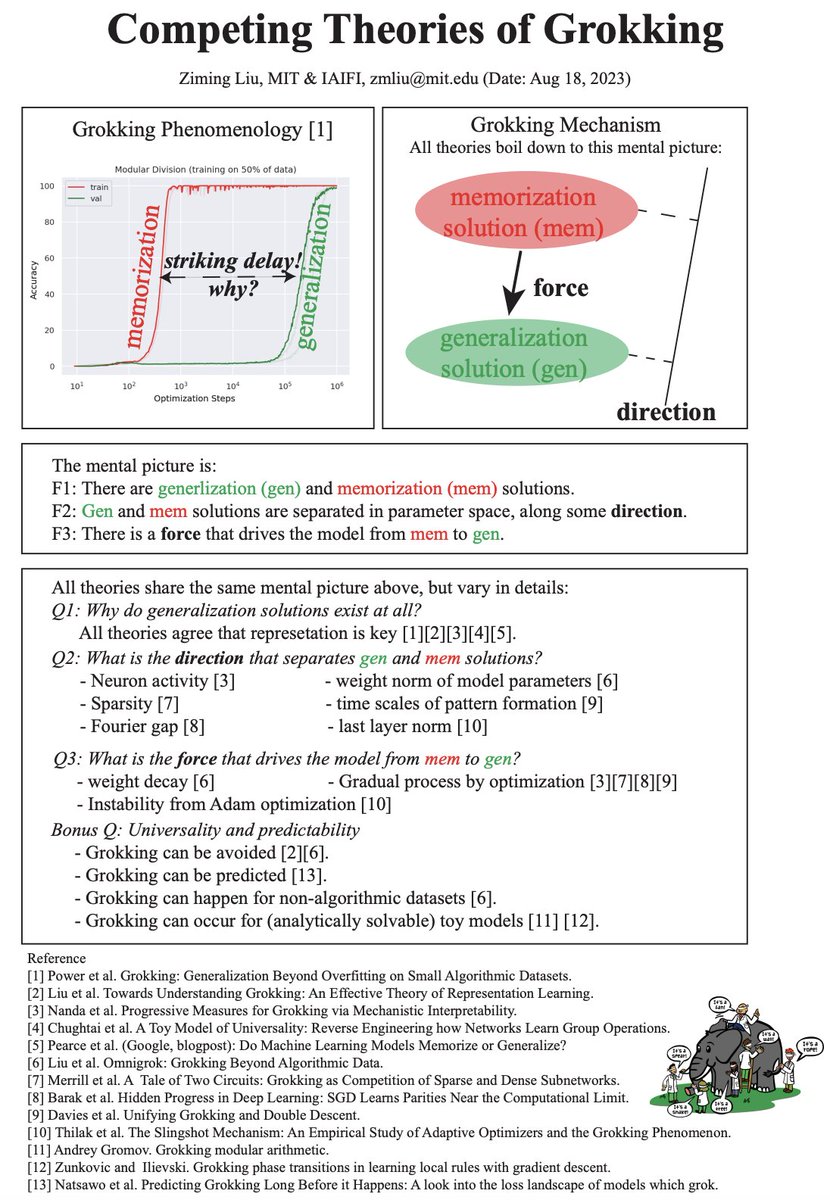
Deep learning has many mysterious phenomena, and grokking is one of the extreme. Want to catch up with the grokking literature? I've compiled a one-page summary of what's going on in the grokking world. Enjoy! :-)
https://t.co/yKvFofkKRu
Many of the professors who sign those open letters are not worried about X-risk. But they lent their name and credibility to the extreme AI doomers.
Due to this exploitation, the fringe becomes mainstream. That's the real misinformation here.
⤵
https://t.co/M76D2lNHTH
@barret_zoph@giffmana Also the inv sqrt LR seems to have a different warmup that ViT (constant vs linear) and no additional cooldown which maybe could have helped bridge the gap with triangular LR
@barret_zoph@giffmana Just checked! Indeed they use such LR, but they also found that, if you know the number of steps in advance, triangular LR (i.e. linear warmup and decay) provides better results
Saw their poster at ACL last month, recommend reading the paper. Cross-lingual transfer works well for classification tasks, but cross-lingual generation is more challenging. Li & Murray use a neat trick: add a second source language during fine-tuning
Most LLMs have been trained on—and generate—English text. But the world needs multilingual text generation! It isn't easy. @tli104 and @kentonmurray have a new technique to improve "zero shot" cross-lingual transfer: just add a second source language. https://t.co/LGk0zeo8JM
@juletxara Very interesting work! Maybe I missed it in the paper, but could the narrower gap between direct and self-translate for smaller models be only explained by their worse translation abilities? It would explain why the gap seems relatively constant when using NLLB for translation