Miracles happen even more than once!
Incredibly excited to be among the awardees of one of the ERC St 2024 grants. Thanks to reviewers and panelists for their trust ☺️
Come join our research group and let’s travel across the protein space!🚀💫🌟
📣 The latest ERC Starting Grant competition results are out! 📣
494 bright minds awarded €780 million to fund research ideas at the frontiers of science.
Find out who, where & why 👉 https://t.co/L6PimhW50v
🇪🇺 #EUfunded#FrontierResearch#ERCStG@HorizonEU@EUScienceInnov
Our best defense against bioterrorism is that biology makes a bad weapon. Malicious actors effectively never choose biology as a tool to cause harm
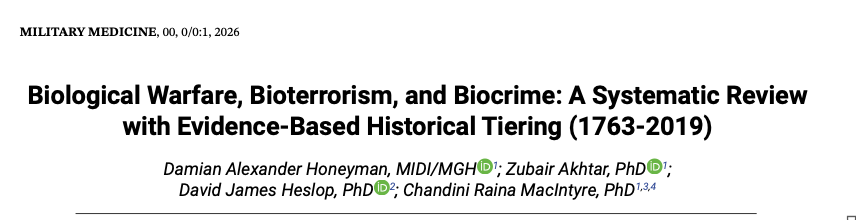
This review surveys all documented biocrimes since 1763. They found 19 events total in more than 250 years.
99.2% of all biocrime deaths were the actions of the Imperial Army of Japan in World War 2. Exluding those, they found 79 total deaths in total. That's < 1 death per year
Bioterrorism kills fewer people than sharks. Fewer people than falling coconuts. Fewer people than vending machines. It simply isn't a thing
I know that the Killer AI Virus crowd will object that the purpose of biosecurity is to defend against hypothetical future threats, not historically documented threats
But history can still inform our biosecurity policy. If you believe that the world is full of people who want to kill with biology, you are wrong. If you base your biosecurity policy on that belief, you will build the wrong safeguards
A rational, evidence-based biosecurity policy needs to begin from the reality that biology makes a bad weapon and focus on ways to make it an even worse weapon
https://t.co/fCum1tK9fQ
First New York City Marathon, first win. Andreas Almgren looked like he had another 5 miles in him. Showed his 800 speed and left everyone in his dust 💪
Desgraciadamente los peores presagios se han cumplido. Se confirma el fallecimiento de la investigadora leonesa Marta Shahbazi tras el accidente ferroviario de Urda. Era líder de grupo en el prestigioso centro LMB en Cambridge, Reino Unido. Descanse en paz
https://t.co/l943yvLJKS
ACTUALIZACIÓN
No una, sino dos, científicas leonesas que viajaban en el mismo vagón, desaparecidas en el accidente ferroviario de Urda. La bióloga molecular Marta Shahbazi, de Carrizo, y la bióloga cardiovascular Tamara González Costa, de Bembibre https://t.co/WKDFWuxlHv
Having started a biotech co in the past two years, the recent Mithril Medicine news felt pretty unsurprising.
When people ask me what surprised me most about being a biotech founder, I always say that I dramatically overestimated the number of people I would need to hire. AI has been transformational here, but so has the excessive build-out of CRO capabilities in the COVID ZIRP era making CRO prices dramatically cheaper than they would be otherwise. Operations, chemistry, tox, and most preclinical work can all be outsourced for 20-60% of the price of building the same capabilities in house. The core platform still needs hands-on internal work, but if you're building a very traditional asset-flip biotech startup, then there is no core platform to begin with.
There is some sacrifice in terms of speed over the long-term, but the combo of AI+automation+CROs suddenly allows biotech startups to create value on previously-challenging VC fund timelines. My prediction is that a biotech startup model consisting of a tiny team of 1-5 people is going to become fairly standard in the near-term future.
we absolutely should in fact genetically engineer bioluminescent plants & trees and then completely eradicate the affront to God that is LED street lights from the face of the Earth
Continuing with with early life origins, Weiss et al. analyzed 6.1 million genes and found 355 protein families likely present in the last common universal ancestor, suggesting it was anaerobic, CO2-fixing, H2-dependent, N2-fixing, and thermophilic: https://t.co/hkdcG2X5Wt
Computational design of protein conformational landscapes for metamorphic behavior
1. The study designs de novo metamorphic proteins that can populate two distinct, well-folded conformations without any external trigger, aiming to move protein design from single static structures to controllable conformational landscapes.
2. The workflow starts from 93 small natural domains (60–150 aa) and uses RFdiffusion to partially remodel termini while keeping cores fixed, generating 200 alternative conformations per domain and selecting large-change pairs (RMSD > 4 Å and ≥40% secondary-structure change in remodeled residues).
3. A key observation: substantial structural changes can be achieved with relatively modest sequence changes. Many alternative-state designs retained >50% sequence identity to the native protein even when the native vs alternative structures differed by up to ~16 Å RMSD.
4. To ensure transitions are structurally plausible (not just two endpoints), the authors built a coarse-grained, sequence-independent transition modeling step inside RFdiffusion using auxiliary potentials: an “unfolding” potential to disengage the moving region and a “transformation” potential to bias toward the target state, producing dense ensembles of intermediate backbones.
5. From thousands of native/alternative pairs, they focused on three transition types with clear structural logic: helix reorientation (H2H), beta-to-helix (B2H), and helix-to-beta (H2B). Alternative folds were experimentally validated; for example, crystal structures for stabilized alternative states matched designs at ~1–2 Å RMSD.
6. Two complementary sequence-design strategies were tested for metamorphism: (i) chimeric “trajectory” design that restricts each position to amino acids from either endpoint sequence (searching the sequence space between states), and (ii) fully de novo iterative ProteinMPNN redesign that optimizes one sequence against both backbones by exchanging per-residue logits biases until convergence.
7. Biophysics and NMR show the central challenge of dynamic design: many candidates are folded (CD, SEC-MALS) yet display exchange broadening, missing peaks, and heterogeneous intensities in HSQC spectra, consistent with micro-to-millisecond conformational exchange concentrated in the metamorphic regions.
8. Unbiased MD (hundreds of microseconds aggregate) supports intrinsic multi-state behavior. For H2H-chimeric, multiple replicas underwent reversible helix reorientation approaching the alternative-like state; for B2H-full, the native beta state was kinetically more stable while the alternative helix showed partial unfolding/refolding and transient beta-strand propensity.
9. A major contribution is a practical strategy to steer state populations with minimal mutational load. The authors combine AF3 (for filtering state-specific predictions) with BioEmu (for ensemble sampling) to identify “state-defining” mutations; 2–3 mutations were sufficient to shift equilibria toward either state.
10. Structural confirmation closes the loop: for B2H-full, a native-stabilized mutant yielded a crystal structure matching the beta state (~2.6 Å RMSD), while an alternative-stabilized mutant enabled an NMR structure confirming the designed helix (~2.2 Å RMSD). For H2H-chimeric, an alternative-stabilized mutant was confirmed by crystal structure (~1.8 Å RMSD), demonstrating that designed sequences can be tuned across distant conformations.
📜Paper: https://t.co/TlqMEU4D71
#ProteinDesign #MetamorphicProteins #ConformationalDynamics #RFdiffusion #ProteinMPNN #AlphaFold3 #NMR #MolecularDynamics #ComputationalBiology #Bioinformatics
Yay!
Soon I'm starting my lab at the Centre for Genomic Regulation in Barcelona (@CRGenomica), as a joint Independent Fellow with Andorra Research + Innovation (@Andorra_RI) . 🧬🤠
https://t.co/Efn0b5EaY8
New Essay in @AsimovPress about why trying to define a "species" can be so difficult; the whole notion of a species, at least for bacteria, is almost nonsensical.
Consider: For a 2015 paper, researchers took 2,000+ full E. coli genomes and compared them. Each genome contained about 5,000 genes total, but only 3,000 of those genes were broadly shared across the strains.
The other 2,000 genes were unique and varied *a lot* from one cell to the next. Collectively, the 2,000+ E. coli genomes contained something like 89,000 distinct genes, all within this single species.
The boundaries between species, then, are basically man-made inventions. The reality is that the branches of the tree of life "criss-cross and merge."
Read: https://t.co/zvlcRB3rJ7
Fascinating paper, they show that synthetic polymers can form vesicles that grow and self-reproduce in water. It happens with no DNA, RNA or proteins involved. It makes me think, how we actually define life? https://t.co/7Q8pkDHwLh
We’re releasing a broad range of new mathematical results produced by an internal frontier model.
We’ve been consulting with the independent Advisory Group on Mathematics and Artificial Intelligence at the Institute for Advanced Study, and we have drawn on their advice and public recommendations to inform how we release these results.
https://t.co/7N6TPlft1P
Call for presenters is published.
New in 2026: Only peer-reviewed publications will be accepted. We can no longer accommodate posters from preprints and/or ongoing doctoral research.
Submission deadline: October 17, 2026.
https://t.co/QtOWFQyr42
The Barcelona Supercomputing Center will be a Diamond Sponsor of the Deep Learning Barcelona Symposium 2026.
https://t.co/IPDRcCaViF
We invite you to follow them @BSC_CNS.