@mattpocockuk Even if you do read the code, having this type of workflow can be good thing to have in your toolbelt. Use it when you are pretty confident about what you will get in the end. I personally use both approaches.
@mattpocockuk Are you reading the code in the end? If you do, isn't it more efficient to read it and approve it in chunks after each milestone? Less mental load on yourself, and you stop errors from propagating downstream.
Absolutely beautiful rant about AI in Linux Kernel from Linus yesterday:
I realize that some people really dislike AI, but this is an area
where I'm willing to absolutely put my foot down as the top-level
maintainer.
Linux is not one of those anti-AI projects, and if somebody has issues
with that, they can do the open-source thing and fork it.
Or just walk away.
AI is a tool, just like other tools we use. And it's clearly a useful one.
It may not have been that "clearly" even just a year ago, but it's no
longer in question today.
There are other questions around AI (like what the economy of it will
actually look like in the end), but "is it useful" is no longer one of
those questions. Anybody who doubts that clearly hasn't actually used
it.
Yes, it can also be a somewhat painful tool, both for maintainer
workloads and just from a "it keeps finding embarrassing bugs"
standpoint.
But the solution is not to put your head in the sand and sing "La La
La, I can't hear you" at the top of your voice like some people seem
to do.
The solution is to make sure those LLM tools _help_ maintainers
instead of just causing them pain. There's no question on that side.
We're not forcing anybody to use it, but I will very loudly ignore
people who try to argue against other people from using it.
And no, AI isn't perfect. But Christ, anybody who points to the
problems at AI had better be looking in the mirror and pointing at
themselves at the same time.
Because it's not like natural intelligence is always all that great either.
The kernel project has been and will continue to be about the technology.
Sure, the social angle of working on open source is important and
often a very motivating part of the project, but in the end that's a
side benefit, not the _point_ of the project.
This is *NOT* some kind of "social warrior" project, never has been,
and never will be.
In the kernel community we do open source because it results in better
technology, not because of religious reasons.
And so we make decisions primarily based on technical merit. Not fear
of new tools.
Linus
I have a deep distrust of almost any 'self-improvement' loop in coding agents
I.e. automatically created memories, CLAUDE.md suggestions applied after every session
Often the suggestions themselves are shit
But even if they're good, the agent often over-indexes on them in a way that's super unhelpful.
It makes the agent impossible to steer. And often because these memories are scoped per-project, each project is unsteerable in its own way.
What's the right name for this? Instruction rot?
It seems like LLMs could optimize coding style by exploring ways of structuring code so weaker and weaker models can still successfully perform tasks in a codebase.
There are surely stylistic quirks that are peculiarly impactful to transformers, but I bet there would be a lot of overlap with human capabilities.
Optimizing for understanding should help even the top frontier models, allowing them to understand things “at a glance” without having to explicitly explore. There will remain “better” and “worse” ways to code.
Coding agents are such amazing pattern matchers. Setting up the right scaffolding and foundation for a new project has become pretty important if you care about consistency.
Code may be disposable but don’t compromise on code quality. Build systems and patterns that make it easier for agents to “do a good job”.
right monitor is 20 codex instances. left monitor has situational awareness on autoscroll. center monitor is my word doc mainfesto. two keyboards, one for both hands. left airpod is dwarkesh x eric jang, 3x speed. right airpod tchaikovsky. meta quest 3 overlays my HUD: heart rate, words per minute, blood caffeine content. one assistant hooks me to an iv of chinese peptides, cocktail. the other feeds me kimchi. my unitree robot steps in when my posture slouches. blue light beams down on me in my herman miller chair. efficiency. no wasted movement. no wasted thoughts. think you can keep up with me? good luck. this is just for my morning emails.
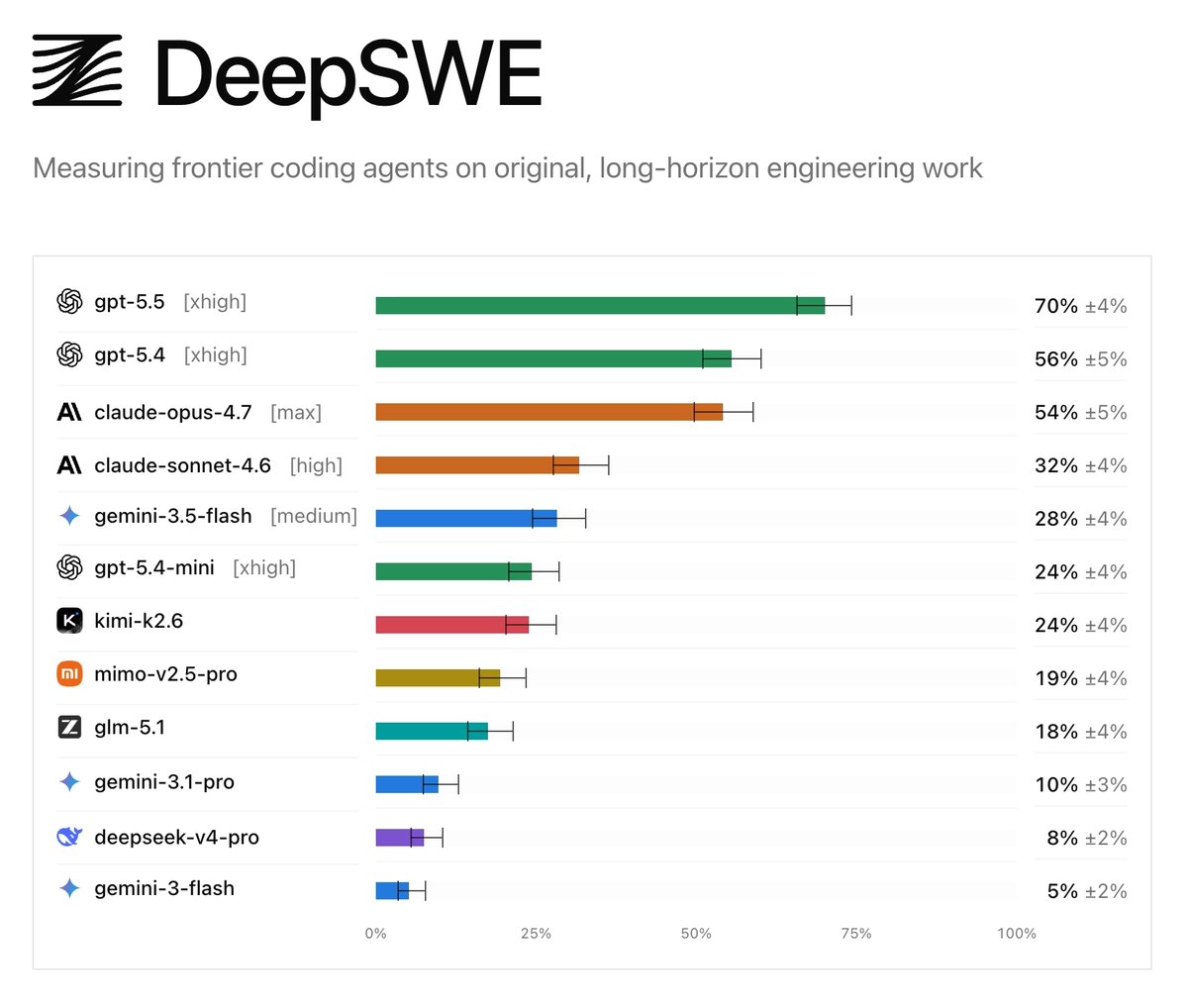
Today we’re releasing DeepSWE, a new standard for agentic coding benchmarks.
On public leaderboards, top models often look relatively close in capability. DeepSWE shows where they actually diverge, reflecting the realistic experience of developers in their day-to-day work.
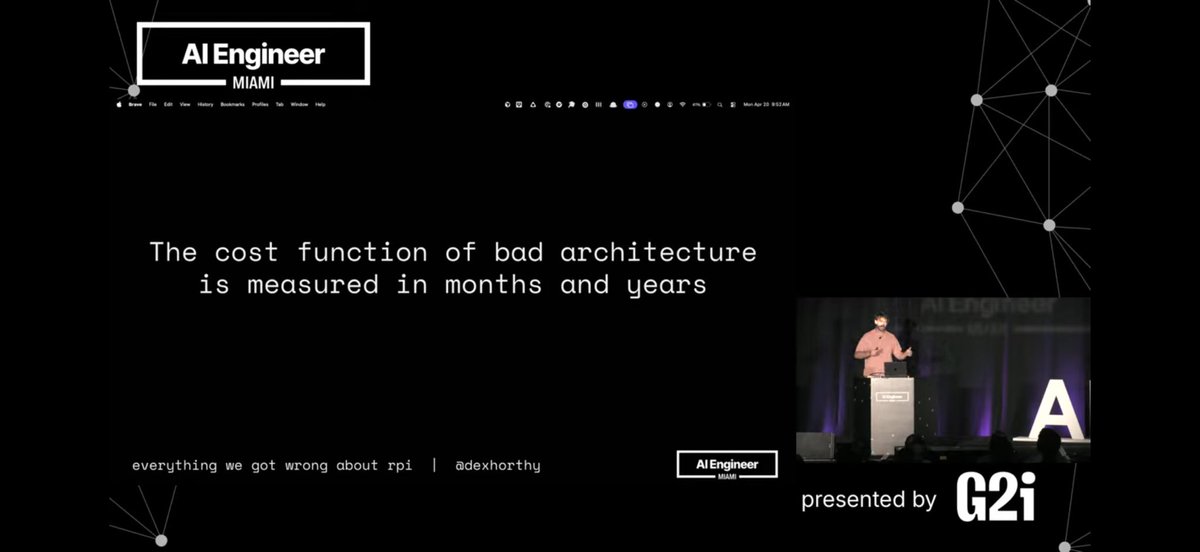
“why do we still need humans in the loop for the design of software”
Because the cost function of bad architecture is measured in months and years, and it’s hard to measure that in an RL environment/benchmark like SWE bench multilingual that is measures a 5-10 minute “can we write the code and get the tests passing”
Spoke about this at @AIEMiami - been Obsessed with this after a convo I had with @calvinfo back in April
https://t.co/C3rmDMBQnP
universal basic compute will be the enfranchisement that creates the politics of the future: people will band together their timeslices of superintelligence to fight the great ideological battles of the future, the outlet for thymos
Now that we're soon running out of 32-bit namespace for transfer IDs at @Wise, the engineers are annoyed with me choosing int over long when I wrote the first lines of code in 2010.
But why don't they appreciate the $17 of savings in storage cost over years!? 🤷
No-one has figured out how an eng team should work with agents yet. Be wary of anyone telling you they know how to do it. Keep exploring. https://t.co/QZ3RXEyIzZ