A Martian meteorite found in the Sahara Desert was formed at least 4.1 billion years ago and is a sample of Mars’ early crust, according to a new study in Science. https://t.co/3UigkPLq0u
Happy 159th Birthday, Marie Skłodowska Curie
Born Maria Salomea Skłodowska in Warsaw on 7 November 1867, she became the woman who named radioactivity, discovered polonium and radium, and remains the only person ever to win Nobel Prizes in two different sciences—Physics in 1903 (shared with Pierre Curie and Henri Becquerel) and Chemistry in 1911 (solo).
What remains to be said? Plenty. In *The Elements of Marie Curie*, Dava Sobel uses Curie’s well-known story as scaffolding for something richer: the brilliant young women who trained in her laboratory. More than forty of them worked with her between 1906 and 1934. Among them were Marguerite Perey (who discovered francium) and her own daughter Irène Joliot-Curie (Nobel Prize in Chemistry, 1935). Curie didn’t just break the glass ceiling; she built a laboratory full of women who kept pushing science forward.
During the First World War she also drove mobile X-ray units to the front lines, training roughly 150 women as radiology technicians and helping treat more than a million soldiers. She died in 1934 from the long-term effects of the radiation she studied—her laboratory notebooks from 1899–1902 are still radioactive today.
Nearly a century later, her discoveries continue to underpin radiation therapy and nuclear medicine. The glow of radium she first measured still lights the path for the women who followed her into the lab.
The hawksbill sea turtle is a critically endangered sea turtle whose shells slightly changes colors, depending on water temperature.
[📷 Orazio Fargione]
✅⬜🟥 The #legendary#Bizzarrini 5300 GT with a front-mid-mounted 5.3-liter #Chevrolet V8, rear-wheel drive, and a chassis engineered for balanced weight distribution. Its competition heritage included a class #victory at the 1965 #LeMans 24 hours 🏁
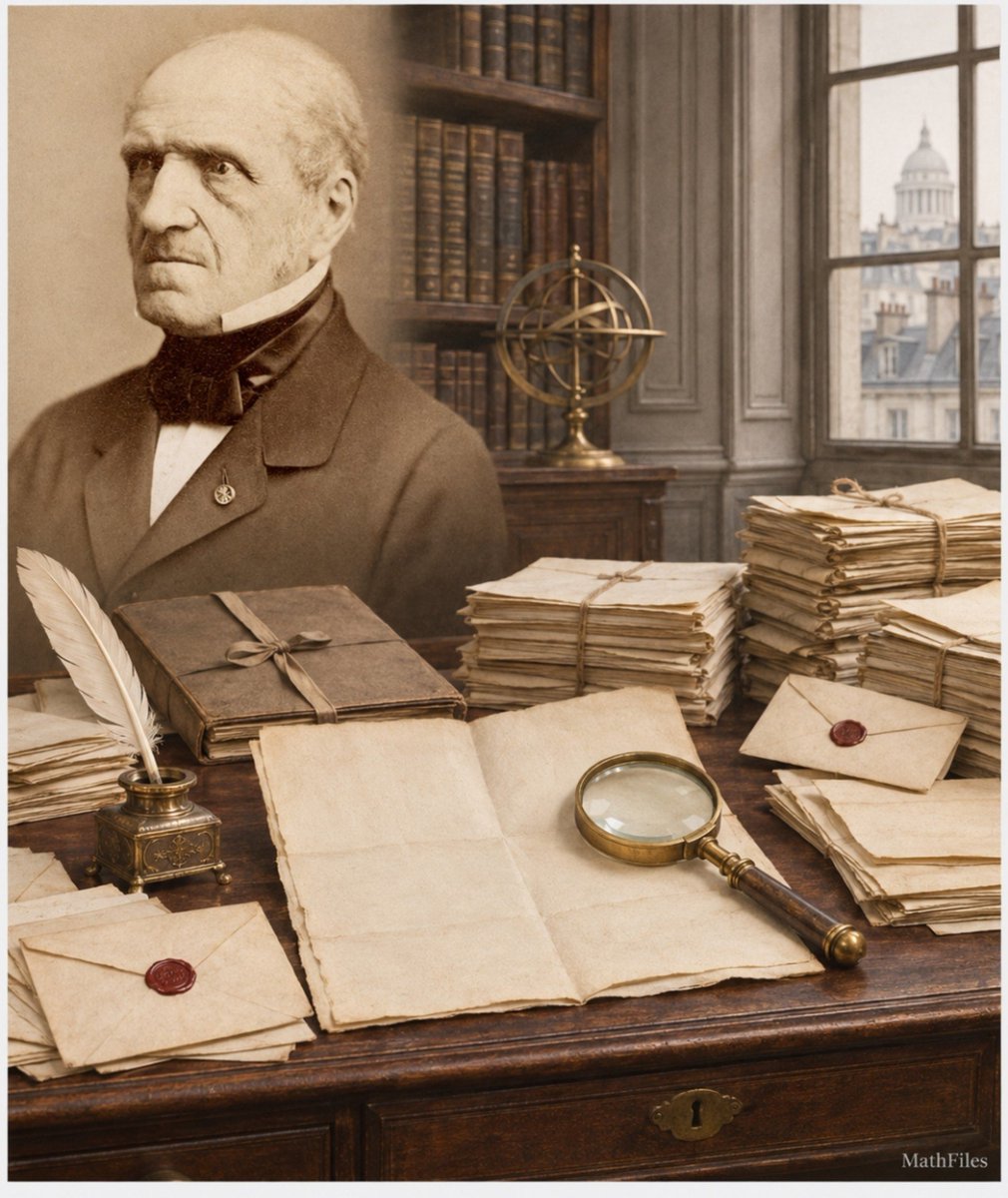
One of France's greatest mathematicians once spent a fortune buying 27,000 fake historical letters.
Michel Chasles (1793–1880) was a distinguished geometer, celebrated for his contributions to mathematics.
But he had an unusual passion: collecting handwritten letters from famous historical figures.
Between 1861 and 1869, a dealer named Denis Vrain-Lucas sold him more than 27,000 supposedly authentic documents for approximately 140,000 francs.
Some letters appeared to prove that Blaise Pascal had discovered universal gravitation before Isaac Newton.
Chasles was so convinced that in 1867 he presented the evidence to the French Academy of Sciences.
Then came the extraordinary details.
His collection included alleged correspondence from:
• Cleopatra to Julius Caesar
• Alexander the Great to Aristotle
• Mary Magdalene to Lazarus
• Pascal to Newton and Galileo
And nearly all the documents shared one remarkable characteristic.
They were written in French!
When scholars noticed impossible dates, suspicious handwriting and historical contradictions, Vrain-Lucas simply produced additional letters to explain the earlier ones.
Eventually the elaborate fraud collapsed.
The dealer was convicted and sentenced to two years in prison.
Chasles, whose mathematical achievements were genuine, had been deceived by thousands of fabricated historical documents.
Howard Eves recounts this episode in In Mathematical Circles.
The irony is difficult to forget: a brilliant mathematician, trained to demand rigorous proof, accepted extraordinary historical claims without sufficiently questioning their evidence.
Discovery of explicit solution formulas for Polynomial equation:
• j=2 Pythagoras (500 BC)
• j=3 Girolamo Cardano (1545)
• j=4 Lodovico Ferrari (1540)
• j≥5 No general formula exists, Niels Abel (1824)
Cpl Ryan L. Ice was the kind of guy who made an impression on everyone he met. He served five years in the Marine Corps, spending time deployed in Okinawa, Japan.
Ryan was famous for his great sense of humor. He always had a joke ready, bringing warmth and laughter to the Marines who served beside him. He was loved by everyone who crossed his path-and mostly by his wife, Joy.
Just ten days after Ryan and Joy got married, Ryan was diagnosed with stage 4 colon cancer. What came next showed the strength Ryan carried inside him. He always said he wouldn't have survived as long as he did without Joy by his side. Even in the hardest moments, his main focus was making sure his family was taken care of.
On November 3, 2026, Ryan's long battle came to an end. Ryan leaves behind a legacy of pure strength, deep devotion, and a spirit that will never be forgotten.
Japan is working on a drone wingman that looks more like a missile than an aircraft 👀 Mitsubishi showed two drone wingman concepts at the 2024 Japan Intl Aerospace Exhibition, including a rather unusual missile-like design called ARMDC-20X (Affordable Rapid Prototype Missile Drone Concept 20X). Then, in March this year, Kawasaki confirmed it is also studying two types of collaborative drones, one missile-like and the other more conventional in shape. The idea is simple: cheap, quick to build and capable of being launched from multiple domains like a missile. What do you think of ARMDC-20X?
ELON MUSK: "I would encourage everyone to be optimistic and excited about the future, and I think for quality of life, it is actually better to err on the side of being an optimist and wrong rather than a pessimist and right usage."
An alternating tread staircase designed to fit into very steep or narrow spaces while saving horizontal floor area....
The offset, alternating steps allow for a much steeper ascent without taking up the room a traditional staircase requires. They are often found in older homes, barns, or tight attic and loft conversions (particularly in New England), and share similarities with ship stairs used on vessels where space is limited.
The myth that the staggered design confuses or traps witches has no historical backing; it is simply a clever architectural solution to a cramped floor plan.
. . . .
Stairs like these are sometimes found in old New England homes. Each step is only half as wide as a normal one, alternating left and right, which lets the staircase climb at a much steeper angle than regular stairs.
That made them useful in tight spots like attics and lofts, where there wasn’t room for a full staircase. Today they’re often called alternating tread stairs, and there’s no real evidence they were ever meant to stop witches.
Still, the legend makes sense in a region with a long history of fear of witchcraft.
In 1692, the Salem witch trials in Massachusetts led to the executions of 20 people accused of witchcraft. Most were hanged, and one man, Giles Corey, was pressed to death with heavy stones for refusing to enter a plea.
Fear of witches also shaped real homes. Builders in England and colonial America carved protective symbols, now called “witch marks,” near doorways, windows and fireplaces, where evil spirits were thought to enter.
Old shoes have been found hidden inside the walls and chimneys of centuries-old homes in England and New England. Historians believe many were concealed on purpose, possibly to ward off evil spirits or witches.
#archaeohistories
Tribute mural unveiled in honour of the late Sir Patrick Stewart in his birthplace of Mirfield, West Yorkshire.
A fitting tribute to a much-loved actor whose incredible talent and legacy touched millions of people around the world. 🌹
On 18 June 1980, Indian mental calculator Shakuntala Devi achieved an extraordinary feat at Imperial College London.
She multiplied two randomly selected 13-digit numbers:
7,686,369,774,870 × 2,465,099,745,779
Her correct 26-digit answer:
18,947,668,177,995,426,462,773,730
Time taken: just 28 seconds.
Guinness World Records recognizes this achievement as the fastest human computation, a remarkable demonstration of mental arithmetic.