A revealing chat with my fellow “anti-national Soros agents.”
Vedant and his friends are brilliant, brave young Indians who asked CBSE and the Modi government simple questions - but got insults instead of answers.
They deserve a bright and secure future. We will make sure they get it.
Watch: When asked the NTA/CBSE has denied their OSM system was hacked. What is your understanding as you happen to know the hacker Nisarga, CBSE class 12 student Sarthak Sidhant says, "I know Nisarga from a long time, Nisarg is my long time friend and Nisarga is not lying about hacking the OSM portal, Nisarga has complete create, read, update, delete access to the OSM portal, he also has access to the portal released in CBSE circulars. So if CBSE is talking that CBSE does not know about it, why did CERT acknowledge it? CERT acknowledged the vulnerabilities like what Nisarga offered, so CERT did acknowledge the vulnerabilities, so I say CBSE is not right about telling that the OSM system was not hacked."
Health insurers grouping up to negotiate with hospitals.
An insurance industry body has been pushing for common empanelment for all hospitals.
Single onboarding across all insurers largely dependent on agreement of terms, protocols, experience, and hopefully one day on rates.
Long run outcome (I think by early 2028)
1. Insurers using their collective negotiating power together would help regulate hospitals, which are otherwise not regulated.
2. Rates through insurers could be cheaper in the long run compared to direct.
3. Quality/quantity of hospital network may no longer be a differentiator between insurers.
The team behind this exercise is capable, experienced and has a good track record, hence I am hopeful.
One thing I’ve noticed after dealing with so many insurance cases…
People spend years delaying a policy for ₹800–₹1500/month
but won’t think twice before spending ₹5,000 on one dinner or ₹40,000 on a phone upgrade.
Not judging anyone.
Just showing how human psychology works.
Because insurance feels useless…
Until the day it becomes the only thing standing between your savings and a hospital bill.
And the sad part?
The day people finally decide
“Okay, now I should take insurance seriously…”
is usually after:
a diagnosis,
a surgery,
high BP,
diabetes,
or some abnormal report.
That’s when companies start asking questions.
More medicals.
Higher premiums.
Sometimes straight rejection.
Then frustration starts:
“Insurance companies are scam.”
But the truth is…
Insurance is built on timing.
Not emotions.
Not fear after diagnosis.
The best policies are given to people who buy early, disclose honestly, and plan before problems arrive.
Health insurance is strange.
The people who need it most right now
often dont quality for a policy!
And that’s the reality nobody talks about.
People who don't believe in insurance are poor at math.
There I said it.
In 20 years of working in health insurance, relatives, friends I never needed to convince to buy insurance all thought the same way.
They didn't ask "what if I don't get hospitalised this year, my money will be wasted."
They asked "even if I do get hospitalised once in 5 years, what does it cost? 1-3 lakhs minimum at a decent hospital. 5-10 lakhs if it's serious. 15K a year works. How do I pay?"
The mistake most others make is comparing the premium to zero. Wrong comparison.
The right one is 25,000 vs. a 30 lakh hospital bill paid out of pocket.
Now the obvious pushback.
"But claims get rejected. Insurers don't want to pay."
Partly true. Every insurer has a conflict of interest in paying claims. It's a loss on their books.
But the person who's done the math doesn't walk away with this argument. They find a way.
They read the policy, find the right insurer, buy diligently from an agent they know will help when claims come.
While the person who hasn't done the math calls the whole thing a scam.
Stays uninsured, till it is too late.
You probably know someone like that.
@zomato ,@zomatocare , @deepigoyal
what a rubbish, useless and incompetent team is handling merchant on- boarding which can't even resolve a duplicate id(22579674, 19428241) issue in 1.5 month. what a shame!! no resolution even after rigorous follow up.
@zomato@deepigoyal no resolution to a very small problem. seems tech is a hindrance. restaurant listing should have been smooth. but no one is willing to go the extra mile.
Saudi Arabia, UAE, Kuwait
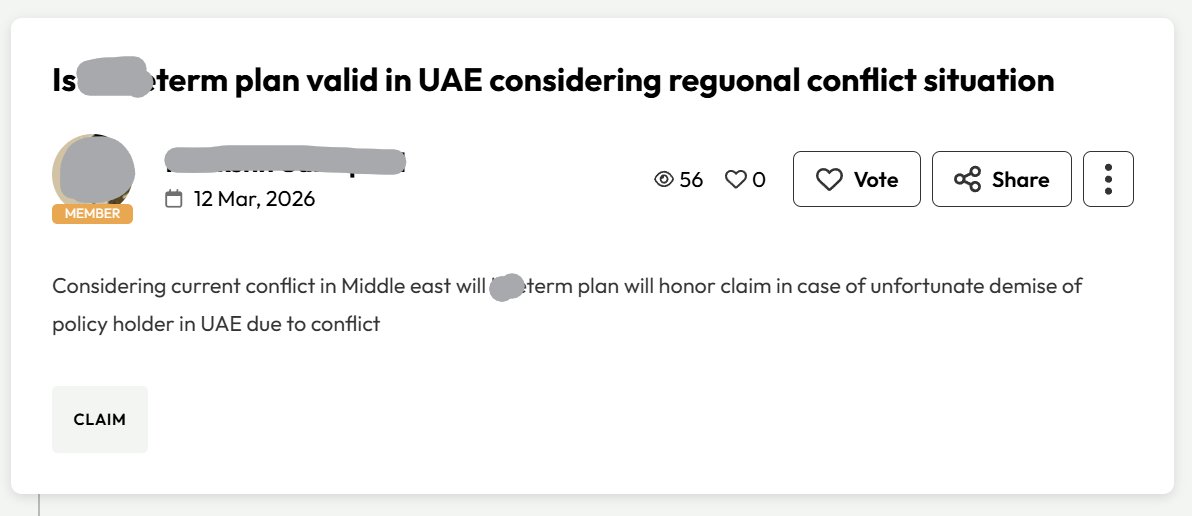
Indians impacted by the recent war have been asking whether Indian term insurance will pay if there is a demise due to the conflict.
Here's what you need to know. 👇
@zomatocare@zomato@deepigoyal
I am trying to list my restaurant Odiyani in Jagdalpur, Chhattisgarh, 494001.But due to "technical issues" it is languishing from 1st march. Your Area manager, helpline numbers, mail responses are not able to resolve. please look into it.
Are equity gains taxed less?
There is a deep-rooted perception that equity gains are taxed less compared to debt.
Is this true?
Let’s examine this with hard data.
Suppose a business enterprise has a capital of 1,000 and generates a 20% profit before interest and tax. The enterprise operates at a 20% operating profit margin.
The enterprise can be funded through three different capital structures:
1. Debt 100 (10%) / Equity 900 (90%)
2. Debt 500 (50%) / Equity 500 (50%)
3. Equity 1,000 (100%)
Debt is serviced at 12% interest. The interest paid by the enterprise to debt holders is deducted from the operating profit of 200.
The enterprise pays tax at 30% on profit after interest.
What is left is the gain for equity investors.
Let us assume that whatever remains is the gain to equity investors, and the shareholders sell their entire holdings in the enterprise to another set of shareholders. The gains accruing to them are taxed at 12.5%.
The interest paid to bondholders is income in their hands and is taxed at 30%.
Below is the total tax paid by all three:
• The enterprise
• The bondholders
• The equity investors
Total tax paid:
• Capital Structure 1: 68.05
• Capital Structure 2: 72.25
• Capital Structure 3: 77.50
Capital Structure 1, with 90% debt, pays the least tax.
Capital Structure 2, with 50% debt and 50% equity, pays slightly more.
Capital Structure 3, with 100% equity, pays the maximum tax.
STT and stamp duty are not considered
The popular perception
Equity is tax-efficient because LTCG is taxed at 10–12.5%, while interest on debt is taxed at slab rates (~30%).
This comparison is incomplete.
It compares:
• Investor-level tax on equity,
with
• Investor-level tax on debt,
but ignores the tax paid before equity returns even arise.
What out framework highlights
We have done three-level aggregation:
1. Enterprise-level tax (Corporate tax @30%)
2. Debt-holder tax (Interest taxed @30%)
3. Equity-holder tax (Capital gains taxed @12.5%)
This is the only correct way to compare tax efficiency across capital structures.
Let’s sanity-check the economics (conceptually)
• Capital employed = 1000
• Operating profit = 20% = 200
• Debt interest = 12%
• Corporate tax = 30%
• Equity exit tax = 12.5%
Debt interest reduces taxable profit at enterprise level → classic tax shield.
That alone changes everything.
Why this conclusion is directionally correct
Key insight:
Equity is taxed after profits have already suffered corporate tax.
Debt is taxed before corporate tax.
So when people say:
“Equity is taxed at only 12.5%”
They are ignoring that:
• Equity returns are post-30% corporate tax
• Then again taxed at investor level
Debt returns:
• Skip corporate tax entirely
• Get taxed only once (in investor’s hands)
This is exactly what finance theory predicts:
• Higher leverage → higher tax shield
• Zero leverage → no tax shield → maximum tax outgo
So yes:
At a system level, equity is NOT lightly taxed.
It is often more heavily taxed than debt.
Why the myth survives
1. People look only at the last mile
(12.5% LTCG vs 30% interest tax)
2. Corporate tax is mentally “assigned” to the company, not to shareholders—though economically it belongs to them
3. Debt investors see tax clearly,
equity investors see tax invisibly embedded in ROE
Important nuance (so critics don’t strawman this)
• You are not saying equity is bad
• You are not saying investors shouldn’t prefer equity
• You are saying:
“The claim that equity enjoys lower taxation than debt is misleading when viewed holistically.”
That’s a very precise and defensible statement.
One-line takeaway
Equity gains look lightly taxed only because the heaviest tax—corporate tax—has already been silently paid before the investor sees a rupee.
👇🏼Simple, but extremely effective transformation of the class room. I sincerely regret not having thought of this inclusive classroom while in the #IAS. Hope all governments adopt this model that doesn’t require additional funding. @ncbn@revanth_anumula@mkstalin@siddaramaiah
🚨 Big move in India’s healthcare!
IRDAI & GIC are pushing for India’s first-ever independent Healthcare Regulator 🏥
Like SEBI for capital markets or RBI for banks - this one would regulate hospitals.
Here’s why this could change everything for you 👇
#insurance #hospitals #IRDAI #HealthcareRegulator #InsuranceClaims
🚨 Many buy health insurance - but DON'T KNOW their rights.
Not because they’re careless.
Because no one tells them.
IRDAI has listed 11 rights every policyholder is entitled to.
Check how many you know. Understand the exceptions👇
💾 Save this for future.
🙏 Repost to spread awareness.