RBI MPC June 2026: Beyond the headlines
First, the broad strokes
No change in the policy rate and no change in the policy stance
That is the headline but there is a long list of uncertainties from geopolitics to the El Nino and the monsoon
Broadly, inflation slated to go up and estimated GDP to soften a bit
Still, the RBI is holding on and promising to be data driven
In spite of the pressure on currency, which we had anticipated after the last rate cut
This is how it goes: Interest rates in India are now only a couple of percentage points higher than those in the West, which is a historic low and in macroeconomic terms was certain to bring pressure on the Rupee exchange rate, which we have now seen playing out
Even the local bond markets never quite got in sync with RBI’s rate cut, with bond yields not coming down in line with the rate cuts…and several state government issuances not going through
However, despite other measures to shore up the currency including the tax ordinance detailed below, the RBI clearly does not want to use rates as a tool for the same…at least for now
Here are the details…
Policy Decision
The Reserve Bank of India (RBI) Monetary Policy Committee (MPC) kept the policy repo rate unchanged at 5.25% and retained its Neutral policy stance in its June 5, 2026 meeting.
Key policy rates remain as follows:
• Repo Rate: 5.25%
• Standing Deposit Facility (SDF): 5.00%
• Marginal Standing Facility (MSF): 5.50%
The decision was unanimous and marks the third consecutive policy pause after the February and April 2026 meetings.
RBI’s stated logic for keeping Rates Unchanged?
The RBI cited heightened uncertainty arising from the ongoing conflict in West Asia, which has increased risks to both inflation and economic growth.
The central bank noted that:
• Rising crude oil prices could fuel inflationary pressures.
• Higher freight and logistics costs may increase input costs across sectors.
• Global growth risks have intensified amid geopolitical tensions.
• Financial market volatility remains elevated.
Given these uncertainties, the MPC preferred to maintain the current policy settings and await greater clarity before taking further action.
Growth Outlook
The RBI lowered its FY27 real GDP growth forecast to 6.6%, compared with 6.9% projected earlier.
Revised Quarterly Growth Projections
• Q1 FY27: 6.6% (Earlier: 6.8%)
• Q2 FY27: 6.3% (Earlier: 6.7%)
• Q3 FY27: 6.5% (Earlier: 7.0%)
• Q4 FY27: 6.8% (Earlier: 7.2%)
The downward revision reflects concerns regarding:
• Global economic uncertainty.
• Elevated energy prices.
• Potential disruptions from geopolitical developments.
Inflation Outlook
The RBI raised its FY27 CPI inflation forecast to 5.1% from 4.6% earlier.
The upward revision is primarily driven by:
• Uncertainty surrounding food inflation.
• Sustained upside risks from crude oil prices.
• Pass-through of higher fuel costs into the broader economy.
Key Risks Highlighted by RBI
Domestic Risks
• Potentially deficient southwest monsoon.
• Weather-related disruptions affecting agriculture.
• Weakening rural demand.
• Food inflation risks.
External Risks
• Elevated crude oil and commodity prices.
• Ongoing supply-chain disruptions.
• Global financial market volatility.
• Slowing global economic growth.
India's External Position Remains Strong
The RBI highlighted that India's foreign exchange reserves stand at USD 682.3 billion, providing a strong buffer against external shocks and enhancing financial stability during periods of global uncertainty.
Measures to Attract Foreign Capital and Strengthen Forex Inflows
1. Expansion of the Fully Accessible Route (FAR)
The RBI expanded the list of government securities available under the Fully Accessible Route (FAR) by including all new issuances of:
• 15-Year Government Securities
• 30-Year Government Securities
• 40-Year Government Securities
In addition, restrictions relating to short-term investments, concentration limits and individual security limits for Foreign Portfolio Investors (FPIs) under the General Route have been removed.
Expected Impact
• Increased foreign participation in India's bond market.
• Greater demand for government securities.
• Support for government borrowing programs.
• Higher long-term capital inflows.
• Positive support for the Indian rupee.
2. Income-Tax Ordinance 2026: Tax Incentives for Foreign Investors
The Government introduced tax incentives for foreign investors investing in Indian Government Securities through the Income-Tax Ordinance, 2026.
Key Benefits
• Exemption on interest income from Government Securities.
• Exemption on capital gains arising from Government Securities.
• No withholding tax on such investments.
Eligible Investors
• Foreign Institutional Investors (FIIs)
• Bank for International Settlements (BIS)
Effective Date
The provisions will be applicable retrospectively from April 1, 2026.
Expected Impact
• Enhanced attractiveness of Indian debt markets.
• Increased foreign portfolio investment.
• Stronger global investor participation.
3. Higher Investment Limits for NRIs and OCIs
The RBI increased investment limits for:
• Non-Resident Indians (NRIs)
• Overseas Citizens of India (OCIs)
in the listed Indian equity instruments.
The same facility has also been extended to all individual Persons Resident Outside India (PROIs).
Expected Impact
• Higher foreign participation in Indian equities.
• Increased capital inflows.
• Broader investor base for Indian markets.
4. Concessional Forex Swap Facility for CPSEs
To encourage overseas borrowing, the RBI announced a concessional forex swap facility for Central Public Sector Enterprises (CPSEs) raising External Commercial Borrowings (ECBs).
The facility will remain available until September 30, 2026.
Expected Impact
• Lower hedging costs.
• Increased overseas borrowing by CPSEs.
• Additional dollar inflows into India.
• Improved forex liquidity.
5. Support for FCNR (B) Deposits
The RBI announced that it will bear the full hedging cost for banks mobilising fresh 3–5 year FCNR (B) deposits until September 30, 2026.
Expected Impact
• Increased NRI deposits.
• Improved dollar liquidity.
• Strengthening of India's foreign exchange reserves.
6. Relaxation of Export Proceeds Rules
The RBI restored the time limit for realisation of export proceeds to nine months.
Expected Impact
• Greater operational flexibility for exporters.
• Support for export-oriented businesses.
• Improved ease of doing business.
Market Reaction
Rupee Strengthens
Following the RBI's policy announcement and the package of capital inflow measures, the Indian rupee appreciated by approximately 50 paise to 95.24 against the US dollar.
Why Did the Rupee Appreciate?
Investors responded positively to measures aimed at:
• Attracting foreign capital.
• Improving forex liquidity.
• Strengthening India's external position.
Confidence was further supported by India's strong foreign exchange reserve position.
Most people “learn” the stock market by
watching tips and chasing trends.
That’s where they go wrong.
So where should you actually start?
And why do even great companies struggle before success?
In this clip, @DevinaMehra shares what most beginners miss.
💬 Not sure where to start or feeling stuck?
DM us or mail us at [email protected]
Watch the full video, link in the thread below.
@INDmoneyApp
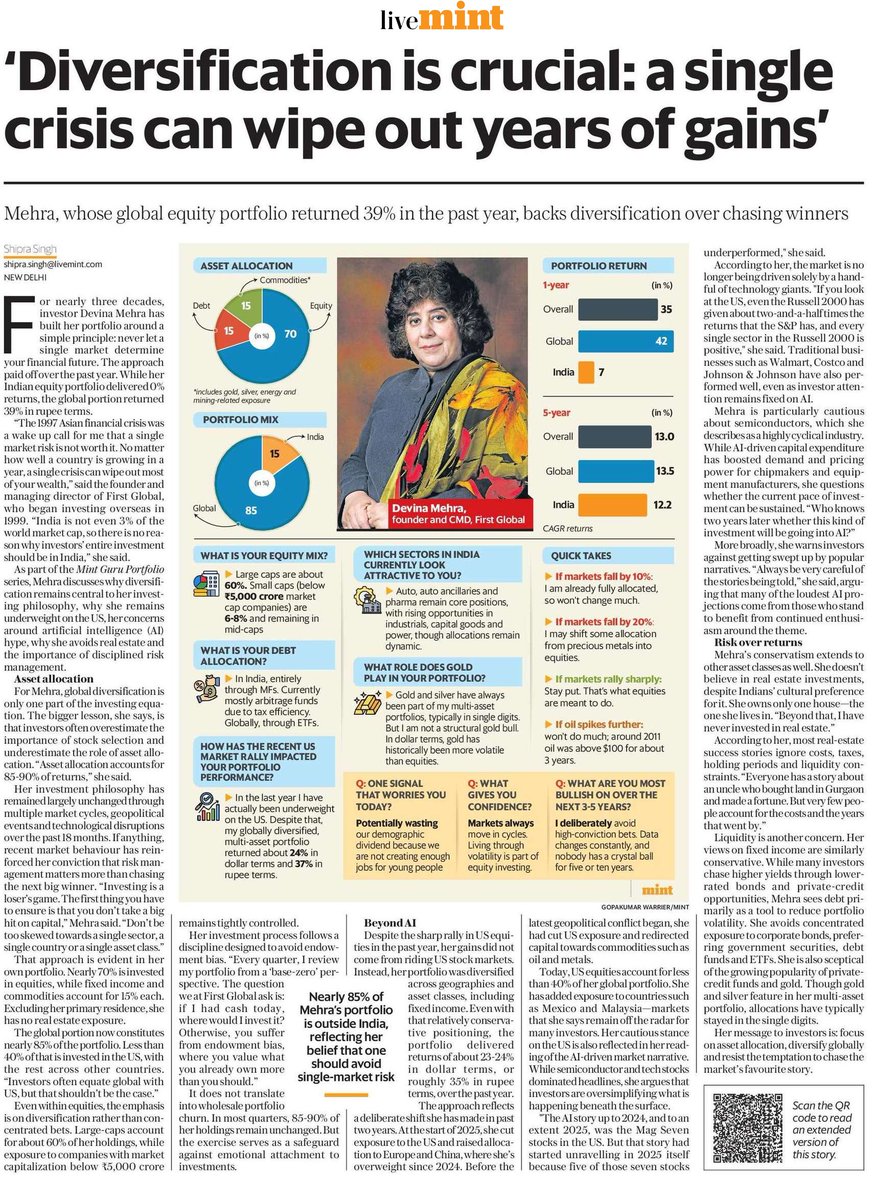
If one market crashes tomorrow, what happens to your entire portfolio?
Most investors never think about it until it's too late.
In conversation with @LiveMint, @DevinaMehra shares the investing principles she's followed for decades—and why avoiding big mistakes matters more than chasing the next big winner.
Read the full interview.
Link in the thread below!
The first four chapters of my book 'Money Myths and Mantras' include one on what asset allocation is and another on what asset allocation is not.
The Asset allocation you were sold as just a split between Indian asset classes was plain and simple wrong!
Thinking that the US markets represents the Global investing is similarly wrong!
Send a DM to @firstglobalsec which has been doing Global investing for over 27 years to understand what Global truly means.
Only when you ask the questions do you see the path!
The questions I asked myself in 1998/99:
What are the risks of being in a single country?
Kab tak wahi stocks karte rahenge? Need more excitement, more learning in my life
And that was the beginning of First Global becoming truly global
Financial bubbles, the greater fools and how you are betting on being more of a genius than Isaac Newton.
After my recent article on the AI bubble, some people have said that they are participating for now but will get out before the bust.
Here is my 2024 column on why that almost never happens in financial bubbles.
In this game of musical chairs almost all the chairs are whisked away in one shot when the music stops!
The only prominent investor or fund manager I have seen riding bubbles and getting out in time with some consistency is the current persona non grata, George Soros
Connecting the dots in my old column:
It is a different bubble being spoken of there but the principles remain the same...indeed the patterns are the same across almost all financial bubbles across the centuries
Promise, it will be an eye-opener.
"Fittingly the original quote is also in French: "plus ça change, plus c'est la même chose” or “the more things change, the more they stay the same.”
Or as one of my favourite quotes ever, from John Kenneth Galbraith's 'A Short History of Financial Euphoria' goes, "There can be few fields of human endeavour in which history counts for so little as in the world of finance"
One of the key points Galbraith emphasises in his characterization of a financial bubble is that it is not as if everybody participating in a bubble believes in it. Many who see the problems still jump in, thinking they can get out ahead of the crowd or the dumb money.
But when the bust comes, it arrives with a bang. Thus, all those who planned to exit, also cannot.
...
And what about Sir Isaac Newton, the genius who made at least three path-breaking contributions to science?
His paths crossed with the South Sea Company, immortalized in history and even Charles Dickens books as one of the big bubbles of 18th century. It was a stock that had a amazing price rise and then a crash that wiped out a number of fortunes.
In between were fancy promises that never had hopes of being fulfilled, insider trading, bribery, connections in high places et al but also the investors who were willing to bet on it. Among them was Newton.
As Andrew Odlyzko writes in ‘Isaac Newton and the perils of the financial South Sea’ in Physics Today
“ Newton was an early investor and profited nicely as the price of South Sea stock rose over the course of the 1710s. However, in 1720 the company’s stock experienced one of the most legendary rises and falls in financial history. Newton decided in the early stages of that mania that it was going to end badly and liquidated his stake at a large profit. But the bubble kept inflating, and Newton jumped back in almost at the peak…
Despite Newton’s general brilliance and his expertise in finance, groupthink led him to plunge into the South Sea Bubble and lose much of his fortune.”
And Newton was no financial rookie. At the time of this bust he was the Master of the Royal Mint - a post he held for decades.
The bottom line is that in this game of musical chairs when the music stops, not just one chair but almost all the chairs are whisked away and everybody is out of the game in one shot.
Play the game only if you're more of a genius than Isaac Newton."
Read. Think. Share.
@livemint@firstglobalsec@fghumsmallcase
Everyone seems to be talking about AI, semiconductors, and global markets.
Meanwhile, India has quietly slipped out of favour.
So, is this a warning sign... or an opportunity?
In this conversation, @DevinaMehra shares her views on India's market underperformance, global diversification, AI's impact on IT stocks, and where investors should be looking now.
Would you Buy India or Go Global?
If you're unsure how to balance India and global exposure in your portfolio, we're here to help.
📩 DM us or write to [email protected]@CNBC_Awaaz@_anujsinghal@virendraonNifty
Heard the 'analysis' that currencies never recover after a sharp fall?
Remember just because someone can thump the table does not mean that they know anything at all 😊
Data free, fact free opinions abound!
The latest one was someone telling me very authoritatively that once a currency, especially an emerging market currency, falls, unlike the stock market, it never recovers.
Apparently they had heard some 'expert' espousing this
Presenting the Thai baht- it fell to 56 to the US dollar in the 1990s crisis
Not only did it recover from there but it continued to strengthen since then
It is now around 32 to a Dollar - not materially lower than where it was under a fixed rate regime 30 years ago
There are many other examples too
The point is to look at data instead of following whatever nonsensical narrative that somebody is pushing for whatever reason
As an aside, there was a time a couple of decades ago when the Indian rupee and the Thai baht were around par
The Thai currency is now three times stronger
Bonus tip: Confidence does not equal competence.
Always remember, just because a person is saying something in a loud and authoritative voice, does not mean that they have any idea whatsoever what they are talking about
And much of the nonsense is not even about the future (like annual index projections which are refurbished every year 🙃), it is about easily verifiable historical data
Graphic: Macrotrends
India's market cap is falling.
SIP inflows are rising.
Foreign investors are pulling out.
So, what should investors make of all this?
In this insightful conversation, @DevinaMehra separates market narratives from market realities and discusses:
* Is the India Growth Story being misunderstood?
* Why market sentiment can be a misleading indicator
* The truth about SIPs and long-term investing
* Why equities are not guaranteed wealth creators
* What's holding back private investment and economic growth
* How investors should think about today's uncertain environment
Need help reviewing your portfolio?
DM us or write to us at [email protected]@ndtv@rahulkanwal
Most investors get in and out at exactly the wrong time.
That may be the most important investing lesson you'll hear this week.
While everyone debates FIIs, market rallies, and AI stocks, @DevinaMehra explains why investor behaviour—not market performance—is often the biggest reason portfolios underperform.
In this interview, she shares her views on:
✓ The reality behind FII selling
✓ Whether India's growth story remains intact
✓ Why SIP investors need to avoid emotional decisions
✓ The sectors she's currently overweight on
✓ Her bold take on the global AI boom
And perhaps the most controversial view: "AI may be a bubble. The question is when, not if."
Wondering if your investments are on the right track?
📩 DM us or email at [email protected]@CNBCTV18News@Reematendulkar@Nigel__DSouza
Market leader = safe investment? Not always.
In Money, Myths and Mantras, @devinamehra explains why dominant businesses look attractive — but can still disappoint investors.
Great business ≠ great investment.
Sometimes the hype, valuation, and expectations are already too high.
Even market leaders face disruption, competition, and slowing growth.
Chapter 14 breaks down when dominant businesses create wealth — and when they become overpriced stories.
Book link in the thread below.
✉️Want experts who look beyond market hype?
DM us or mail [email protected]
@devinamehra@nikunjdalmia Will soon watch it. Never miss your conversations even on subjects where I don't align with you because you always give a reason to think again