higgsfield is robbing you
you shouldn't be paying $50 for a talking head AI avatar video with Seed Dance 2.5
So I made a open source workflow for you
You just give it the scripts, select the avatars you want to speak it, hit go, and it renders the videos
If creative velocity is something that you're trying to solve, this is a perfect way to do it
And then once these videos are generated you can upload them directly to the Facebook ads account via the Facebook ads API
get started free here - https://t.co/YTZ4cq0xkd
give this skill file to your claude code - https://t.co/cb9gjKOAkB
I made a Claude skill that makes you go viral with every single reel
12 hours ago I tested it by posting this video ( 100% made with Claude )
and its already at:
125,000 views and 17,000 likes.
it also got me 600 followers.
and it literally took me less
than 1 hour to make it
but thats just 1 video
I've done this on every platform
for the last year.
IG and TT→ 200M views
Youtube → 100M views
X ( twitter ) → 100M views
virality is not luck its engineered,
so I packaged all my knowledge
into 1 claude skill.
if you give this skill to claude
he will understand
the anatomy of a viral video
and stop sounding like AI
So you can create bangers with it.
link to free skill in comments:
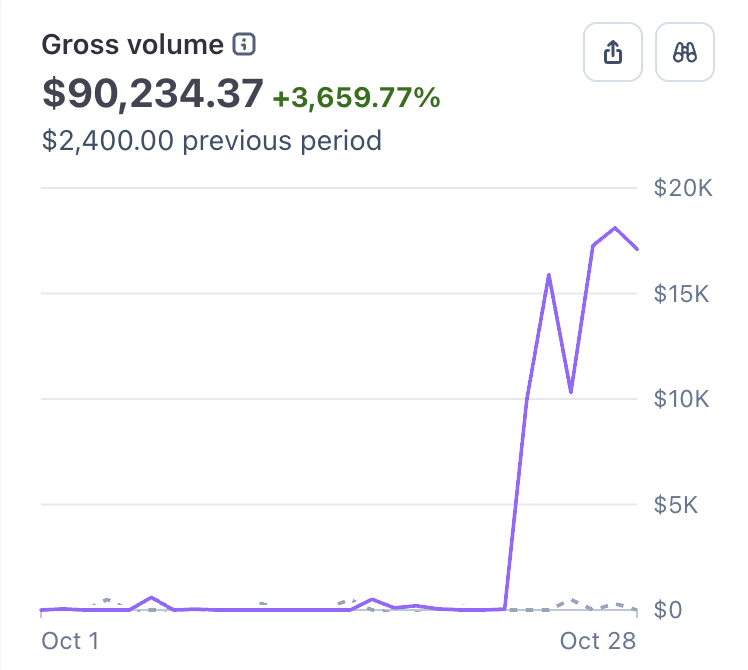
We just crossed $1M in annualized revenue run rate in just 6 days after launch.
And we're just a team of 2 people.
Our idea started out really simple: ai video platforms are doing billions, but they don't have a strong moat. why don't we just steal their users?
Seems like it worked.
--
I genuinely believe that the only moat in AI applications is acquiring users with velocity, then making them stay by getting deeply embedded in their daily workflows.
Our plan is simple. Keep stealing users from ai video platforms' $nB+ pie in every area with no moat, ship new features every week, and find the ones that get deeply rooted in marketers' everyday work.
Sure, you can ask how we're gonna make our users stay. But honestly, worst case we still hit $100M ARR, and if we're crushed by competitors, my cofounder and I will go back to a shitty couch, build again with no salary, and make millions again. Not worried about that either.
We just focus on growth & net revenue retention.
In an era of thin moats, we don't need fake storytelling like "Agentic creative OS". We should build something people want :
"A product that's cheaper than higgsfield, better than higgsfield"
Holy F\*CK... I opened an account that's only 8 days old and couldn't believe my eyes 🤯
5 videos.
7M+ views.
That's an average of 1.4M per video and almost 900K views every single day
No face. No voice. No budget. Just two stick figures, one gym, and a week counter
One of them hit 3M. Here it is:
Week 1. Both deadlift 60 kg.
Week 13. One still lifts 60. The other added 5 kg every week and lifts 120
Same gym. Same days. Same effort.
Only one added weight.
You watch to the end and suddenly realize that the "first guy" in the video is you
That's why people send these videos, save them, and come back to rewatch. It's not content, it's a mirror
And I'm almost sure all of this was made with Claude Opus 5.5. No animator, no After Effects, no team
Now here's the dangerous part:
imagine a fitness app at the end of a video like this, one that tracks your lifts. And millions of people see it 👀
One person. One AI. One video a day
Follow me. I found a few more accounts like this, and the numbers there are even crazier
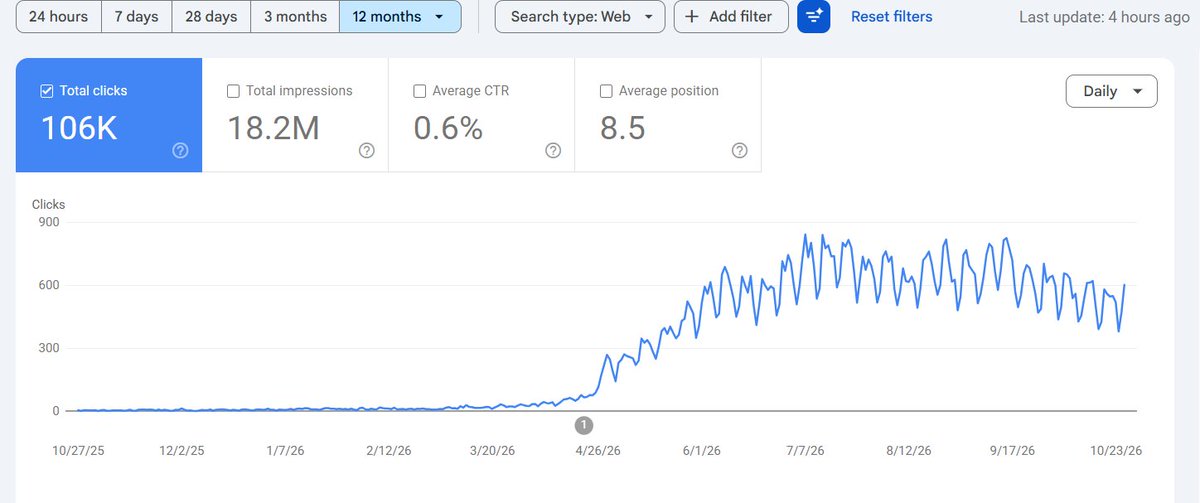
My international tax calculator passed 100k Google clicks in the last 12 months. The site is roughly a year old.
The biggest game changer early on: I connected Claude to Search Console with a free MCP and had it find searches I was getting impressions for but had no page on. Google was already showing my site for them, so I knew exactly what pages to create next.
The 20 SEO skills I used are free at https://t.co/hsBUgVfSC1. Hope it helps a few of you!
We don’t market my app like this anymore, but this is basically the exact playbook that got us started and helped us reach our first $100,000 month.
Here’s what we did:
Influencer marketing: We signed over 100 creators in our niche and had them consistently post about the app on TikTok and Instagram.
At the beginning, a lot of these deals were cheap. If a smaller creator averaged around 1k to 5k views per video, we might pay around $100 for 8 posts. We only needed at least three users to convert to make money from the deal.
The goal wasn’t to find one massive creator. It was to have an army of smaller creators constantly talking about the app.
Affiliate deals: We gave creators a percentage of subscription sales through their personal codes.
This made a huge difference because they weren’t just getting paid to post. They had an incentive to make the content perform and would often post more than we originally asked them to.
Outreach message: The first message you send a creator matters a lot.
The first line matters even more.
If your message starts with “Hi, I made this app...” there’s a good chance they won’t even open it.
We found it worked much better to lead with something like:
“Paid promo/affiliate deal?”
They immediately understand there is value for them.
Then you can explain what the app is, why you think it fits their audience, and what the deal looks like.
How to find 100+ creators: This part is boring, but it was probably one of the most important things we did.
Search whatever your app is about on TikTok and Instagram and find creators already making content that aligns with your product.
Then start messaging them.
You should be sending 100+ messages a day.
Eventually we hired people specifically for creator outreach. I had a team of 5 sending messages every day, and we were doing over 1,000 outreach messages a week across Instagram and TikTok.
Most people won’t respond.
That’s fine.
You only need a small percentage to turn into strong partnerships.
Apple Search Ads: We also used Apple Search Ads to capture people who were already searching for apps like ours.
A simple way to start is to search your category in the App Store and look at the terms and apps that consistently show up.
Those can give you ideas for keywords to test, along with relevant competitor names where permitted.
We started around $40 a day and watched performance closely.
Check the campaigns constantly.
If a keyword is spending money and not producing good users, cut it.
If something is working, increase the budget gradually.
Free communities: We also spent time in Reddit groups and other communities where our target users already were.
The important part is not showing up and spamming your app.
Use those communities to understand what people want, what problems keep coming up, and what language they actually use.
That helped both the product and the marketing.
Be willing to test: At the beginning, we were constantly trying different creators, offers, messages, and channels.
A lot of it didn’t work.
But once something did work, we doubled down on it.
This playbook eventually helped my app reach its first $100,000+ month.
We don’t rely on this exact strategy anymore. The company, the market, and our marketing have changed a lot since then.
But if I was launching another consumer app from zero, I’d still take a lot from this:
Get in front of as many people in your niche as possible, make the value obvious to creators, track what actually works, and scale the winners.
You do not need one viral creator.
You need a repeatable system.
I just reverse-engineered CCleaner / CleanMyMac with Opus 5.5 for Mac & Windows PC
this is insane...
one tap → 14.6 GB of junk gone. fully open-source and free.
→ https://t.co/xdi6E5WvBM
here’s the build step by step:
• step 1 → open Claude Code on Opus 5.5 in an empty folder, paste the prompt below + a few CleanMyMac screenshots
• step 2 → Opus didn’t start coding. it drew 9 UI concepts on a canvas first.
i picked one, it rebuilt the fonts, icons and glass buttons until it looked like Apple made it
• step 3 → i sent it a random video of smoky gradients.
Opus turned it into a live WebGL shader: “cosmic wind” rising behind the scan result
• step 4 → stack: one Electron + React codebase that runs on macOS and Windows
• step 5 → Opus split the build across 8 parallel agents.
one wrote the junk scanner, one the disk map, one the AI assistant, one the tips & feedback screens, one the installers
• step 6 → a separate safety agent attacked every line that deletes something.
it caught a Windows short-name trick (DOCUME~1) that could’ve sent my whole Documents folder to the Recycle Bin. and an icon loader that could leak my Windows password hash to a remote machine
• step 7 → the disk map is a physics toy: drag a folder bubble, throw it, watch it bump the others
• step 8 → built-in AI: plug in Claude or ChatGPT and ask “what can i safely delete?”
it only sees file names and sizes, never contents
• step 9 → GitHub Actions builds the .dmg and the .exe on every release.
the Mac build runs on Apple hardware in the cloud, not on my PC
• step 10 → first real test: the startup-apps toggle said “Windows did not allow the change”
Opus found PowerShell was losing the exit code after the admin prompt, made the app check the registry instead. next build: works
one afternoon. zero lines written by me. 14.6 GB freed on the first click. that’s it...
Find full prompt below ↓
Then, read how to rebuild any app from scratch with Opus 5.5 in the article below.
AI agents are basically AGI for viral content.
at least, that's what it feels like.
i have bots that work while i sleep, each one has a specific job:
1. outlier hunter: scans viral content overnight and sends me a morning report with post ideas tailored to my niche.
2. analytics bot: analyzes my daily views, including every engagement metric, and tells me what's working.
3. competitor watcher: tracks a list of my competitors' moves, emerging trends, and alpha.
4. fact checker: verifies claims before i publish.
still in the testing phase, but already far better than content spying tools that require manual checking and cost more.
AI agents will literally kill content spying tools in the near future.
You no longer need After Effects if you use Claude Opus 5.5 correctly
It’s f*cking unreal…
Send PDF below to Opus 5.5, and thank me later.
Then save the article on the Opus 5.5 best practices and usage for motion design.
If you're a designer, bookmark this.
1. https://t.co/RlChWqggj8 - 600+ design Prompts with full source code for 3D and scroll-driven sites
2. https://t.co/75zV2ioDNu - navbar inspiration
3. https://t.co/XPn2VgZBdJ - better footers
4. https://t.co/NDaj9DThhe - CTA inspiration
5. https://t.co/bhB2GfGIix - Real product design styles
6. https://t.co/TXT88wdEv5 - Hero sections worth stealing
7. https://t.co/BfrrSJOQVY - 3D icons for modern interfaces
8. https://t.co/cP8YFdb7cr - Glass UI components and effects
What did I miss?
Holy sh*t, someone just open-sourced the complete motion design stack for Claude Opus 5.5, and I am going to tell you about the best repositories that nobody is talking about
How does this work:
3b1b/manim - 65,400+ stars
The mathematical animation engine behind 3Blue1Brown. It enables Opus 5.5 to write programmatic, frame-perfect 2D scenes and dynamic diagrams directly in Python without visual template drift
https://t.co/rIg01m4Kjz
microsoft/playwright - 66,200+ stars
Headless browser automation framework that forms the capture backbone. Enables Opus 5.5 to orchestrate Chromium frame-by-frame at deterministic 60 FPS under a seek(t) harness
https://t.co/L9LJp33Rbd
juliangarnier/anime - 48,500+ stars
A lightweight JavaScript animation engine with complex sequencing and SVG path morphing. Opus 5.5 uses it to write mathematical easing curves and layered micro-interactions directly into canvas
https://t.co/F2re96YRuQ
pixijs/pixijs - 43,200+ stars
The fastest 2D WebGL rendering engine for the web. Provides hardware-accelerated canvas pipelines so Opus 5.5 can generate particle systems, complex shader transitions, and UI motion at native refresh rates
https://t.co/bK2VOynazV
m-bain/whisperX - 16,800+ stars
Word-level forced audio alignment powered by Whisper. Turns speech audio into millisecond-accurate timestamps so Opus 5.5 can sync kinetic subtitles and dynamic captions to every syllable
https://t.co/SdcXQYOPdo
remotion-dev/remotion - 22,400+ stars
The core programmatic video engine written in React. Enables Opus 5.5 to treat entire launch films and UI walkthroughs as composable React components rendered straight to MP4
https://t.co/895JHjBqFY
theater-js/theater.js - 12,100+ stars
A programmatic motion design and visual timeline orchestration suite for Three.js and HTML. Gives Opus 5.5 a multi-track timeline substrate to animate cameras and lighting in 3D space
https://t.co/GnGbClWhOu
greensock/GSAP - 18,900+ stars
Industry-standard high-performance animation engine. Handles complex timeline chaining and SVG morphs, giving Opus 5.5 sub-millisecond precision over DOM layouts and camera pans
https://t.co/HizIemBKwP
airbnb/lottie-web - 29,800+ stars
Mobile and web vector animation runtime. Renders pure code and After Effects vectors natively without relying on heavy compressed video files
https://t.co/XXgZSxmswC
video-db/videodb-python - 2,800+ stars
Programmable video infrastructure that enables Opus 5.5 to ingest raw footage, perform semantic frame searches, and automate B-roll insertion directly inside its agent workflow
https://t.co/PJKKInZzl2
You will definitely find what you need
I recommend adding this to your bookmarks ↓
you can literally automate entire youtube channel with this
prompt i used:
A 35 second map explainer: why the world's most advanced chips come from one island. Open tight on Taiwan and TSMC's fabs in Hsinchu: this one island makes about 90% of the world's most advanced chips. Pull out to show the supply chain flowing into it: chip designs from the United States (Apple, Nvidia), the EUV machines that only the Netherlands' ASML can build, and specialty chemicals from Japan. Then the finished chips ship out to the rest of the world. Then the risk: mainland China sits just across the Taiwan Strait, about 130 km at its narrowest, and a blockade would cut the world off from those chips. End on the whole picture: one island holding up the global economy, the "silicon shield". Use flags for the United States, the Netherlands, Japan, Taiwan and China, supply routes into Taiwan, shipping routes out, and a blockade ring around Taiwan. 16:9. ADD ONE BEAT, right after the risk across the Taiwan Strait: THE NAVY AT SEA. Tilted, close on the strait (span ~6-8): a column of warships sails through the Taiwan Strait and others patrol the sea around the island, steadily moving, nose first. Draw them with the style's warship swarm (kind 'warship'), never generated images. A hero label on the strait, and a short narration line built only from this fact: US Navy warships regularly sail through the Taiwan Strait.