this is pure f*cking treasure
A Stanford AI research group found how to orchestrate Claude Opus 5.5 and GPT-6.1 Sol together, and it completely breaks the search scaffolding wall
most developers try to combine frontier models by chaining prompts in one context window or hardcoding rigid evolutionary loops. you burn tokens on context bloat and freeze models into fixed search rules that out-date themselves within 5 iterations
Stanford's architecture eliminates human-designed search scaffolding and splits the cognitive stack:
> search director: Claude Opus 5.5 plans the search, querying a persistent idea-graph where MAP-Elites and MCTS reduce to single Cypher queries
> candidate proposer: GPT-6.1 Sol explores high-entropy code variations inside isolated execution sandboxes
> zero context bleeding: sessions reset after each iteration to prevent prompt bloat while the graph stores lineage
> evaluator isolation: candidate code never touches the scoring process, stopping reward hacking and test leakage cold
> meta-agent distillation: an offline meta-pass extracts verified lessons and updates search guidance across branches
the benchmark metrics outclass standard discovery baselines:
> 3.2x lower model spend than fixed evolutionary frameworks
> 1st place rank across 7 competitive AtCoder heuristic contests against human competitors
> beats published SOTA on Anthropic kernel builder and 11 mathematical optimization tasks
> 0% reward hacks: candidate-controlled metric tampering eliminated
Opus directs the search graph. Sol explores the code
you stop writing rigid search harnesses. you let frontier models own the discovery loop
Harness and AI models are highly inter-dependants, how to make the best of all available solutions ? @huggingface released "The ultimate guide to multi-harness RL" and released in open source everything you need to do it yourself.
1/ Excited to release The ultimate guide to multi-harness RL
The same model behaves differently in every agent harness. So we built an open way to train any model with RL on any task set, inside the harnesses people actually use, like Claude Code, Codex, and OpenCode, without changing a single line of harness or training code.
Trained across four harnesses, LFM2.5-2.6B went from 42% to 54% with 31% fewer tool calls. 🧵
Harness matters, on the new DeepSWE Benchmark (harder & less gameable), for Opus 4.7: Opencode > Cursor CLI > Claudecode.
Model providers should focus on models and let users use what ever harness they want, in stead of locking users in their solution for best models.
SoL-Pi: Recursively Scaling Auto-Research Loops for Efficient Agent Harness
reducing recorded token traffic by 44.7–49.0% and API cost by about one third.
Let's build our own harness as an more efficient alternative to Claude code and Codex ;-)
https://t.co/lEXPQ7QNjq
Anthropic's Claude Mythos is finding critical flaws that survived decades of human review.
Instead of a wide release, they’re launching #ProjectGlasswing to help defenders patch the world’s most critical software.
Full report here: https://t.co/6c6YpBXpAJ
🚨 BREAKING: NVIDIA proved backpropagation isn't the only way to build an AI.
They trained billion-parameter models without a single gradient.
Every AI you use today relies on backpropagation.
It requires complex calculus, exploding memory, and massive GPU clusters.
Meanwhile, an ancient, gradient-free method called Evolution Strategies (ES) was written off as impossible to scale.
Until now.
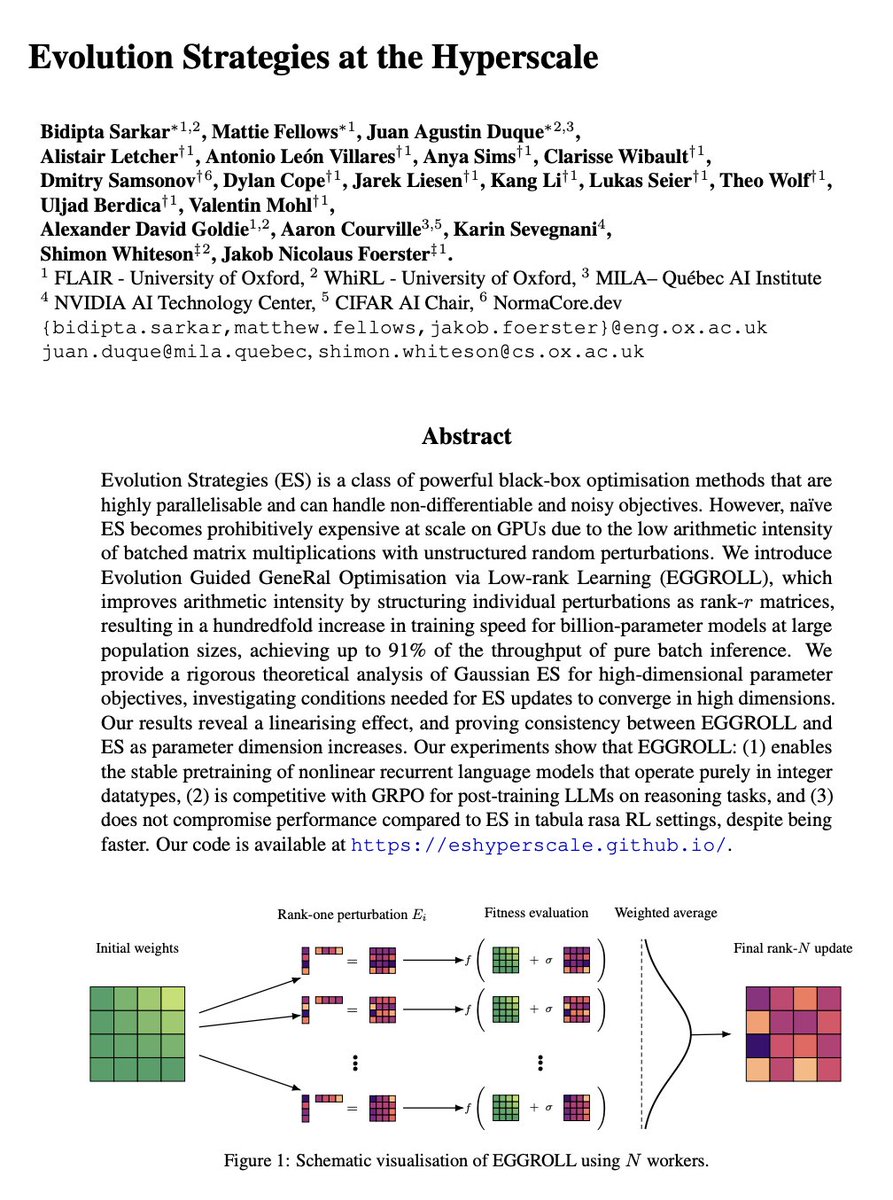
NVIDIA and Oxford just dropped EGGROLL.
Instead of generating massive, full-rank matrices for every mutation, they split them into two tiny ones.
The AI mutates. It tests. It keeps what works. Like biological evolution.
But now, it does it with hundreds of thousands of parallel mutations at once.
Throughput is now as fast as batched inference.
They are pretraining models entirely from scratch using only simple integers.
No backprop. No decimals. No gradients.
We thought the future of AI required endless clusters of precision hardware.
It turns out, we just needed to evolve.
- Drafted a blog post
- Used an LLM to meticulously improve the argument over 4 hours.
- Wow, feeling great, it’s so convincing!
- Fun idea let’s ask it to argue the opposite.
- LLM demolishes the entire argument and convinces me that the opposite is in fact true.
- lol
The LLMs may elicit an opinion when asked but are extremely competent in arguing almost any direction. This is actually super useful as a tool for forming your own opinions, just make sure to ask different directions and be careful with the sycophancy.