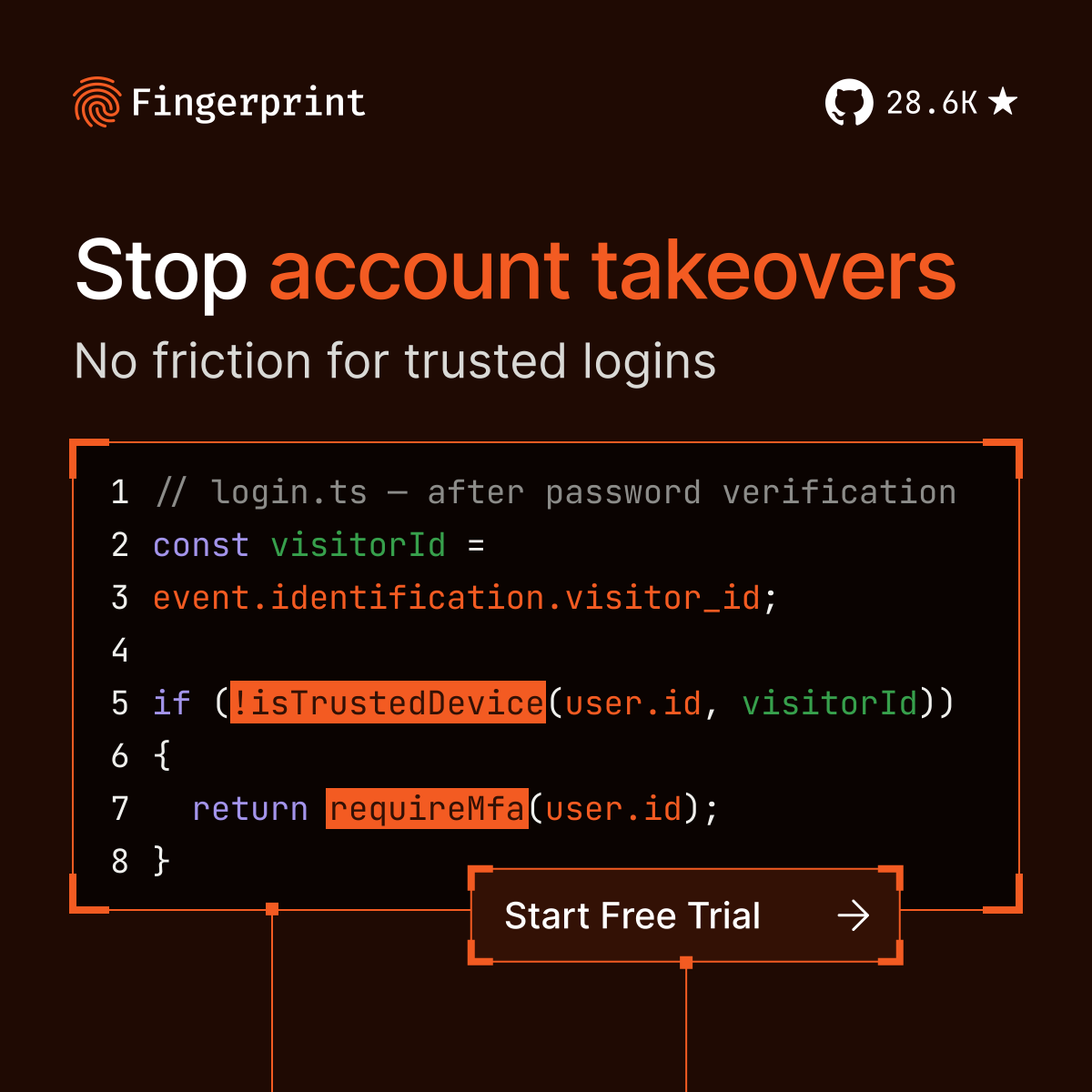
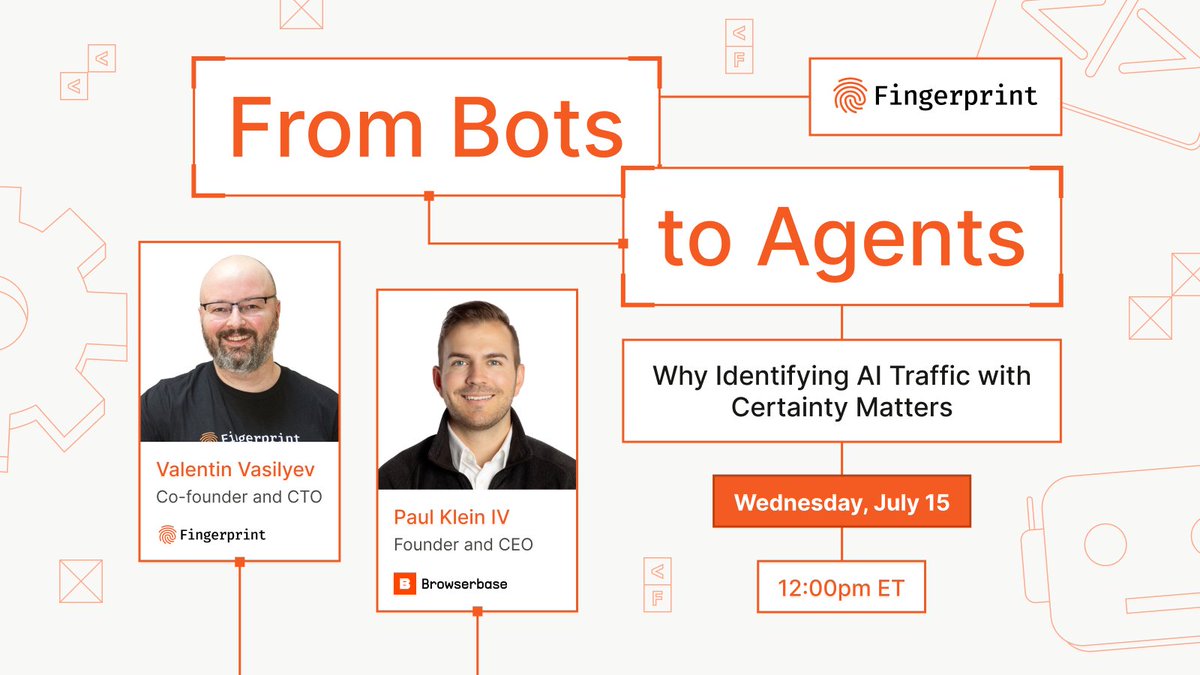
We're partnering with Fingerprint JS to build a safer web.
Fingerprint is a leading partner for fintech and retail companies that helps identify fraud early and correctly, keeping your data safe.
This partnership built on top of Web Bot Auth is our commitment to enabling verified agents while continuing to block bad actors.
"Together with Narmi, we’re enabling faster, more confident fraud detection while maintaining the seamless digital experiences customers expect.”
Read the full press release on Narmi's partnership with Fingerprint: https://t.co/qXA5jrG5P3
What happens when suspicious traffic looks completely normal?
Join us tomorrow as we reveal how credential-stuffing, scraping, and automation attacks blend into everyday sessions and which browser-layer signals expose them.
https://t.co/bJUNs5gKqz
📍 One location. Many devices. One powerful signal.
Introducing Proximity Detection, our newest mobile signal that adds a powerful layer of location-based intelligence to your fraud detection toolkit.
https://t.co/l86lZMMHHa
Gartner predicts that by 2031, online fraud, identity, and cybersecurity will converge, reshaping the way companies buy and deploy solutions.
Curious about what this means for your organization? Download the Emerging Tech report for the full story: https://t.co/8d6Yq18pEq
Not all AI agents are bad actors. Some power accessibility, automate tasks, and boost productivity. But dangerous ones are getting harder to spot. So, what should organizations do?
Fingerprint CEO, Dan Pinto, outlines smart strategies in the AI Journal: https://t.co/nFdh5y7Yj8
In the latest @Forbes Tech Council piece, our CEO Dan Pinto says it’s time to “move beyond CAPTCHAs and rely on real-time device and behavior signals.”
Catch Dan’s full take (and other expert insights) here: https://t.co/JDZqfrtizq
Today we launched a new product called ChatGPT Agent.
Agent represents a new level of capability for AI systems and can accomplish some remarkable, complex tasks for you using its own computer. It combines the spirit of Deep Research and Operator, but is more powerful than that may sound—it can think for a long time, use some tools, think some more, take some actions, think some more, etc. For example, we showed a demo in our launch of preparing for a friend’s wedding: buying an outfit, booking travel, choosing a gift, etc. We also showed an example of analyzing data and creating a presentation for work.
Although the utility is significant, so are the potential risks.
We have built a lot of safeguards and warnings into it, and broader mitigations than we’ve ever developed before from robust training to system safeguards to user controls, but we can’t anticipate everything. In the spirit of iterative deployment, we are going to warn users heavily and give users freedom to take actions carefully if they want to.
I would explain this to my own family as cutting edge and experimental; a chance to try the future, but not something I’d yet use for high-stakes uses or with a lot of personal information until we have a chance to study and improve it in the wild.
We don’t know exactly what the impacts are going to be, but bad actors may try to “trick” users’ AI agents into giving private information they shouldn’t and take actions they shouldn’t, in ways we can’t predict. We recommend giving agents the minimum access required to complete a task to reduce privacy and security risks.
For example, I can give Agent access to my calendar to find a time that works for a group dinner. But I don’t need to give it any access if I’m just asking it to buy me some clothes.
There is more risk in tasks like “Look at my emails that came in overnight and do whatever you need to do to address them, don’t ask any follow up questions”. This could lead to untrusted content from a malicious email tricking the model into leaking your data.
We think it’s important to begin learning from contact with reality, and that people adopt these tools carefully and slowly as we better quantify and mitigate the potential risks involved. As with other new levels of capability, society, the technology, and the risk mitigation strategy will need to co-evolve.
Fingerprint is teaming up with Unit21 to bring real‑time device intelligence straight into their fraud‑risk workflows.
Join our webinar to see Fingerprint + Unit21 tackle credential stuffing, tech‑support scams, and geolocation spoofing.
Register now: https://t.co/QxxB8LJLjA
💡 Elevating user journeys with device intelligence
Use the @descopeinc connector with @FingerprintJS to stop bots and bad actors while giving legitimate users a seamless login experience.
✅ Detect fraud, headless browsers, and anomalous login signals
✅ Create tailored MFA and step-up auth risk paths
✅ Integrate Fingerprint client-side with minimal backend effort
Did you know nearly 70% of all fraud in iGaming comes from bonus abuse?
Our latest article dives deep into how bonus abuse happens, its hidden impacts on customer lifetime value, and practical steps your company can take to fight back effectively. https://t.co/lP3KHlHYS2
Fake accounts = drained promos & skewed growth metrics.
Learn how to block them without slowing real users during our expert panel webinar with Native[Risk] and Experian.
https://t.co/wWe2S4mLj6
Google’s new Device Recall API is a solid step toward persistent device identification on Android, but it only scratches the surface.
Learn how deeper signals and broader visibility can help close those gaps.
https://t.co/BD39mGGjrf
Some fraudsters play the game. Others play the system. 🎰
Learn how matched betting and gnoming slip past traditional fraud tools, and how device intelligence exposes repeat offenders in our latest article. https://t.co/2VHRIRCXVo
Big News! 🎉 Fingerprint now powers real-time threat detection in Sumsub’s full-cycle verification with advanced device intelligence.
Read the full announcement: https://t.co/atOnzOinqA
In this revent interview, CEO & Co-Founder Dan Pinto unpacks how advanced tactics, like deepfakes, residential proxies, and agentic AI, are reshaping online fraud. https://t.co/js0x0Rp4hI
Secure your Android app in minutes, now with 500K free API calls/month.
Fingerprint’s Android SDK helps identify devices, block fraud, and build frictionless login and checkout flows. Fast to implement, simple to scale, and free to start.
https://t.co/gtcc25lfW3