As Assad's government fell today, one person I keep thinking about is Abu Layla and his vision of an inclusive, free Syria.
What would he think if he knew that one day, Syria would have a legitimate chance of realizing that vision?
@Charles99038922 @jane11243962@LigmaSkunt@davenewworld_2 Considering how pervasive drug war violence and lack of economic opportunity are in many Latin American countries, you know for a fact they weren’t suffering back home?
@johncitysq@trampinio@BadBoyCroy That’s the problem—people’s personal anecdotes and perceptions have somehow become more important than concrete data. The latter should be more valued than the former.
@dutch_obliged @J72046363 @driftwoodrat @bigsa1mon @SkipStrobelskip@allinsea Not to mention that reducing auto-dependency actually saves tons money in the long run by disincentivizing car ownership and reducing road maintenance.
@The_Ishue@RepJoshG@MTA I actually agree with you---imo most major policy decisions should be done via referendum w/ 50% turnout required for validity. Get the public more involved in decision-making.
@ThelmaBartlet14 Actually the exact opposite is true, RCV lets the public more accurately represent their interests at the ballot box by allowing them to rank candidates.
Much, much better than any traditional plurality voting system.
@bagheera79@LBelenky@marklevinshow Of course, I do hope that you considered the points I put forward. RCV has quite a bit of potential and I hope to see more instances of it soon.
I think we just disagree, no fault on our own but I applaud the civil discussion, enjoy your week👍🏻
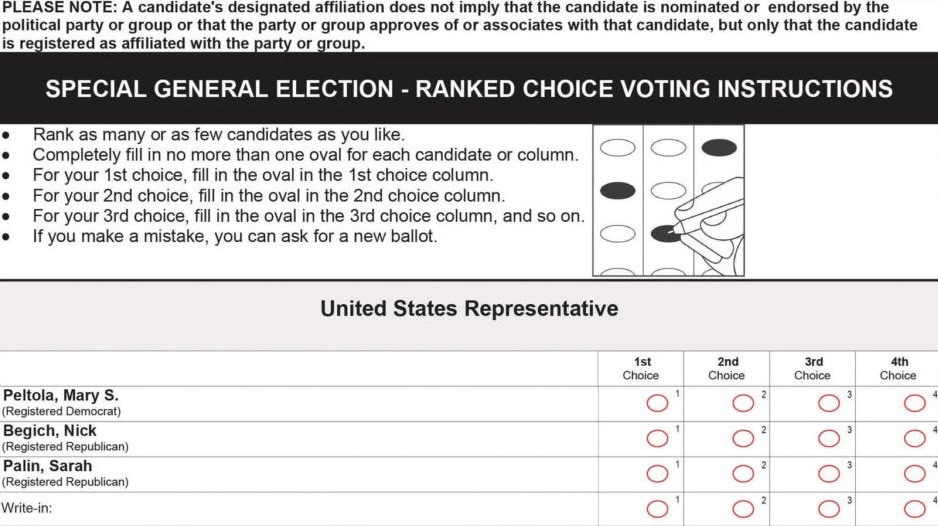
@bagheera79@LBelenky@marklevinshow … hence why Palin lost. She lacked enough broad support to win over Peltola in the end.
No need to overthink it, it really is as simple as that. If anything, RCV was Palin’s only way of winning after the GOP vote was split in the first round.
@bagheera79@LBelenky@marklevinshow In the scenario I listed (in a run-off system) I’d probably resort to strategically voting for the candidate I like a little less—which is fear of the spoiler effect.
Now, from my understanding Begich is a moderate Republican and a chunk of his supporters were sick of Palin…
@bagheera79@LBelenky@marklevinshow People never bring this up but I think another pro is that if voters are expected to rank multiple candidates, there will be greater urgency to be politically active/understanding.
The one main con like you pointed out is that RCV isn’t designed for a ton of candidates.
@bagheera79@LBelenky@marklevinshow But to answer your question about RCV pros (simplified):
-Removal of spoiler effect (potential for third parties to actually grow).
-Negative campaigning deterred (critical in a now-toxic political environment).
-Public’s interests more accurately respectfully, typically.
@bagheera79@LBelenky@marklevinshow I’m not sure if that’s a criticism of RCV itself or rather just a concern regarding a potential transition to it.
But I’ll point to how Alaska’s ballot for example simply tells people to rank their “choices,” seemingly good language there.
@bagheera79@LBelenky@marklevinshow My knowledge on Israel is pretty basic but idk if I would use them specifically as any kind of example—Netanyahu was so fiercely disliked that getting him out was the only objective of many, not forming a sustainable government.
Four elections so far with another in November.
@bagheera79@LBelenky@marklevinshow Granted this is probably not too common a scenario, but it does illustrate why I personally like RCV so much over other systems—candidates can be supported to varying degrees.
If I really love one candidate and only kind of like another, I can more properly express that.
@bagheera79@LBelenky@marklevinshow I like run-off systems, but there is still a chance for the spoiler effect.
Scenario: I vote for the eventual-4th place candidate instead of another candidate whom I like less, but just barely places 3rd instead of 2nd. Then the runoff is between two people I may not like.