This paper is f*cking brilliant
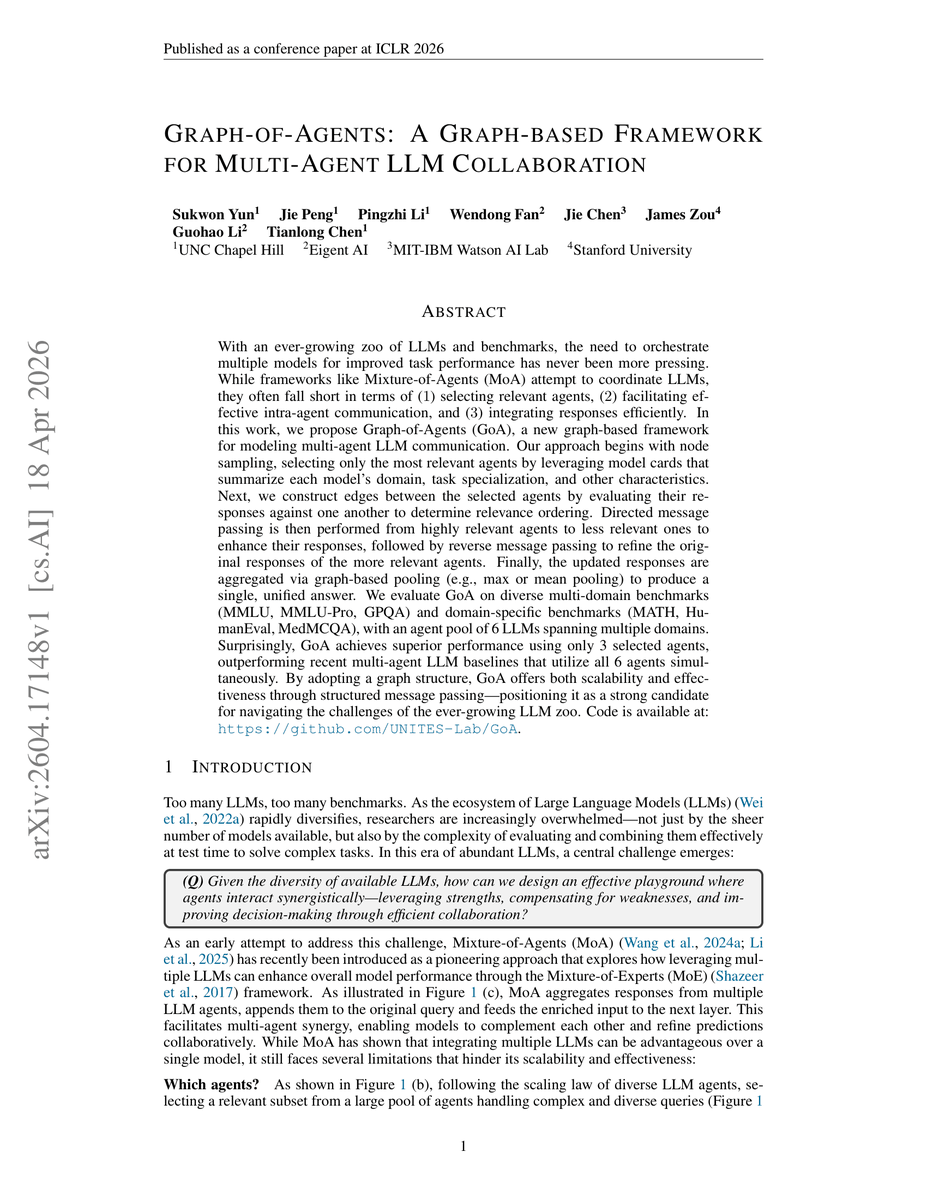
A computer science paper replaces Mixture-of-Agents with Graph-of-Agents for multi-LLM collaboration
The result: structured node sampling, directed message passing, and graph pooling deliver state-of-the-art benchmark scores using only 3 active agents instead of 6
The crazy part is how graph engineering cuts multi-agent inference cost while improving decision accuracy
Relevant model nodes are sampled via domain cards, directed edges pass responses from expert to generalist models, and graph pooling aggregates final consensus
Most multi-agent architectures blindly feed every query to every model in the pool
This framework converts multi-agent collaboration into an optimized communication graph
Read the complete paper + article below
Bookmark it for future reference
Head of Claude Code:
"85% of our engineers are running dozens or hundreds of agents. The way you do it is graph engineering."
In 40 minutes he explains how a single engineer now does the work of a whole team, how far this has gone inside Anthropic and where it goes next.
This is something you can't skip if you don't want to be left behind.
Watch it, then read the full guide on graph engineering below.
Claude Code ships with 5 architectural layers most engineers never open.
Not features. Not settings. Layers — each solving a distinct problem that LLMs alone can't solve. And four of them have nothing to do with prompting.
Here's the full Agent Development Kit:
Layer 1 — CLAUDE.md → The Memory Layer
Architecture rules, naming conventions, test expectations, repo map. Always loaded. Always active.
Two scopes:
• ~/.claude/CLAUDE.md → global
• .claude/CLAUDE.md → project
This isn't context you paste in before every session. It's context that never needs repeating. The agent's constitution.
Layer 2 — Skills → The Knowledge Layer
Each SKILL.md carries a description. Claude matches it at runtime and forks the skill into an isolated subagent. On-demand, never always-on.
Task-specific knowledge without inflating your main context window. Modular by design.
Layer 3 — Hooks → The Guardrail Layer
PreToolUse → PostToolUse → SessionStart → Stop → SubagentStop
This is the layer most teams skip. And the one they regret skipping first.
Hooks are NOT AI. They're deterministic event-driven shell commands.
• Auto-lint on every Write
• Hard-block on rm -rf
• Slack notification on Stop
Event fires → Matcher checks → Command runs
Quality enforced at the infrastructure level. Not the prompt level.
Layer 4 — Subagents → The Delegation Layer
Each subagent gets its own context window, model, tools, and permissions.
Main agent delegates down. Receives results up. That's it.
No infinite recursion — subagents can't spawn subagents. Main context stays clean. Hard boundaries by design.
Layer 5 — Plugins → The Distribution Layer
Bundle your skills + agents + hooks + commands into a plugin. One install. Whole team inherits the behavior.
Think npm packages — but for what your agent knows how to do.
Wrapping everything:
→ MCP Servers on the left (GitHub, databases, APIs, custom integrations)
→ Agent Teams on the right (parallel execution, message passing, shared permissions)
The 5-layer stack in one line:
CLAUDE.md sets rules → Skills provide expertise → Hooks enforce quality → Subagents delegate work → Plugins distribute to the team
Most production failures in agentic systems trace back to one missing layer.
Which one is the gap in your current setup?
Karpathy described the highest-paid skill in AI engineering and it is not what you are being told to study
It's a short post called Verifiability, written a while back. One idea, and it holds up better than any roadmap.
His claim: the best predictor of what AI masters is whether the task is verifiable. If a model can practice something, it gets extremely good at it.
Three properties make a task verifiable. Resettable, you can start a fresh attempt. Efficient, you can run many attempts fast. Rewardable, a machine scores an attempt without a human.
Now read that as a job description instead of a forecast. Anything with all three, the model eats. Anything missing one, that gap is your work.
Turning a fuzzy task into a resettable, scorable environment is what the industry calls evals. That is the whole job in one sentence.
Bookmark this
this is my AI marketing engine
say I have an idea I want to turn into a campaign. a guide, a cohort, a webinar, something we have been planning for a while, or just something cool I came across and want to build around.
it usually starts as one thing, an idea or an evergreen piece, and this engine is how that one thing becomes a full campaign and fans out across every vertical
the engine is a graph, a general step-by-step the idea moves through. at each step I can swap the harness, the loop, the tool, or the model to fit the campaign
right now I'm testing gstack, superpowers, and matt's skills, engineer tools I'm bending toward marketing
the models can write and design well now. what takes work is the context you feed them, the routing per job, and the evals that catch what is weak
there are eval stops all through the graph. both human and other agents evaluating and reviewing output, and then looping it back if it doesnt
here is the path it travels, from a raw idea down to a shipped campaign
PLANNING
1. the idea in
I dictate the whole thing out loud, every half-formed thought, and let the skill bundle catch the mess and hand me back a starting brief. this is the karpathy point, get it out of your head first and clean it up after
2. ideation
off that brief it opens the idea into angles and directions to choose from. I throw most of them out
3. research and context
this is where I pull context, and how much I need depends on the campaign, sometimes a ton of internal history, sometimes barely any. the internal side is our company brain (gBrain), the voice, the past campaigns, what converted, the offers, the ICP. externally I pull the market, the competitors, the hooks working this week
4. synthesis
different models merge all of that into a draft plan. the plan itself, the architecture and the trade-offs, runs on opus 5, and the narrow work underneath gets cheap fast models. that split is model routing
5. the sign-off
nothing crosses into execution until I sign it off. I read the draft against our marketing protocols, the voice rules, the brand, the SOPs, and I cut, sharpen, or send it back
EXECUTION
6. handing it to the build
once the plan clears the sign-off it goes into the build, and the idea splits into all the parts a campaign needs. here I run two shapes depending on the job. when a piece is one task that has to clear a bar I run a loop, the agent drafts, checks itself, fixes, and keeps circling until it is good.
the bigger many-part pieces I build as a graph, drawing the steps and routes ahead of time so the agents travel the map I laid down. it is usually a bit of both
7. the models doing it
routing runs in execution too, you do not pay opus prices to resize a thumbnail for example
8. what stays with people
some of it I coordinate, some assets I make myself, and the work that needs taste, a relationship, or a client in the room I hand to the agency team
that one idea comes out the other end as a full campaign across every vertical, landing pages, blogs and guides, video scripts, email, PR, paid, and the social cuts
then the results come back in, what got bookmarked, what converted, what died, and that updates the brain for the next campaign
everyone has the same models, so the edge is the graph, the brain, and the protocols, and those you have to build yourself
An Anthropic engineer shared the exact system they use as a second brain.
Three folders. One file. One evening to build.
Most people use Claude the same way every day. Open a new tab. Rebuild context. Get an answer. Close the tab. Tomorrow it remembers nothing. You are still the one holding all the context. You are still the one resetting.
This architecture solves that problem.
The system is built around three folders and one file.
raw/ holds everything unstructured. Articles, transcripts, PDFs, voice memos, screenshots. Drop it in and never touch it again. Immutable ground truth.
wiki/ is where Claude converts everything in raw into structured, linked, cross-referenced knowledge. Clean. Organized. This is the folder Claude actually thinks from. The human reads it. The model writes it.
output/ is where finished work lands. Reports, posts, documents, presentations. Everything Claude builds using the wiki as its source.
At the center is CLAUDE.md. Not a prompt, but a persistent layer of identity, preferences, goals, and project context. Claude reads it before every session. You never explain yourself again.
Five automations run the system.
Ingest captures and extracts new sources into the wiki. Write retrieves context and drafts outputs. Manage links decisions to context. Review summarizes and updates. Maintain prunes and improves connections.
Every session adds to the system. Every source makes the wiki smarter. The returns compound over time.
One month in, context stops disappearing. Three months in, the vault surfaces ideas you forgot you had. Six months in, the gap between compounding and resetting becomes impossible to ignore.
Build once. Maintain daily. Let it compound.
Bookmark this.
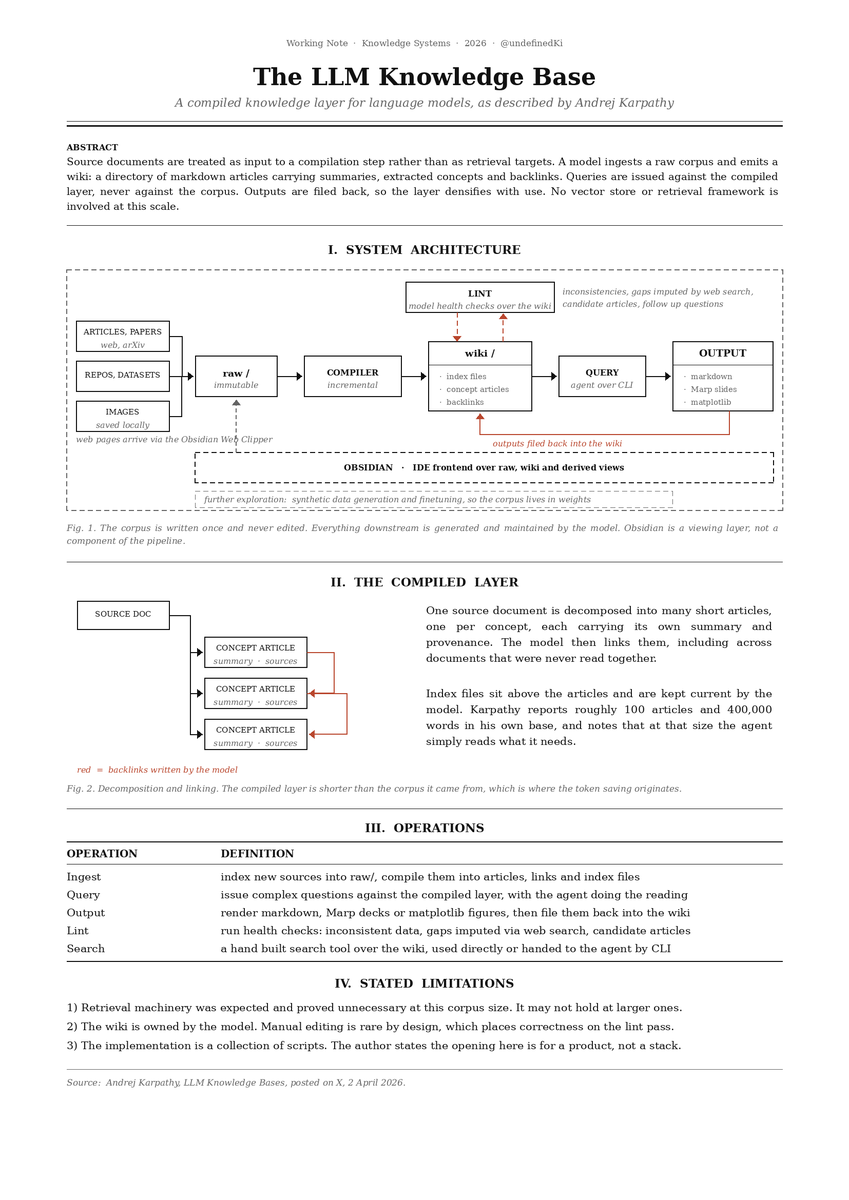
Everyone tells you to build a second brain. It is pointless until you understand how one actually works
The whole thing turns on one idea. Your documents are source code. The wiki is the compiled binary. You compile once and run the binary forever.
That is why the raw folder is never edited, why one paper comes out as a dozen short linked pages, and why every question after that reads the pages instead of the papers. Same reason nobody recompiles a program each time they open it.
Once you see it that way the rest follows on its own. The cleanup pass, the linking, the answers getting filed back in, none of it is a trick. It is what compilation always did.
Karpathy's version, drawn exactly as he described it, on one page above.
Bookmark this
A guy just turned standard home Wi-Fi into a radar that sees through walls.
Over 62,000 stars on GitHub for a system that tracks humans without using a single camera lens.
It doesn’t just know you’re there.
Watch what happens when a person lies down on a bed in another room.
The AI instantly maps their exact posture, tracks their breathing, and calculates their heartbeat in real-time.
No optical surveillance, no privacy leaks - it just analyzes how your body disrupts ordinary radio waves.
The whole thing runs on a tiny $5 microchip.
Traditional security requires a direct line of sight and invades your personal space.
Now, your Wi-Fi router is a camera that sees through solid brick.
High Income ETFs:
$JEPI 8.00% dividend yield
$JEPQ 11.36% dividend yield
$SPYI 12.52% dividend yield
$QYLD 13.72% dividend yield
$QQQI 14.56% dividend yield
Are any of these worth owning in your opinion?
So you're telling me if I own 5,000 shares of $JEPQ at around $0.64 monthly dividend
I will get $3,200 every month for literally doing nothing
You could retire off of that income.
Why aren’t more people doing this?
In 2008, Malcolm Gladwell explained why some people succeed and some don't in a single 1-hour talk.
This will permanently change the way you think about talent, effort, and success.
Bookmark & watch today, no matter what.
🚨 BREAKING: Claude has a feature called ADHD Executive Function Mode.
You can use it to hack your brain’s dopamine and finish a week’s worth of work in 4 hours.
Here are 7 prompts to access it: 👇
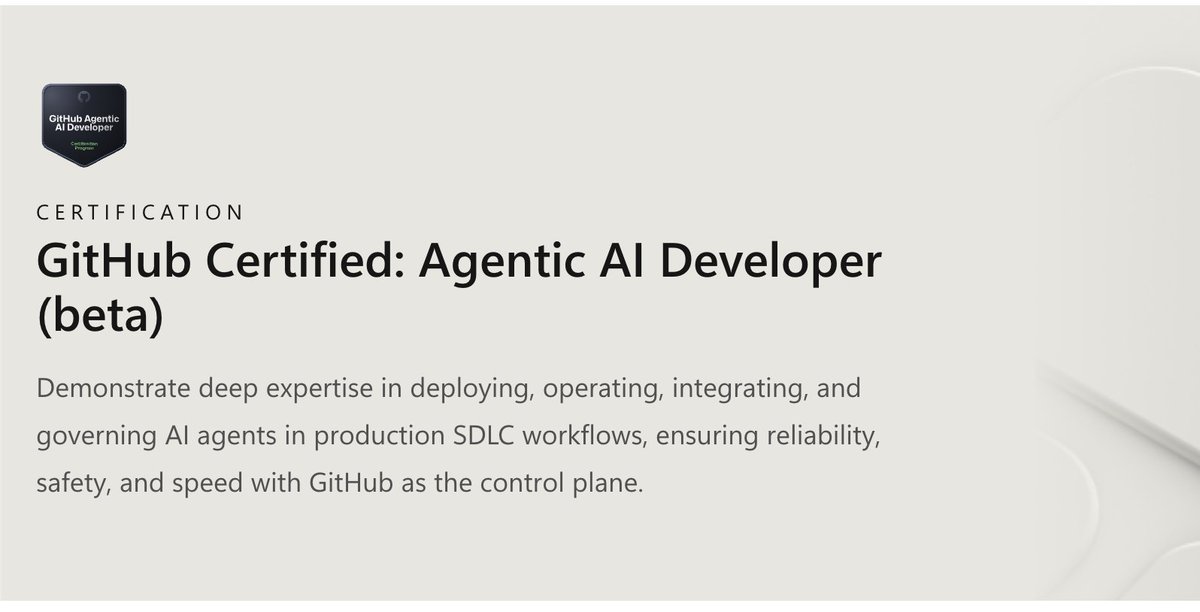
GITHUB JUST CREATED AN OFFICIAL CERTIFICATION FOR THE MOST IN-DEMAND DEVELOPER ROLE OF 2026.
It is called Agentic AI Developer.
GH-600.
And it is the first formal signal that running AI agent teams is now a recognized engineering discipline with a credential behind it.
Not a prompt engineer.
Not a vibe coder.
An Agentic AI Developer.
The person who operates, supervises, and integrates AI agents across the entire software development lifecycle.
The person who knows where agents fail in production.
The person who understands how to build autonomous workflows that do not introduce catastrophic failure modes into CI/CD pipelines.
The person every engineering team is going to need and almost none of them have right now.
GitHub certifying this role changes the hiring conversation permanently.
Before GH-600: "Do you work with AI agents?" is an interview question with no standard answer.
After GH-600: the credential tells the hiring manager exactly what you know and what you can do before the interview starts.
The engineers who get certified in the first wave of GH-600 will have a credential for a role that has more demand than supply for the next 3 to 5 years.
The engineers who wait until it is mainstream will be competing with everyone who moved first.
If you are already working with GitHub Copilot or building agent-driven workflows you are already doing this job.
GH-600 is how you prove it.
Bookmark this.
Follow @cyrilXBT for every AI certification worth your time the moment it drops.
Got connected to a 33-year-old Saudi guy through our WhatsApp community who sells collagen supplements across the Gulf region.
$1.8M/month across Saudi Arabia, UAE, Kuwait, and Bahrain.
One product. One funnel. Arabic-language ads.
He told me something that completely reframed how I think about the Middle East:
"Americans think of the Gulf as one small market. It's not. Saudi alone is 36 million people with the highest beauty spending per capita in the region. The combined Gulf states are 60 million people with more disposable income than most European countries."
His CAC across the Gulf: $18 on a $95 AOV product.
Saudi Arabia's ecom market hit $31 billion in 2026 and is growing at 12% annually. 99% internet penetration. 78% 5G coverage. The government's Vision 2030 initiative is literally building the infrastructure to make ecom easier — better logistics, faster payments, customs reform.
He runs the ads himself. Has a customer service team in Riyadh and a 3PL in Jeddah. Total team: 5 people.
His advice: "If you can get Arabic translation right — and I mean RIGHT, not Google Translate — the Gulf market will print for you. The spending power here is unreal and the competition from Western DTC brands is almost zero."
If you have Arab friends or family — put them on this. The Gulf ecom market is growing at double digits and almost nobody from the Western DTC world is there yet.
Jamie Dimon, CEO of $JPM, has fired people for running good meetings.
Not bad meetings. Good ones.
His definition of a bad meeting: it ends with "great session, let's pick this up next week."
No owner. No deadline. No accountability.
The people who run those meetings, he calls them "good bureaucrats." They love the process. They angle for the next job. They pound their chest. They grade themselves on activity, not outcomes.
"If you don't get rid of them, no one believes you."
He's applied this at $JPM, the most profitable bank in history, for 20 years.
Bureaucracy doesn't require size. He said it can hit a single branch.
"It's always the manager, stupid."
The full clip is worth 3 minutes of any leader's time.
A man spends 50 years teaching at MIT.
He knows his time is running out.
So he records one last lecture — everything he knows, distilled into a single hour.
He died 5 months later.
This is that lecture.
The most important hour you'll watch this week. 👇
Bookmark it for later