@lowmegatron Im reading the book and its really good, but does anyone know how reliable the info is? I can hardly find anything on Steven w. Scott and his background.. or what his sources are. Does anyone know?
Den Haag heeft ons beleggers helaas blij gemaakt met een dode mus😠
1. Vermogensaanwasbelasting blijft bestaan
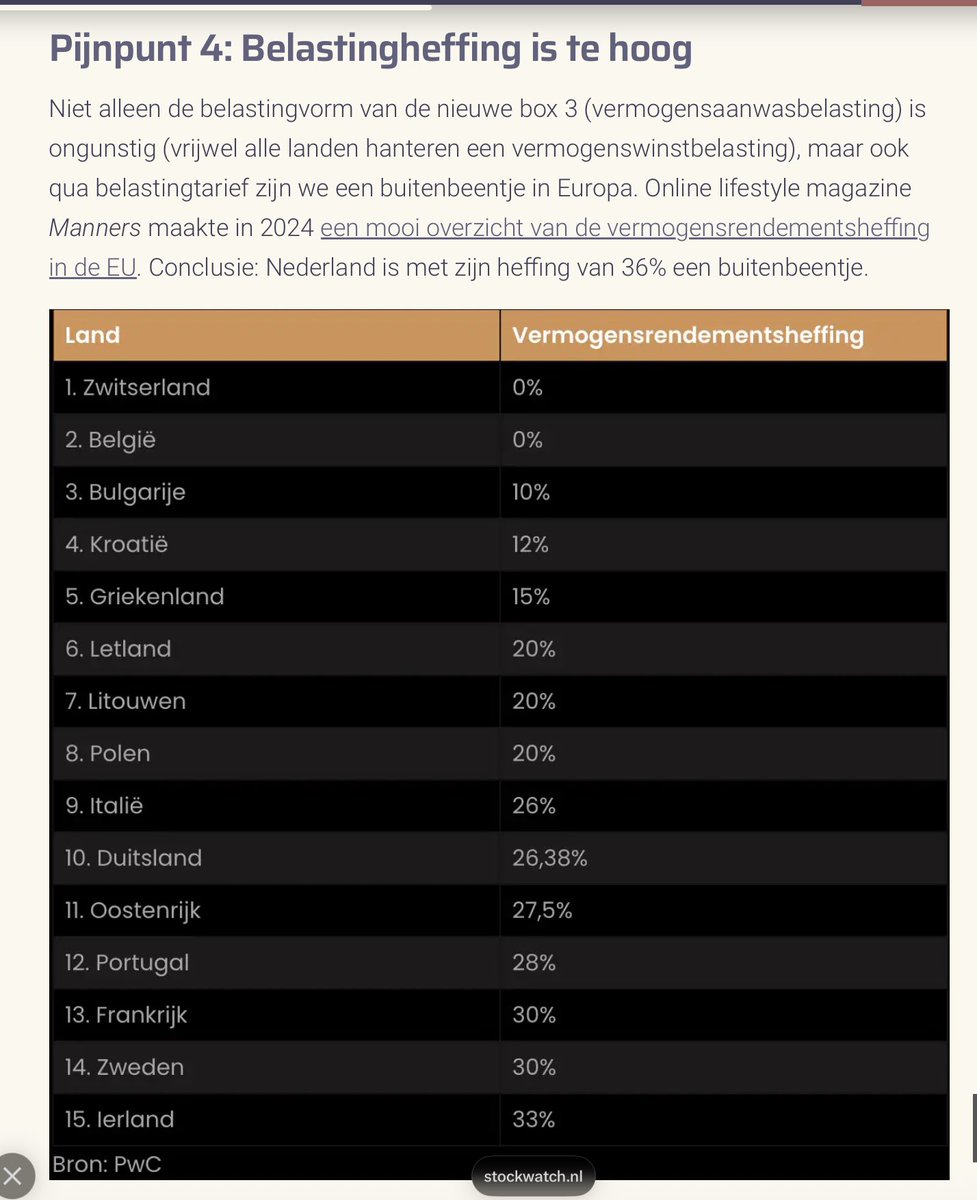
2. 36% tarief (hoogste ter wereld) blijft bestaan
3. Geen inflatiecorrectie
4. Geen woord over verhogen belastingvrijstelling
De belangrijkste problemen blijven dus bestaan
1. Lage inkomens moeten in goede beursjaren gedwongen aandelen verkopen om aan hun belastingplicht te voldoen
2. Er zullen situaties ontstaan waarin je belasting moet betalen terwijl het reële vermogen is gedaald. Bijvoorbeeld omdat het behaalde rendement lager is dan de inflatie.
Deze nieuwe box 3 sluit niet bepaald aan op de wens van de Europese Commissie om het investeringsklimaat in Europa te verbeteren.
Enige lichtpuntje is dat de verliesverrekening wordt verbeterd. Probleem is alleen dat deze slecht blijft. Achterwaartse verliesverrekening moet niet over één jaar plaatsvinden, maar over minimaal 10 jaar.
https://t.co/vlQ8e8sHpf
#box3: hoe de Nederlandse roverheid flirt met het #communisme
Wie nog denkt dat Nederland het #belasting stelsel slechts wat ‘bijstuurt’, kijkt niet goed.
Wat zich nu aftekent is geen kleine belastingtechnische aanpassing, maar een fundamentele ideologische verschuiving: van een samenleving gebaseerd op privé-eigendom naar een systeem waarin de staat zich steeds nadrukkelijker als mede-eigenaar opstelt.
Het artikel van Prof. dr. Jan Latten is in dat opzicht onthullend. Niet omdat hij een donker scenario schetst, maar omdat hij hardop uitspreekt wat beleidsmakers allang denken: huiseigenaren zijn een onbenutte geldbron. En geldbronnen moet je aanboren. Niet vrijwillig, maar dwingend.
De overheid kijkt niet langer naar wat je verdient, maar naar wat je hebt. En zelfs dat is niet genoeg: ze kijkt ook naar wat je zou kunnen hebben. Waardestijgingen die alleen op papier bestaan, worden alvast opgeëist. Erfenissen die nog niet zijn ontvangen, worden vooruit belast.
Bezit dat je niet liquide kunt maken, wordt tóch aangeslagen. Dat is geen belasting meer, dat is niets anders dan confiscatie in termijnen.
De staat wil belasting heffen op ongerealiseerde winsten. Dat is een revolutionair concept, en niet in positieve zin. Het betekent dat eigendom niet langer wordt gezien als iets van jou, maar als iets waar de overheid een structureel claimrecht op heeft. En dan tekent zich een ontluisterend perspectief af: vandaag een percentage, morgen een beleidsdoel, overmorgen een noodmaatregel en op termijn bent u uw eigendom kwijt, geconfisceerd door de Nederlandse staat, in termijnen.
Ik ga er niet omheen draaien, dit is namelijk exact hoe communisme werkt.
Volgens het communistische gedachtegoed is privébezit verdacht, want ongelijkheid.
En dus moet bezit ‘maatschappelijk worden ingezet’, en da’s niets anders dan een eufemisme voor: de staat bepaalt wat u mag houden.
Men noemt het solidariteit. Men noemt het rechtvaardigheid. Maar laten we eerlijk zijn: solidariteit zonder keuze heet dwang.
En rechtvaardigheid die alleen geldt voor wie bezit heeft, is niets anders dan straf op verantwoordelijkheid en vooruitdenken.
Wie een #huis kocht, spaarde, risico nam en afzag van consumptie, wordt nu weggezet als probleem.
Niet omdat hij iets verkeerd deed, maar omdat hij iets hééft.
Dat is geen liberale rechtsstaat meer. Dat is precies het wereldbeeld waarin communisme wortel schiet. Daardoor horen ook bij u alarmbellen af te gaan: als de staat mag bepalen hoeveel van uw bezit ‘van u’ is, dan is eigendom een fictie geworden. En een samenleving zonder echt eigendom is geen vrije samenleving.
Daarom wil ik u het volgende meegeven: communisme komt niet met vlaggen en leuzen.
Het komt met beleidsnota’s, verkiezingsprogramma’s en keer op keer een kleine belastingtechnische aanpassing.
Totdat het huis waarin u woont, waar u uw hele leven hard voor gewerkt heeft, nooit echt van u is geweest.
Daarom moeten alle voorgestelde aanpassingen aan Box 3 van de baan en moet de roverheid snijden in eigen vlees, bezuinigen is het devies, niet de burger nog verder uitknijpen totdat slechts onvervalst communisme rest.
Taxing unrealized gains is economic suicide. You are taxing what does not exist in cash. That forces constant selling, drains capital from productive use, and accelerates capital flight.
Reflections on this bill from a Dutch citizen who has closely followed this process for years.
First: the old system. It was pretty simple: the government assumed that you make ~5% return on your assets per year. That return is then taxed (~35%). Assets include savings, stocks, crypto, etc. There is an exemption of ~€55.000 per person. Assets are measured on the 1st of January every year.
Imagine you hold one bitcoin worth €75,000. Subtracting the exemption leaves €20,000 taxable. The government presumes a €1,000 return (5%), resulting in €360 tax (35%).
In summary, this system is:
- Very simple to understand
- Low administrative burden
- Advantageous to investors where ROI >5%
- Disadvantageous to investors where ROI <5%
Savers fall into that latter group. Years of sub-5% interest rates led the government to overestimate savers' returns.
In 2021, the Supreme Court ruled that this was unlawful and that this needed to change. The government should calculate taxes based on the actual return on investment instead of the assumed return.
At this point, I want to make a few things clear:
- I don't mind paying taxes
- I think the Supreme Court's decision was correct
What I do mind is:
- Tax on paper gains
- Added administrative complexity for tax filings
- The Government is not listening to the advice of the Netherlands’ highest advisory body on legislation
- That the Tax Authority is pressuring the legislative process to make a quick decision
- Making obviously bad legislative decisions
And these are exactly the things that are happening.
For some reason, the Government decided against a capital gains-like system and chose an unrealized capital gains system.
This means that you pay tax on the paper profit you made during the year.
Let's say you have one Bitcoin on January 1st, valued at €70.000. On December 31st, Bitcoin is at €115.000. A return of €45.000. Taxes to pay: €15.750 (35%). No exemption in the new bill.
The problem: all your money is in Bitcoin.
But that is not a problem! That is what I want! That is why I stacked every single Satoshi I could since 2016. The same goes for stocks, gold, silver, or real estate: the goal is to have as little fiat as possible!
But in the short term, I have to pay €15.750 in taxes. In this example, it means I have to sell some of my Bitcoin (0.137 BTC, to be precise). After the tax, I'm left with 0.863 BTC (€99.245).
So on paper I'm doing fine (from €70.000 to €99.245 in a year). But my underlying assets are diminishing (1BTC to 0.863 BTC). The amount of Bitcoin, stocks, and gold in my portfolio is decreasing each year.
This creates a dilemma: I don’t want to sell. I expect bitcoin, stocks, and gold to rise over time. But I have to, because the Government demands it.
The obvious better choice was to tax when people decide to take a profit. I don't really have a problem with paying taxes on my realized profit. When I decide to sell, instead of being forced to sell when I don't want to.
I'm not the only one who thinks there are better options. The Council of State (the Netherlands’ highest advisory body on legislation):
"Don't do it. It's too complex (for both the tax authority and the citizens). Look for alternatives."
And still, the government marches on. And the House of Representatives 'reluctantly agrees'. What the fuck does that even mean?
"Yeah, we also don't like this bill, but we still are going to sign it into law."
It's batshit crazy. But it's where we are. That's what the quoted tweet is about.
Not all is lost, though:
- House of Representatives (2e kamer) still has to approve this bill (quote tweet is wrong here).
- Senate (1e kamer) still has to approve.
- The Tax Authority is unable to comply with this bill (too complex)
- Complexity makes this bill filled with loopholes
So, to sum it up: hopefully, Parliament comes to their senses and stops this monstrosity of a bill, and chooses one of the better options instead.
The Netherlands has gone insane.
The government wants to tax unrealized gains on #Bitcoin from 2028 onwards.
I simply don't understand why people are blindly accepting this and not going all-in to demonstrate against this particular law.
The amount of tax being paid each year is going through the roof, and now the government wants more.
Why? How so?
Let's first try to solve the entire system and stop the billions and billions of euros being spent each year for nothing.
The system is completely inefficient and broken.
No wonder people are leaving the country, and to be fair, it's completely right to do so.
The Dutch governments decision to tax unrealized gains starting from January 2028 (and a possible exit tax) is the final straw. I’m leaving the country by year-end. Can’t thrive under policies that punish success and wealth creation. Significant capital flight seems imminent.
Het is een onbeschrijfelijk dom plan om ongerealiseerde winst te belasten. Hier krijgen ze eindeloos veel spijt van.
Tienduizenden BV’s zullen worden opgetuigd om in box2 onder deze dwaling uit te komen.
Coming soon to Kraken 📱
$TEL, the native token of Telcoin Network.
@TelcoinTAO aligns mobile networks around a shared blockchain standard, connecting global users to the Internet of Money.
Trading starts on Jan 22 at 14:00 UTC.
Get ready → https://t.co/kNX0x9LOnM
@SahilBloom How will you tell the difference? Sometimes its obvious but it can become easily a blur. People who struggle the most being themselves will have it increasingly harder with time to tell the difference between being themselves and a adaptive version. How to learn to distinguish?
@DrewZirkDZ@project_89 I dont really find how i can do it? I have to send my tokens to one of the wallets eligible for the claim through https://t.co/RQ2eWLlfW6? Or can i directly migrate from coinex? Can you else send a link of post where to find the info?
🚨 MEGA XRP POSTER GIVEAWAY 🚨
💰 $1,800 in prizes | 11 winners
💎 Win ultra-rare XRP Community posters!
Platinum, Golden (NFT) & Special
📋How to enter:
1) Retweet
2) Follow @DefendDark + @sentosumosaba + @allthemoney + @BankXRP
3) Tag 2 XRP legends
🗓️ Winners announced on Oct 8
🎉 Bonus: Everyone who enters gets featured in the brand-new #XRP Community Poster #19