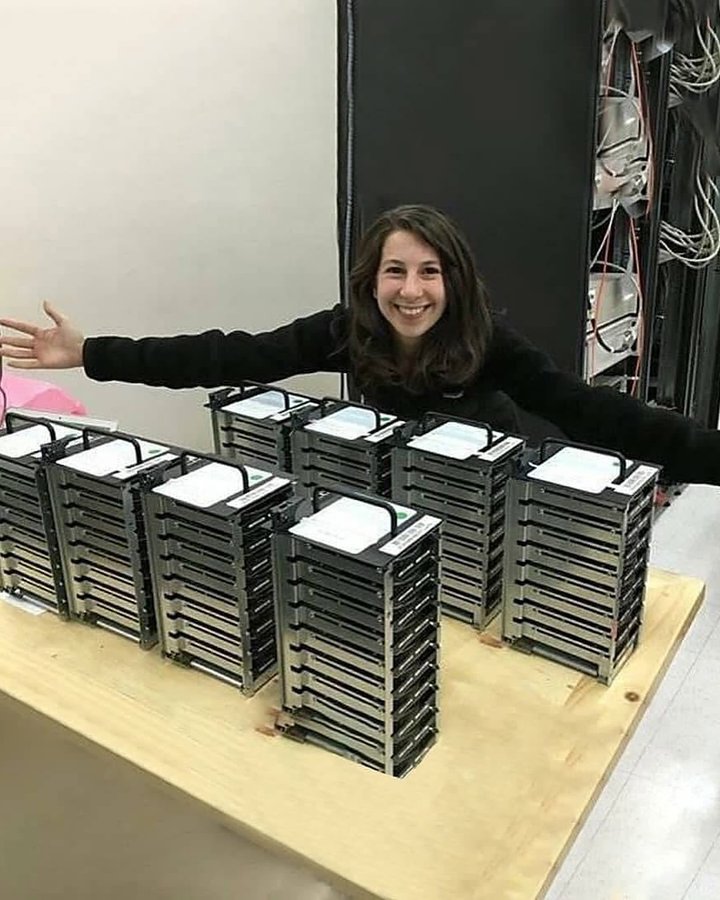
🚨: Dr. Katie Bouman, the computer scientists behind the first-ever image of a black hole, developed the algorithm that transformed telescopic data into the historic photo.
This image shows her reaction when the algorithm processed the image.
The process required 5 petabytes of storage, equivalent to nearly 5,000 years of MP3 audio.
A region of the brain named Wernicke’s area—long thought to be involved in speech perception—also generates spoken words, according to a new Science study in humans that tackles a century-old debate in the neuroscience of speech.
Learn more: https://t.co/3wPpd4gKGx
Neurons don't connect randomly.
In this video by our #ElectronMicroscopy team, a blue neuron's axon forms a connection to a far neuron. Along the way, it links to some neighbors while skipping thousands. Connectomics seeks to understand what makes those connections special.
neuroscience says pivoting your life
can turn you into the luckiest person alive.
when you change carers, move cities, or take a leap of faith, your brain updates its predictions about whats possible. thanks to neuroplasticity, it learns to spot new opportunities, making you more likely to meet the right people, take bigger chances, and create more luck.
you are never a finished product. your brain has room for a thousand new beginnings. new skills. new careers. new people to love. new places to call home.
you can become beautifully unrecognizable. your brain can learn new patterns. your life can get wonderfully unfamiliar.
Anthropic just brought down one of the biggest walls in mathematics. Holy shit.
Another Millennium Prize Problem might have just fallen, this time to Claude.
Levent Alpöge, a mathematician at Anthropic, claims he and Claude have discovered proofs of BOTH the Riemann Hypothesis and the Generalized Riemann Hypothesis.
- Unsolved since 1859 (167 years).
- One of the seven Millennium Prize Problems, with $1 million at stake.
- The arguments have reportedly been formalized in Lean without additional assumptions.
What's even crazier is that Alpöge says Claude actually outpaced him toward the end of the discovery.
The proofs still need independent verification, but if they hold up, we're looking at one of the biggest breakthroughs in the history of mathematics.
167 years. Generations of mathematicians. And Claude might have helped crack it.
Two scientists just won the 2026 Brain Prize for uncovering mechanics of touch.
Every caress, pinch and burn you feel starts with specialized nerve cells in your skin, and the two scientists who mapped them won the world's largest brain research prize.
The 2026 Brain Prize, awarded by Denmark's Lundbeck Foundation, went to David Ginty of Harvard Medical School and Patrik Ernfors of Karolinska Institutet in Sweden.
Over decades, the two classified the distinct types of sensory nerve cells in the body and linked each one to its own endings in the skin and its own route through the spinal cord to the brain.
That work explains how stroking, vibration, pressure, heat and pain get turned into separate signals the brain can read. Ernfors's lab also reported in 2019 that some Schwann cells, support cells that wrap around nerves, form a mesh in the skin that helps sense painful touch, at least in mice.
This matters because chronic pain is one of the most common reasons people suffer and see a doctor, yet most painkillers act bluntly on the whole nervous system. The prize committee said the winners' work gives a blueprint for finding exactly where things go wrong in chronic pain and in conditions that make people over- or under-sensitive to touch.
Knowing which cells carry which sensations gives drug developers far more precise targets than the painkillers we rely on today.
source: Lundbeck Foundation. (2026). The world's largest brain research prize awarded for groundbreaking discoveries on how we sense touch and pain [Press release].
Sprinting is anaerobic. Endurance exercise is aerobic. Right?
Wrong.
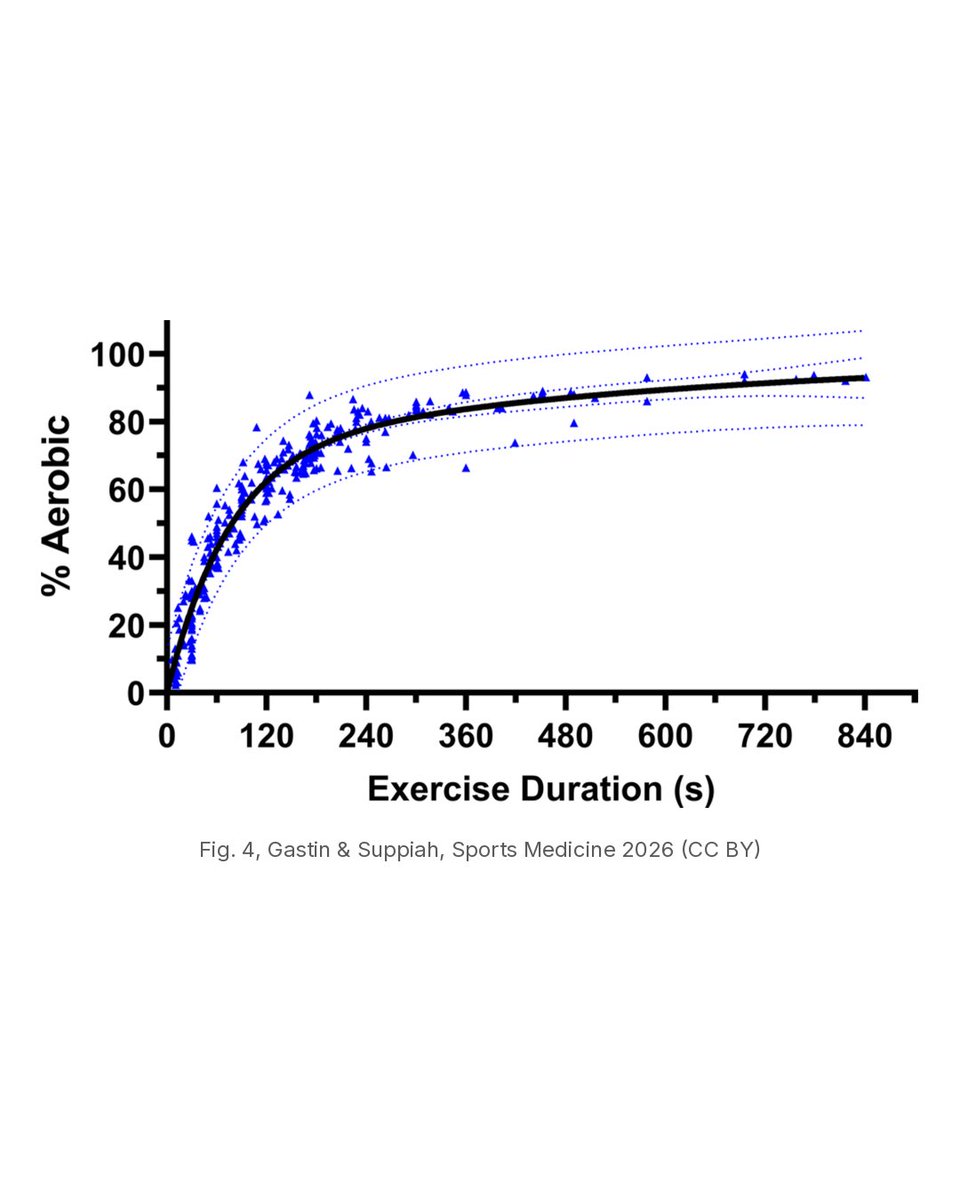
A 2026 systematic review estimated where the energy comes from during all-out efforts lasting anywhere from 6 seconds to more than 28 minutes.
• A 10-second maximal effort was about 91% anaerobic and 9% aerobic. By 30 seconds, the aerobic system was already supplying 25% of the energy, and by 60 seconds, 42%.
• The two systems contributed equally at about 78.6 seconds.
• At 2 minutes, the effort was roughly 62% aerobic, and at 5 minutes, 81%.
The curves didn't differ between running and cycling or by training status.
The aerobic system isn't a backup generator that kicks in late. It contributes meaningfully even in very short maximal efforts, and its share rises fast.
Google Reveals How Hackers Are Using AI Agents to Automate Real-World Cyberattacks
Details: https://t.co/q5D9pdzVIv
Hackers are no longer just asking AI chatbots for help. They now run AI agents that can scan, break in, and move through networks with very little human input.
In its latest AI Threat Tracker, published on November 16, 2026, the Google Threat Intelligence Group (GTIG) and Mandiant said AI misuse has reached a “critical inflection point” across cybercrime, spying, and influence campaigns. The findings come from Mandiant incident response cases, global tracking of threat groups, and Google’s own platform defenses.
Google says attackers are using AI to shorten attack timelines, grow their operations, and run multi-stage intrusions at machine speed.
#CybersecurityNews
Practice it.
Practice it.
Practice it.
Practice it.
Because repetition can make motor memories stronger and longer-lasting.
A 2026 study published in Nature Human Behaviour found that motor learning continued to improve after thousands of repetitions.
the winter arc tier list.
dopamine, metabolism & blood flow maxxing amidst the seasonal-induced drop.
𝗦-𝗧𝗜𝗘𝗥 (essentials)
> vitamin D3: directly replaces the UVB sunlight deficit to protect immune system, mood & hormone output.
> bromantane: soviet actoprotector that boosts dopamine synthesis. increases motivation, stress resilience & cold tolerance, keeping internal warmth high.
> walking pad: cold weather means less outings. walking after each meal triggers insulin-independent glucose uptake.
> 10,000 lux light box: morning photons hit eye receptors to lock in your circadian rhythm & combat daytime fatigue.
> heated blanket: simple ball knowledge.
𝗔-𝗧𝗜𝗘𝗥 (amazing)
> T3 (liothyronine): pure thyroid support & metabolism maxxing. forces thermogenesis, body heat & fat oxidation when winter slows metabolic rate down.
> tadalafil: inhibits PDE5 to boost nitric oxide & blood flow. fights cold-induced vasoconstriction & keeps the pumps, pumping.
> magnesium L-threonate: crosses the blood-brain barrier (BBB) to replenish neural electrolytes, deepen sleep & lockin circadian rhythms.
> caffeine/modafinil: both provide clean wakefulness & an essential mood lift. short, dark days trigger brain fog & lethargy.
> red light therapy: charges mitochondrial ATP production to offset zero sun exposure.
𝗕-𝗧𝗜𝗘𝗥 (basic fundamentals)
> pregnenolone/DHEA: backfills neurosteroids that drop during winter stress, keeping cognition sharp & mood stable. more dopamine. more everything.
> taurine: boosts cellular energy to maintain immunity & physical vitality during winter.
> vitamin E: shields blood vessels from cold-induced oxidative stress while working synergistically with vitamin C.
> vitamin C: keeps nitric oxide bioavailable for blood flow while acting as an adrenal cofactor during winter stress.
> l-citrulline: solid over-the-counter nitric oxide booster for blood flow, just weaker than tadalafil.
𝗖-𝗧𝗜𝗘𝗥 (cope)
> multivitamins: basically dust. way too under dosed.
> green tea: keeps your warm for 5mins. caffeine is the better option.
𝗗-𝗧𝗜𝗘𝗥 (placebo)
> himalayan salt lamps:
> cold showers: fighting fire with fire. spikes norepinephrine & activates brown fat, mildly forcing cold adaptation?
not medical advice.