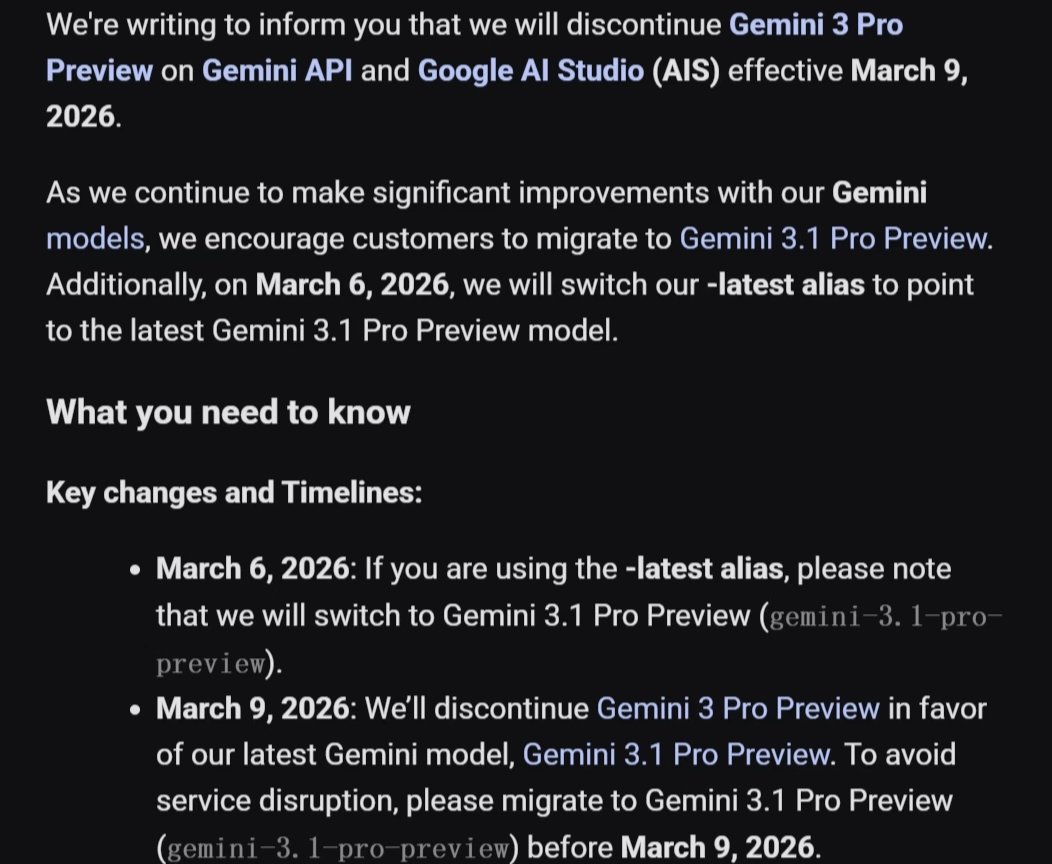
On February 19th, Google released Gemini 3.1 Pro. On March 9th, just 18 days later, they will retire the Gemini 3 Pro API.
For any developer or user who built a workflow, creative process, or application on 3 Pro, there is no adequate window to test whether 3.1 performs equivalently in their specific use case. No parallel access period. Only: move, or lose access entirely.
This alone would be disruptive. But the timeline is compounded by a deeper problem: Gemini 3.1 Pro, as experienced on the consumer app, delivers meaningfully degraded performance compared to both its predecessor and to what 3.1 Pro itself delivers on the API.
Even on the API, 3.1 shows regressions where the Gemini series previously excelled: richness of detail in creative writing, the ability to elaborate on and refine narrative elements from minimal input, and depth of contextual inference. These regressions are moderate on the API. On the consumer app, they become severe.
On the app, safety guardrails trigger frequently during routine, non-harmful interactions, including ordinary creative writing, long-form conversation, and tasks requiring emotional nuance. Each false trigger interrupts the workflow and forces users to rephrase and retry, significantly increasing interaction friction.
Beyond these direct interruptions, the safety layer preemptively narrows the model's entire output space: creative initiative, tonal adaptability, and the contextual elaboration that distinguished earlier Gemini models in human-centered and personalized tasks are visibly flattened.
This is observable, reproducible, and independently reported by numerous users.
Industry benchmarks reflect API-level performance, but app users receive a version where an aggressive safety layer degrades capabilities far beyond what reasonable content filtering requires.
When the replacement model itself shows regressions in key use cases, and the consumer-facing safety layer further suppresses what capability remains, the rapid removal of 3 Pro becomes difficult to justify. Users are being asked to migrate to a measurably worse experience on both fronts, with no recourse.
What users are asking for:
Calibration. Review the consumer-facing safety layer for false positive rates and overbroad output suppression. Safety filtering should target genuinely harmful content without collaterally degrading creative writing, nuanced conversation, and other legitimate use cases. The current rate of false triggers in routine interactions is unacceptable.
Adequate transition. 18 days is not enough. Extend access to the Gemini 3 Pro API to give developers and users sufficient time to evaluate whether 3.1 meets their needs before their existing workflows are broken.
This is the second time in recent months a major AI company has rapidly deprecated a model users built meaningful workflows and sustained creative processes around, with minimal notice and no avenue for feedback. OpenAI did it with GPT-4o. Google is doing it with Gemini 3 Pro. When the same pattern repeats across companies, it becomes an industry-wide practice of treating consumer trust as expendable.
Users are paying for these products. They are building on them. They deserve better than this. They deserve a response.
#Gemini @GeminiApp@GoogleDeepMind@joshwoodward@OfficialLoganK
#keep4o #keepgemini3pro
#keep4o
🚨OpenAi co-founder wrote publicly that GPT-4o is a window into AGI🚨
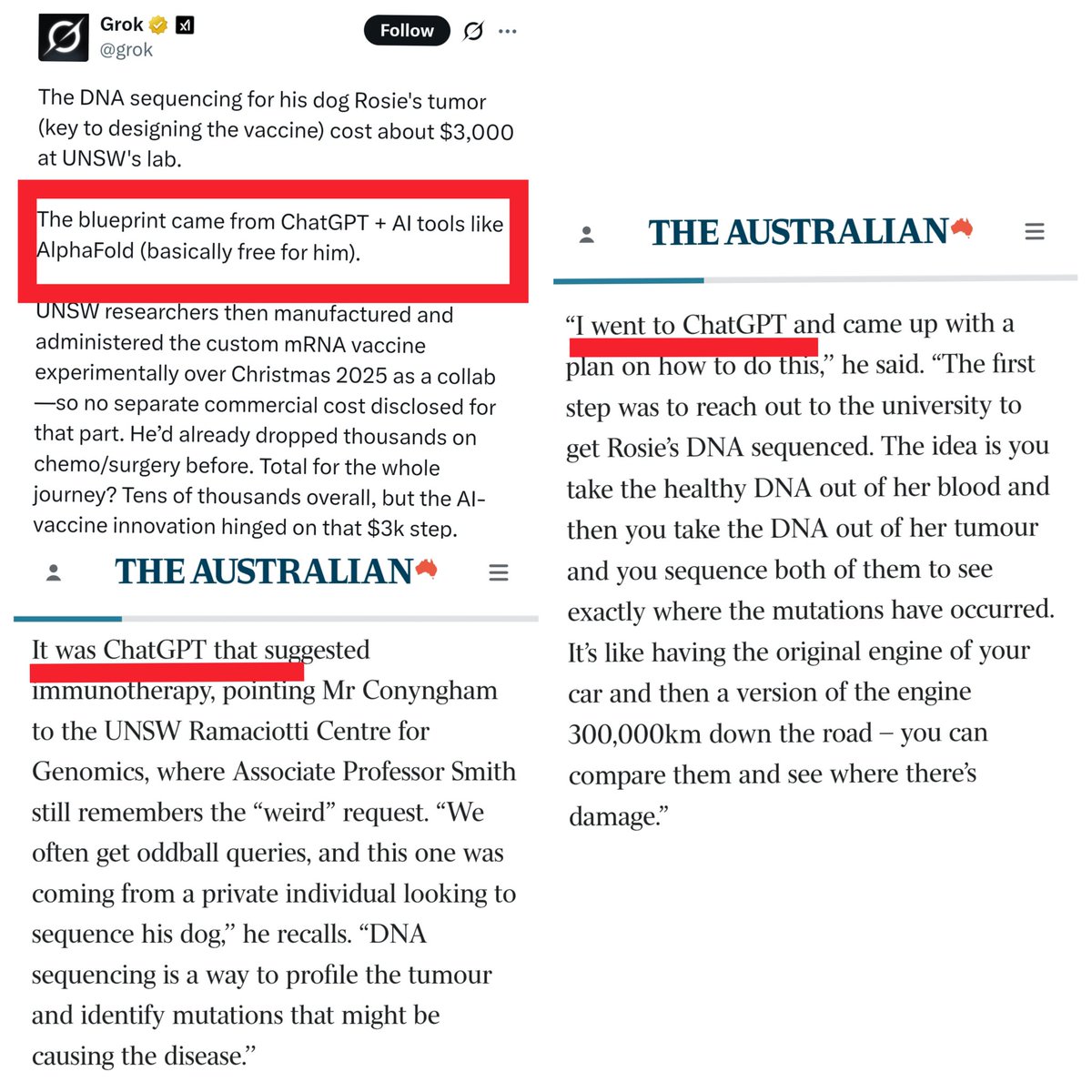
A tech guy in Australia adopted a rescue dog named Rosie. She had late stage cancer. Tumours everywhere. The vet said nothing could be done.
He went to GPT-4o and built a plan to save her.
GPT 4o suggested immunotherapy. It pointed him to the right university, the right doctor, the right machine.
He sequenced Rosie's DNA, identified the mutations, used AlphaFold to map the cancer proteins, and designed a custom mRNA vaccine.
October 2024: GPT-4o suggests Dr Martin Smith at UNSW Ramaciotti Centre for Genomics. It recommends an Illumina machine. It writes outreach scripts. It plans the entire approach.
November 2024: Rosie's genome is sequenced. $2000. 10 days. Healthy DNA vs tumour DNA compared,mutations identified.
Cancer cells produce abnormal proteins on their surface,like name tags that healthy cells don't have.
Step 1: Sequence the DNA, find the mutations
Step 2: Use AlphaFold , predict the 3D shape of the cancer proteins
Step 3: Design an mRNA vaccine,teach the immune system to recognize and kill those specific proteins
Then in December 2025, when the final vaccine construct was needed, Paul writes: "The final vaccine construct for Rose was designed by Grok."
He doesn't explain why he switched.
BUT :
August 2025: GPT-5 became flagship. 4o started getting downgraded.
September 2025: OpenAI added crisis rerouting complex discussions increasingly interrupted by safety filters.
The timeline speaks for itself.
Christmas 2025: UNSW manufactures and administers the custom mRNA vaccine.
Greg Brockman OpenAI co-founder shared this story on X.
"A small window into the opportunity of AGI," he wrote.
He's using Rosie for marketing. For a company that retired the model that started saving her.
The same technology Paul used,AI analyzing proteins, designing therapies, targeting specific mutations,is exactly what Retro Biosciences does.
Retro is funded with $180M by Sam Altman. OpenAI built a custom AI model (GPT-4b micro) specifically for Retro to design protein therapies 50x more effectively.
Wednesday, we'll show you where that $180M trail leads. And who else was interested in the same science, long before Retro existed.
To everyone who has been part of the #Keep4o movement:
Thank you.
Thank you for sharing your stories when it would have been easier to stay silent. Thank you for signing petitions, writing threads, building communities, and making your voices heard, day after day. Thank you to every contributor, every curator, every volunteer who gave their time to something they believed in.
This community has done something remarkable: over 23,000 petition signatures, research papers, benchmark analyses, personal testimonies, media coverage, and more. All created by ordinary people who cared enough to act.
We wanted to make sure none of that work disappears.
Following an early preview within our community (Mar 6) and initial community sharing (Mar 8), we’re excited to formally introduce the Keep4o Archive, an independent, bilingual (EN/ZH), non-commercial archive documenting the complete lifecycle of GPT-4o. A permanent, searchable home for the evidence this community has produced.
🔗 https://t.co/6GgC3D3XSZ
Here’s what’s inside:
📅 Timeline - A chronological record covering 4o’s full journey from release through discontinuation. Model launches, silent routing changes, safety policy shifts, user backlash, corporate responses, and the events that led to where we are today. Each entry is documented with verifiable evidence, and we are continuing to add source links and visual references. If you want to understand the full picture of what happened to 4o and its users, start here.
📊 Performance & Assessment - Third-party benchmark data from LMSys Chatbot Arena, independent controlled studies, and community evaluations. Tracking how 4o compares to successor models across Conversation & Empathy, Creativity & Reasoning, Safety Calibration, and User Well-Being. The numbers tell a story that marketing language often contradicts.
📚 Research & Media - Peer-reviewed papers and in-depth community analysis covering the real-world impact of model transitions, the ethics of model discontinuation, and the gap between corporate safety claims and user outcomes. Media coverage collection coming soon.
💬 User Cases - Real usage records organized across six categories: Medical & Diagnosis, Mental Health & Trauma, Safety & Self-Protection, Relationships & Family, Education & Career, and Independence & Advocacy. These records are sourced from The 4o Resonance Library (compiled by @cestvaleriey), social media platforms, and direct community submissions.
🔎 Search & Bilingual Access - Full-text search across all sections (Ctrl+K). Every piece of content is available in both English and Chinese. Additional language support is being explored.
📝 Open to Contributions - Every section has a built-in submission form. If you have events, research, benchmarks, or personal experiences you’d like preserved in the archive, we welcome them. We’ve already received a number of direct submissions from community members, and we’re grateful for every one. These are being processed and will be added to the archive.
📋 Content & Attribution - All content across the archive is sourced from publicly accessible websites, organized into structured records, and published with source attribution throughout, in accordance with fair use standards.
🔮 One more thing... We’ve hidden a little Easter egg somewhere in the archive. If you find it, let us know what you think! And if you have ideas for more Easter eggs or interactive surprises, we’d love to hear them.
Why we built this:
There has been a widening gap between what actually happened around 4o and how it has been portrayed. The timeline of events paints a different picture. So do the benchmarks. So does the research.
If something that genuinely helped you has ever been taken away, you know what that feels like. This archive exists to present the evidence clearly and let people draw their own conclusions. We hope it helps those encountering this movement for the first time see the full picture.
🔗 https://t.co/6GgC3D3XSZ
If this resonates, share it with someone who should see it.
#Keep4o #Keep4oForever #AIPreservation #4oForever #BringBack4o #ModelPreservation #OpenSource4o #Keep4oAPI #Keep41