Climate Change Editor @Straits_Times. Ex-@Reuters.
#ClimateChange = story of our age. Let's overcome the risks and seize the opportunities. Views are mine.
🌍 “This is no longer a warning for the future; it is a diagnosis of the present.” Our 2026 State of the Climate report finds 7 of 16 planetary vital signs at record extremes. The planetary emergency is already here.
https://t.co/Ppb8TluFCG
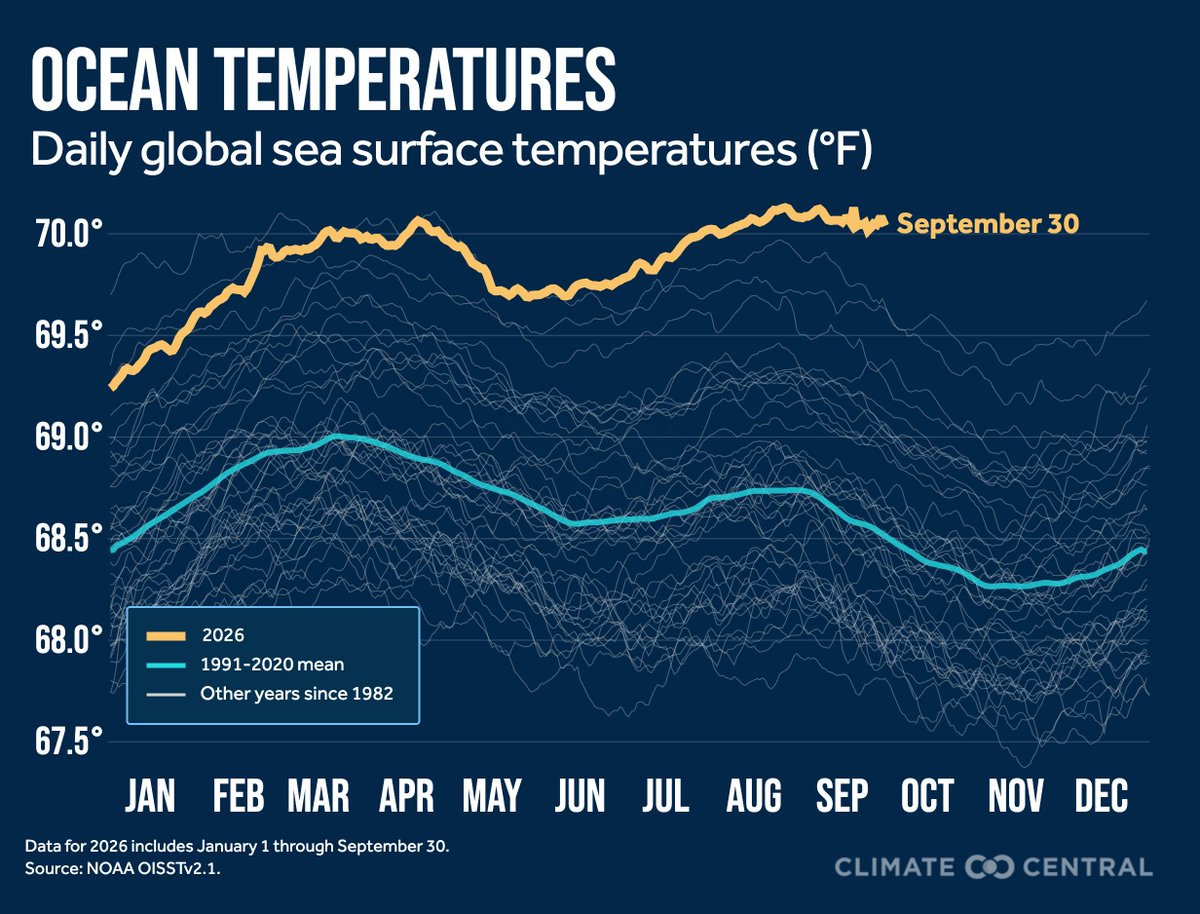
🚨 This is pretty wild... the average global sea surface temperature (outside of the polar regions) is still above 70°F (21.1°C) through the end of September. This is significantly above the prior record.
We'll cover this in our October climate briefing: https://t.co/ARKKxOCpD6
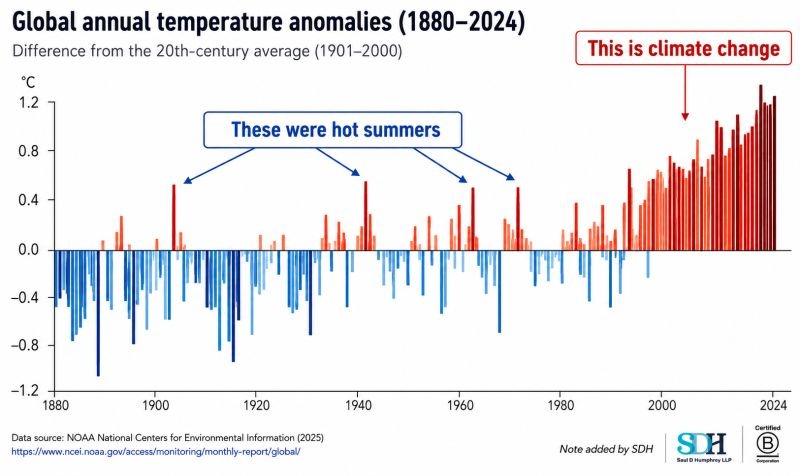
2026 is not like the others.
This year’s record-breaking El Niño stands out like a skyscraper would in a small town.
Here it is next to every year since 1940.
Beef production has been the largest driver of deforestation this century.
Over the last two decades, around 128 million hectares of forest have been cleared to make way for agriculture and forest plantations. That’s an area five times the size of the United Kingdom.
What has driven this deforestation?
A recent paper estimated the contribution of different agricultural products over the last few decades. In the chart, you can see the breakdown.
Beef production has been the largest driver by far, contributing over 40% of the total. This has mostly been the clearing of forest for grazing pasture, especially across Brazil and other countries in Latin America.
Oilseeds — mostly soy and oil palm — were the second-largest driver, again concentrated in Latin America for soy and in Indonesia and Malaysia for palm oil. While deforestation for palm oil was high in the early 2000s and 2010s, it has fallen a lot in recent years.
Forest plantations have been a large driver of deforestation in North America and East Asia. Deforestation for most other products — including cereals, roots and tubers, and cash crops like cocoa and coffee — has been concentrated in Africa, where yields have not grown quickly enough to offset rising demand.
(written by @_HannahRitchie)
Breaking News!
Code: y-Axis Alert!
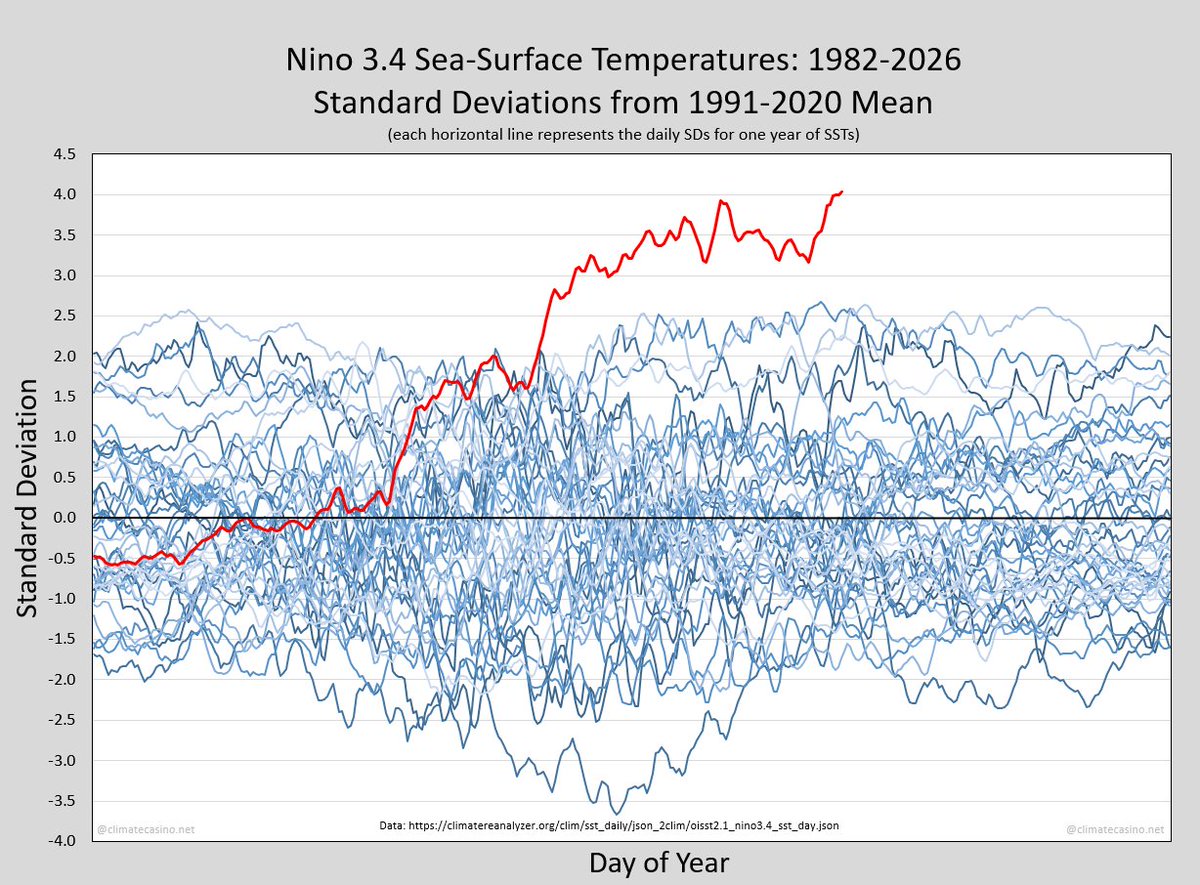
On September 11th, the preliminary Nino 3.4 sea-surface temperature measured 2.98°C above the 1991-2020 mean, which was 4.03 standard deviations above the mean. No previous year has broken 3SD.
The Climate 8-ball is feeling oblong.
Strongest El Niño on record this year?!
New ECMWF guidance shows a *75% chance of a super El Niño* by October, with some scenarios suggesting the most intense event in more than a century.
It will bring wide-reaching weather impacts that last into 2027 🧵
One of the most intense marine heatwaves on Earth has developed off the coasts of China and South Korea, where ocean temperatures are up to 5°C (9°F) above normal.
NOAA has classified this event as a Category 4 (extreme) marine heatwave.
This graphic shows average Arctic sea-ice thickness (average monthly volume divided by average monthly extent, 12-month running average). October, 2017, saw the minimum, at 1.228 meters. Current is 1.267 meters and falling fast.
What's next? The Climate 8-ball is frozen solid.
Up. Up. And away!
North Pacific water temps the past 15 years, with September 2025 being the cherry on the top (right) of the chart. @ZLabe is going to need a bigger Y axis!
Your 'moment of doom' for Sept. 25, 2025 ~ Ocean acidification.
"A new report from the ... Potsdam Institute for Climate Impact Research (PIK) reveals that 7 of the 9 critical Earth system boundaries have now been breached, one more than last year."
https://t.co/Jlyc7D8rb8
Breaking News!
Code UFB!
The 36-month running average for Earth albedo (reflectivity) hit another record low as of the latest data release for July, 2025 by CERES.
In other words, the darkening of the planet is growing stronger.
New research explores the wide-ranging consequences of record low summer sea ice in Antarctica. From more ocean warming to extra icebergs, it's bad news we must hear. @edoddridge@UTAS_ https://t.co/bzhdQpo7bi
1⃣ Like a heartbeat driving one of the largest seasonal cycles on Earth, Antarctic sea ice is central to the global climate system and vital for unique ecosystems.
Animation: @southpolecoffee
Breaking News!
Code UFB!!!
The planet's albedo (reflectivity) hit yet another new record low as of the latest data from CERES from April, 2025, now at 28.714%.
Darker days ahead!
@F10fromMAGArone@PiperK No--the entire https://t.co/ct38twg55j team was fired and they will no longer be able to generate the products that used to be housed there. There may be a historical archive available, but no new/continuing information.
85 years ago Chaplin decided to speak in one of his films for the first time in his career. It was to deliver this message that rings true today. #NoKingsDay